
Through Dozens of Military Orders
Union for Justice Foundation: Israeli Occupation Seized More Than 6,860 Dunums of West Bank Land During Last July
05/08/2026 – Union for Justice Foundation
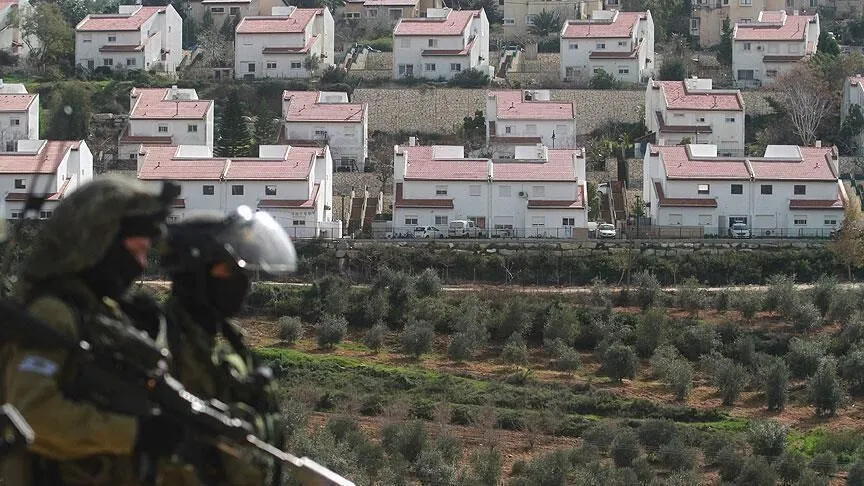
The Union for Justice Foundation stated that the Israeli occupation authorities seized approximately 6,860 dunums of Palestinian land in the occupied West Bank during July through dozens of military orders.
The Foundation noted that these figures do not include the seizure of Palestinian land carried out by settlers, particularly in areas adjacent to Israeli settlements and especially in the Jordan Valley, where settlers seize land through armed force and intimidation before fencing it off and cultivating it as a fait accompli, while preventing Palestinian landowners from accessing it.
According to the Union for Justice Foundation’s monitoring and documentation, many of the land seizure operations were concentrated in Ramallah and Al-Bireh Governorate, while others were distributed across Nablus, Jenin, Tubas, Jerusalem, and Bethlehem. The Foundation noted that the overwhelming majority of confiscation measures serve settlement-related purposes, whether to expand Israeli settlements or the facilities associated with them.
The Foundation further affirmed that Israeli land confiscation policies are primarily intended to transform numerous Palestinian towns and villages into isolated enclaves and to prevent any geographical continuity that would enable Palestinian urban expansion.
While fragmenting and isolating Palestinian areas into disconnected enclaves, the Israeli occupation authorities continue to connect Israeli settlements through extensive networks of modern roads and highways, a process that requires the confiscation of hundreds of additional dunums of Palestinian land.
In most cases, military seizure orders are issued by the so-called “Military Commander of the Area,” who serves under the Israeli army and claims that such confiscations are required for military and security purposes.
Public Benefit… A Pretext for Settlement Expansion
In many cases, the Israeli occupation authorities invoke the argument of “public benefit” to justify the construction of roads, essential infrastructure, and public parks. In reality, however, and according to reports by human rights organizations based on testimonies provided by Palestinians, this serves as a concealed pretext for the seizure of Palestinian land, particularly in and around Jerusalem, for the construction and expansion of Israeli settlements and the Separation Wall.
The “public benefit” law is not applied according to the same standards to land owned by Jews, demonstrating that Palestinians alone are the targets of its implementation.
Theoretically, the occupation authorities claim to provide Palestinians with an opportunity to object to confiscation orders. In practice, however, Palestinians rarely resort to Israeli courts because they believe such efforts are futile, in addition to the high financial costs involved and legal proceedings that may continue for years.
Land Confiscations in Ramallah
According to the Union for Justice Foundation’s monitoring, on 17 July, the Israeli occupation authorities issued an order to seize 16.577 dunums of land belonging to the village of Dura al-Qar’, northeast of Ramallah and Al-Bireh Governorate, under the pretext of “military needs.”
Two days later, the occupation authorities issued two additional orders: one confiscating 4.854 dunums of land in Ein Siniya, Ramallah District, for the construction of a security road in the area; and another confiscating 13.627 dunums from the villages of Silwad, Ein Yabrud, and Dura al-Qar’ to construct a security road linking Highway 60 with the boundaries of the Beit El settlement.
On 20 July, the occupation authorities issued another order placing 32.596 dunums of land belonging to the villages of Ras Karkar, Kafr Ni’ma, Kharbatha, and Bil’in, in Ramallah District, under military seizure in order to construct a security road connecting the Sde Ephraim settlement outpost with the Modi’in Illit settlement.
The following day, the occupation authorities delivered an order to residents of Al-Mazra’a al-Sharqiya, northeast of Ramallah, confiscating 3.766 dunums of village land for the construction of a security road branching off Highway 60.
Highway 60 is considered one of Israel’s most strategic transportation routes, connecting the northern and southern parts of historic Palestine and primarily linking West Bank settlements to one another without passing through Palestinian cities and villages.
On 27 July, the occupation authorities issued two military orders seizing a total of 46.793 dunums of land belonging to the town of Deir Dibwan, east of Ramallah and Al-Bireh Governorate.
Land Confiscations in Nablus
In Nablus, on 19 July, the Israeli army issued a new military order seizing 16.5 dunums of land belonging to the villages of Qusra and Jalud, south of the governorate, for the construction of a settlement road linking the Migdalim settlement with the settlement outpost recently established by settlers, Esh Kodesh.
The maps attached to the military order confirm that the road does not respond to any military necessity. Rather, it forms part of the development of settlement infrastructure, the integration and legalization of existing settlement outposts, while further consolidating control over Palestinian land and imposing additional restrictions on Palestinians’ movement and access to their property.
Nablus is surrounded by a chain of Israeli settlements encircling the city from every direction. To the south and southeast lies the Yitzhar settlement between the town of Huwara and the village of Burin. It is considered one of the most ideologically extreme settlements and contains numerous settlement outposts. Also to the south is the Bracha settlement, situated atop Mount Gerizim near the lands of Kafr Qalil and Burin.
To the southeast of the city lies the Itamar settlement, established on land belonging to the villages of Awarta and Beit Dajan. To the north and northeast lies the Alon Moreh settlement, built on lands belonging to the villages of Salem, Azmut, and part of the Jordan Valley, from which several pastoral settlement outposts have expanded.
To the northwest of the city are the Shavei Shomron settlement, established on lands belonging to the villages of Deir Sharaf, Sebastia, and Burqa, and the Homesh settlement, to which settlers have recently returned.
Before the end of last year, the Israeli authorities approved the establishment of a new settlement, Har Eibal, on Mount Eibal, which directly overlooks the city of Nablus and its surrounding villages. The occupation authorities justify the project on the basis of alleged religious and Talmudic claims concerning the existence of the “Altar of Joshua bin Nun” at the site, while Palestinian archaeological authorities maintain that the site dates back to the ancient Canaanite period.
Land Confiscation in Jenin
Jenin has been among the governorates most severely targeted by settlement expansion over the past three years. This has resulted in the confiscation of hundreds of dunums of land, the fragmentation of the governorate, and the disruption of geographical continuity among dozens of its villages.
On 16 July, the Israeli authorities issued an order to seize 22.026 dunums of land belonging to the town of Al-Yamun, west of Jenin.
On 28 July, the occupation authorities issued a series of military orders placing approximately 200 dunums of land belonging to the towns and villages of Arraba, Al-Yamun, Qabatiya, Misilyah, Marka, and Jaba’ under military seizure for the purpose of constructing and expanding military roads and establishing settlement infrastructure.
In Tubas, neighboring Jenin, the Israeli authorities issued six military orders on 26 July to seize 498 dunums of privately owned land in the villages of Tayasir, Al-Aqaba, Ibziq, and Raba, as part of the expansion of a settlement project known as “The Scarlet Thread.”
In Jerusalem Governorate, the occupation authorities issued a military order on 21 July placing 5.283 dunums of land belonging to the town of Jaba’, north of Jerusalem, under military seizure on the pretext of “military purposes.”
The Largest Land Confiscation in Bethlehem
On 23 July, the occupation authorities approved the seizure of 6,000 dunums of land under a large-scale colonial structural plan covering the area southeast of the Tekoa settlement, which is built on land belonging to the town of Tuqu’, in Bethlehem Governorate.
The project is being promoted by the so-called Gush Etzion Regional Council, the Tekoa Regional Council, and the colonial settlement organization Amana.
The new settlement plan includes the construction of residential units, tourism facilities, agricultural land, open spaces, and roads in the area situated between the villages of Tuqu’ and Al-Minya, including land designated as a nature reserve east of Bethlehem.
Through this project, the occupation authorities seek to create a geographical extension of the Tekoa settlement toward the south by seizing Palestinian land and carrying out settlement construction on it, thereby restricting Palestinian urban expansion in the area.
The Union for Justice Foundation reaffirms that international law prohibits the acquisition of land by force and that any confiscation of land resulting from military occupation is illegal. The West Bank, including East Jerusalem, and the Gaza Strip are recognized as occupied territories under United Nations resolutions and the Geneva Conventions.
End
