06/05/2026 – Union for Justice Foundation
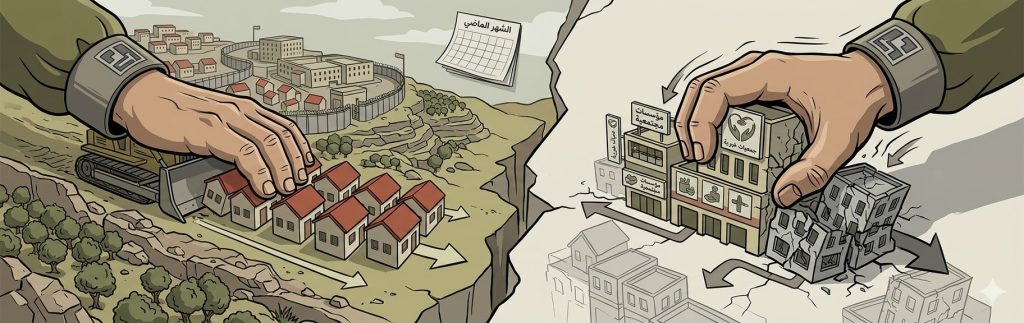
The Union for Justice Foundation stated that the Israeli occupation authorities issued a series of decisions last April aimed at expanding settlement activity in the West Bank and the city of Jerusalem, as well as undermining the Palestinian charitable sector.
The Foundation reported that the Israeli Ministerial Committee for Political and Security Affairs (the Israeli “Cabinet”) approved, on April 9, the establishment of 34 new settlements in the occupied West Bank—the largest single batch of settlement approvals passed in one cabinet session in decades.
The Union for Justice explained that the areas designated for these settlements are located within Palestinian enclaves in the northern West Bank and in remote areas rarely accessed by the Israeli army.
It further noted that the Israeli government had previously approved the construction of 69 settlements, bringing the total number, following this latest decision, to 103 settlements.
The Foundation added: “Within days of this decision, the Israeli government approved the allocation of a budget amounting to $270 million to pave and construct roads connecting the new settlements in the West Bank, as well as the construction of 126 new settlement units in the ‘Sanur’ settlement, built on lands belonging to Jenin Governorate.”
Since the formation of the current Israeli government led by Benjamin Netanyahu in late 2022, settlement activity has witnessed a significant expansion and acceleration in the West Bank, including East Jerusalem, which the United Nations considers occupied Palestinian territory.
Approximately 750,000 Israeli settlers reside in 141 settlements and 224 outposts in the West Bank, including around 250,000 in 15 settlements in East Jerusalem.
On April 20, the Union for Justice indicated that the so-called “District Planning Committee” affiliated with the occupation municipality in Jerusalem approved a plan to construct a Jewish school named “Ohr Somayach” in the heart of Sheikh Jarrah neighborhood in Jerusalem, opposite one of the historic Islamic mosques.
The school plan—set to be built on an area of approximately 5,000 square meters—includes an 11-story building, dormitories for hundreds of Haredi Jewish students, and housing for faculty members.
The Union for Justice believes that the construction of this school will significantly increase the Jewish settler presence in the area, open the door to the displacement of Palestinian residents of the neighborhood, and generate further tensions and violence, particularly as it is located opposite the historic Sheikh Jarrah Mosque.
On April 23, what is known as the Israeli Enforcement and Collection Authority issued a decision to evacuate seven residential apartments in favor of the “Ateret Cohanim” association in the Batn al-Hawa neighborhood of Silwan, south of Al-Aqsa Mosque, and expel their residents, as part of occupation efforts to alter the demographic composition of the holy city in favor of Jews.
Targeting Palestinian Charitable Associations
Within the framework of Israeli targeting of the Palestinian charitable sector, and according to monitoring by the Union for Justice Foundation, occupation authorities closed three charitable associations in Hebron Governorate last month.
On April 6, the Israeli army closed the headquarters of the Muslim Youth Association in Hebron, arrested two of its officials, and confiscated equipment and electronic devices.
On April 14, occupation authorities closed the headquarters of the Islamic Charitable Society in Hebron and arrested its chairman, Hatem Al-Bakri. The following day, authorities issued a decision to close the Zakat Committee office in the town of Idhna, west of Hebron.
On April 16, occupation authorities issued a decision prohibiting the holding of administrative board elections for the Palestinian Red Crescent Society in Jerusalem.
The remaining Palestinian associations and unions operating in Jerusalem continue to face ongoing Israeli restrictions aimed at undermining any manifestation of Palestinian sovereignty in the city and obstructing efforts to strengthen the resilience of Jerusalemites.
Since the beginning of this year, occupation authorities have closed the headquarters of the “Burj Al-Luqluq Social Center” in the Old City of Jerusalem for six months, as well as the Jerusalem Health Center (“Al-Zawiya Clinic”), affiliated with UNRWA, located inside Bab al-Sahira in the Old City, for one month.
Since 2000, following the outbreak of the Al-Aqsa Intifada, occupation authorities have shut down hundreds of Palestinian charitable associations in the West Bank and Jerusalem, including medical centers, Zakat committees, sports clubs, schools, kindergartens, and institutions supporting orphans and Palestinian prisoners—under the pretext of supporting “terrorist” organizations. In other cases, the occupation forced the Palestinian Authority to replace the heads of these associations and their boards of directors with others loyal to it.
Continued Financial Strangulation of the Palestinian Authority
In addition to these measures, on April 16, Israeli Chief of Staff Eyal Zamir issued a decision to return soldiers from “Force 100” unit to reserve duty, despite their prior involvement in a case of torture and rape of a Palestinian detainee from Gaza inside the Sde Teiman detention camp.
On April 27, Israeli Finance Minister Bezalel Smotrich issued a decision to deduct 590 million shekels from Palestinian clearance revenues out of a total of 740 million shekels for April, claiming the funds would be used to cover debts owed by the Palestinian Authority to Israeli electricity, water, and environmental entities, while the remaining balance was frozen and not transferred.
This step falls within an ongoing policy since 2019, whereby Israel has deducted amounts from Palestinian clearance revenues under various pretexts, leading to a financial crisis that has left the Palestinian Authority unable to fully pay salaries, alongside mounting debts to the private sector and local banks.
According to Palestinian government sources, Israel is withholding approximately 13 billion shekels in Palestinian clearance revenues—taxes imposed on goods imported into Palestinian areas, whether from Israel or through border crossings.
End
