

13/1/2026 – Union for Justice
The Union for Justice stated that the Israeli occupation authorities are seeking to assert control over and confiscate as much land as possible from the town of Sebastia, north of Nablus, under the pretext of “protecting” antiquities.
The organization explained that, at the end of last year, the occupation authorities issued a decision to confiscate 1,800 dunums of land belonging to the town—one of the oldest archaeological sites in Palestine—claiming these areas are antiquities sites. This decision constitutes the largest land seizure of Palestinian territory since the occupation of the West Bank in 1967.
The organization stressed that the occupation aims to alter historical facts and change the town’s Palestinian cultural identity, replacing it with a Jewish one. To this end, Israel has allocated more than 152 million shekels to Judaize the area and exploit it for tourism in its own interest.
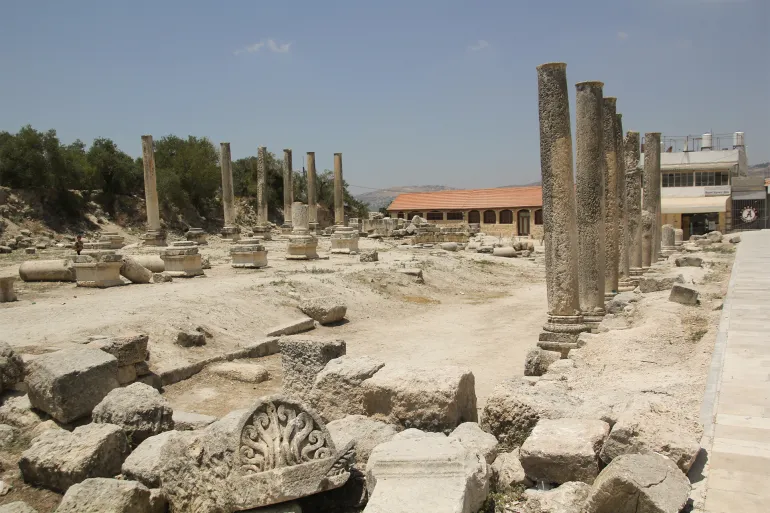
Sebastia dates back to the Bronze Age. It was inhabited successively by the Canaanites and Assyrians, later conquered by Alexander the Great and transformed into a Hellenistic city. It was destroyed in 107 BCE, then rebuilt by the Romans and named Sebastia, a name it has carried since.
The archaeological town contains numerous significant landmarks from different eras, most notably the Roman colonnaded street, the Roman theater and amphitheater, the Temple of Augustus, the Roman cemetery, as well as the Shrine and Mosque of Prophet Yahya, Qasr al-Kaid, the Crusader cathedral, and the Ottoman mosque, in addition to other Canaanite and Byzantine remains.
Consequences of the Decision
According to the Union for Justice, the 1,800 dunums slated for confiscation include more than 3,000 ancient Roman olive trees, eight homes, five tourism facilities, one industrial facility, and two agricultural facilities, all owned by Palestinian residents of the town.
Most of Sebastia’s approximately 3,700 residents rely primarily on agriculture and tourism for their livelihoods. If the occupation completes its settlement plans in the town, the majority of residents would lose their only source of income.
The organization affirmed that the claim of “protecting antiquities” is a pretext, asserting that the real objective is to seize additional Palestinian land and establish new settlements in the northern West Bank.
The land confiscation decision was not limited to Sebastia alone; it also included neighboring villages such as Naqoura, Deir Sharaf, and Burqa, indicating an attempt by the occupation authorities to create a geographical link between existing settlements—such as Shavei Shomron—and new outposts planned for the area, using the excuse of “protecting” antiquities to achieve this goal.
The organization added: “The targeting of Palestinian archaeological sites in the West Bank is not merely administrative or formal legal measures, but part of a systematic policy aimed at confiscating Palestinian heritage and reshaping Palestinian cultural identity to serve the Israeli narrative—particularly as most archaeological sites are located near Israeli settlements.”
Recently, the head of the Northern West Bank Settlements Council, Yossi Dagan, announced the Israeli government’s intention to bring one million settlers to the northern West Bank and to reestablish the four settlements evacuated in 2005 around the city of Jenin.
A Larger and More Dangerous Plan
The organization continued: “The settlement plan in Sebastia is one link in a larger scheme announced by the occupation in August of last year, classifying 63 sites in the West Bank as ‘Israeli historical and archaeological sites,’ including 59 sites in Nablus Governorate, three in Ramallah and al-Bireh, and one in Salfit—indicating a deliberate and strategic expansion to control archaeological sites and their surrounding areas.”
According to the Applied Research Institute – Jerusalem (ARIJ), from 1967 to 2025, Israel classified more than 2,400 Palestinian archaeological sites in the West Bank as “Israeli archaeological sites.”
ARIJ notes that while the occupation claims these areas must be “protected and preserved,” in practice they are used to seize vast areas of Palestinian land, which are later annexed to settlements, military zones, and tourist and recreational sites, benefiting only Israeli settlers, tourists, and soldiers.
Under international law, classifying Palestinian archaeological and historical sites as “Israeli” constitutes a violation, particularly of the 1954 Hague Convention for the Protection of Cultural Property in the Event of Armed Conflict and the Geneva Conventions, which prohibit an occupying power from altering the historical and cultural character of occupied territories or exploiting them for political or military purposes.
End
