
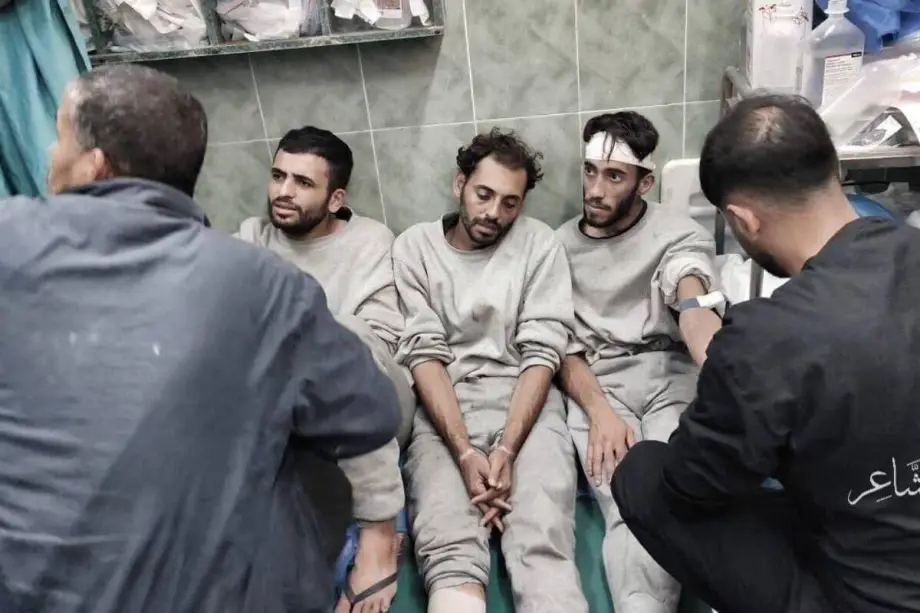
The Union for Justice Foundation: The occupation government seeks to legalize the torture and killing of Palestinian prisoners in its prisons
17/11/2025 – The Union for Justice Foundation
“The Union for Justice Foundation” stated that the Israeli government is seeking to legitimize the torture and killing of Palestinian detainees in its prisons, giving these practices a legal cover through a set of recently approved laws and regulations.
“The Union for Justice Foundation” explained that the Israeli Minister of Defense, Yisrael Katz, issued a decision at the end of last month extending the ban on International Committee of the Red Cross representatives from visiting detainees in Israeli prisons, under the pretext of “endangering state security.”
It added that a few days ago, the Knesset’s General Assembly approved in its first reading a bill to execute Palestinian prisoners. The bill has been referred to the so-called “specialized parliamentary committee” in preparation for its second and third readings.
“The Union for Justice Foundation” stressed that the occupation’s decision to block Red Cross visits to Palestinian detainees aims to conceal the abuses and inhumane practices to which prisoners are subjected, especially as the number of prisoners dying from torture, ill-treatment, and inadequate medical care continues to rise.
According to human rights organizations, the number of detainees and prisoners whose identities are known and who have died since the start of the genocide in the Gaza Strip has risen to (82), including at least (47) from Gaza.
“The Union for Justice Foundation” believes that although the bill to execute Palestinian prisoners is extremely dangerous, it will not change the reality on the ground, as the occupation already carries out executions in various forms—during arrest, through systematic torture, deliberate medical neglect, and starvation inside prisons.
These two Israeli decisions—banning Red Cross prison visits and executing prisoners accused of carrying out operations—come at a time when the Israel Prison Service continues to deny Palestinian prisoners family visits since October 7, 2023.
Although family visits previously took place only once a month for 45 minutes, they constituted a major source of emotional support for prisoners, as they were the only window through which they could learn about their families and social life.
Prisoners in Numbers
As of early November, more than (9,300) Palestinian detainees are held in Israeli prisons, most of them under administrative detention or pending trial, not including those held in Israeli military camps.
Among them are (49) Palestinian female prisoners—all from the West Bank except one from Gaza—and (350) child prisoners held in Ofer and Megiddo prisons. Meanwhile, the number of administrative detainees has risen to (3,368), a record number unprecedented since the occupation began in 1967.
Torture: A Systematic Policy, Not Isolated Incidents
Since October 7, 2023, Palestinian prisoners have faced a series of abusive, arbitrary, and degrading measures. The current situation is arguably the harshest and most brutal the prisoner movement has endured since the occupation of the West Bank and Gaza began in 1967.
Recently, the Israeli facility “Sde Teiman” has become a central reference point when discussing the systematic torture inflicted on Palestinian prisoners, especially those from Gaza.
“Sde Teiman” is one of several camps established by the Israeli army after October 7 due to the sharp rise in Palestinian arrests—alongside “Rakevet” Prison, and the “Anatot,” “Naftali,” and “Menashe” camps.
Human rights organizations have documented terrifying testimonies from former detainees describing horrific torture methods used in these camps, including: sexual violence, direct rape of male and female prisoners, sexual assaults with objects and dogs, prolonged forced nudity, pepper-spraying the face, forced filming, medical procedures without anesthesia, verbal abuse, and deliberate psychological humiliation aimed at destroying human dignity.
These organizations note that these testimonies do not represent isolated incidents; rather, they reflect a systematic policy carried out within the broader context of the ongoing genocide against the more than two million residents of Gaza, including thousands of detainees held in prisons and camps completely closed to international oversight.
These testimonies show that the arrests were carried out without any legal basis simply because the victims were residents of Gaza, as part of a collective punishment policy aimed at degrading Palestinians and inflicting maximum psychological and physical harm—systematic practices that constitute one of the forms of the ongoing genocide against the Palestinian people in the Strip.
Torture and abuse are not confined to Gaza detainees; they have extended to most prisoners in Israeli custody—those recently arrested as well as those imprisoned before October 7.
Prisoners: Hunger and Illness
Many released prisoners confirmed that they were severely beaten during their arrest—whether in their homes or at checkpoints across the West Bank—and that these beatings left lasting scars and fractures on their bodies.
From time to time, Israeli prison forces storm prisoner sections, violently assaulting detainees after binding their hands and feet and blindfolding them, often accompanied by gas spraying and intimidation using dogs.
In recent months, hundreds of prisoners have suffered fractures in their limbs and ribs, in addition to deliberate medical neglect and the starvation policies imposed by the Israel Prison Service.
Social media platforms regularly circulate images of prisoners before and after detention, showing their extreme weakness, weight loss, and the severe physical and psychological conditions they suffer upon release.
Former detainees affirm that the food provided in Israeli prisons is poor in quality and quantity—barely enough to keep them alive. The closure of the prison “canteens” after October 7 has further intensified prisoners’ hunger.
The prison administration also refuses to provide clothes, underwear, or hygiene supplies. Prisoners are denied sufficient sunlight exposure, bathing is heavily restricted, and severe overcrowding has led to the spread of contagious skin diseases—most notably scabies, which begins with mild itching and develops into large, pus-filled lesions.
Prisoners: Overcrowding and Solitary Confinement
In addition to overcrowding, many prisoners suffer long periods of solitary confinement. Since October 7, most leaders of the prisoner movement have been subjected to this form of detention.
A prisoner placed in solitary confinement is transferred to cells with almost no light or ventilation. They are allowed only one hour a day in the yard, shackled by the hands and feet. In some cases, they are forced to share the tiny solitary cell with another inmate, adding to the hardship, even though the cell barely fits one person.
“The Union for Justice Foundation” confirms that all these practices constitute clear violations of international laws and conventions, as the occupation authorities deliberately disregard the principles of international humanitarian law and international human rights law.
It notes that deliberate medical neglect violates Article (91) of the Fourth Geneva Convention, which requires appropriate medical care for chronic illnesses. Denying prisoners medical treatment is classified under the Rome Statute as slow execution and a crime against humanity.
End
