12/5/2026 – Union for Justice Foundation
Today, the Palestinian cause stands on the brink of the most dangerous precipice since the Nakba of 1948. What is currently being debated in the Israeli Knesset is not merely a set of legal provisions or administrative measures; rather, it is an attempt to uproot the legal and political foundations that once offered Palestinians a glimmer of hope for an independent state.
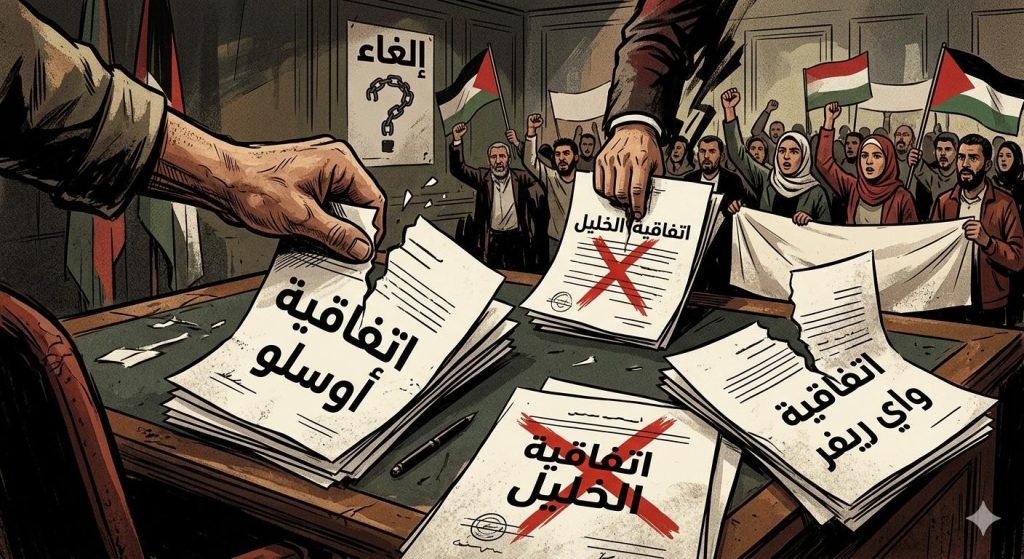
The move toward annulling the Oslo, Hebron, and Wye River agreements is, in its essence, a decision to sentence the “future” to death and turn back the clock more than thirty years, to a time when the Palestinian was merely a “resident” living under direct military rule, without representation and without hope for self-determination. This move constitutes a political earthquake aimed at stripping the Palestinian people of their limited national gains, returning the region to an era of direct military rule, and legitimizing an apartheid system.
This journey, burdened with disappointments, began with the Oslo Accords (1993–1995), which were once presented as the “peace of the brave.” For Palestinians, Oslo represented the gateway through which fighters became state-builders, and it served as the cornerstone upon which maps were drawn dividing the land into Areas A, B, and C. Area A was nominally placed under Palestinian Authority control; Area B under Palestinian civil administration and Israeli security control; and Area C, comprising 60% of the West Bank, remained under the full grip of Israeli domination. Yet reality has revealed that this dream has turned into a nightmare. The areas that were meant to become sovereign have become a vast prison fragmented by settlements. Today, the idea of annulling these agreements sends a clear message to the world: Israel’s recognition of the Palestine Liberation Organization was nothing more than “ink on paper” whose relevance has expired, and the crumbs granted under the name of a “Palestinian Authority” can be withdrawn by extremists who view the Palestinian presence on its own land as a “historical mistake.”
The Hebron Protocol (1997) was merely another chapter in this ongoing suffering. The city that houses the tombs of the prophets was divided through coercion and rigid division into H1 and H2, leaving thousands of Palestinians living in the heart of their own city at the mercy of settlement enclaves suffocating their daily lives. The annulment of the implementation of this agreement would simply mean giving settlers free rein in the Ibrahimi Mosque and the Old City, with neither restraint nor deterrence, and abolishing any security or administrative special status that had granted the people of Hebron a fragile form of steadfastness in the face of the growing aggression of settlers.
As for the Wye River Memorandum (1998), it was introduced at the time as an attempt to revive the political process through promises that included establishing a safe passage linking Gaza and the West Bank, constructing a Palestinian airport, and implementing further Israeli redeployments. However, most of the memorandum’s provisions were effectively suspended following the outbreak of the Second Intifada in 2000, when Israel reimposed full security control over the Palestinian territories, gradually turning the agreement into a frozen accord consigned to the drawers of international diplomacy.
Today, the move toward officially annulling it does not merely represent a procedural or legal step; rather, it constitutes the final nail in the coffin of any possibility for geographic or political continuity between the two parts of the Palestinian homeland. The real danger lies not only in tearing up these agreements, but in the “day after” such a decision. Israel is seeking to legitimize the “clinical death” of the political process that began in Washington in 1993 and to permanently close the door on any prospect of an independent Palestinian state.
The adoption of this approach would effectively amount to an Israeli declaration that there is “no authority, no state, and no Palestinian partner,” thereby paving the way for transforming the Palestinian National Authority into an entity stripped of legitimacy and powers in the eyes of the occupying power. It would also grant Israel broader space to evade its political and economic obligations, threatening the collapse of Palestinian institutions, disrupting essential services, and pushing millions of Palestinians into an extremely fragile political and humanitarian reality.
Within this context, Palestinians would find themselves facing an actual return to the model of direct military rule, with isolated cities, land gradually consumed through annexation and settlement expansion policies, and a population being driven toward silent displacement.
Thus, it appears that the “two-state solution,” which for decades formed the core of international consensus, is now collapsing under the blows of the Israeli far right. This is a defining political moment in which Israel chooses “land” over “peace,” pushing the region toward a reality open to prolonged confrontation, unconstrained by agreements and undeterred by international conventions. Should this law be approved, Palestinians will, under Israeli law, be transformed from a people seeking self-determination into merely “residents subject to civil and military administration,” as was the case prior to the Oslo Accords of 1993.
At the Union for Justice Foundation, we affirm that the silence of the international community — foremost among them the United Nations and major world powers — regarding attempts to revoke international agreements signed under international sponsorship and guarantees does not merely represent political negligence, but rather reflects a dangerous decline in the effectiveness of the international legal order and the standing of international legitimacy. When agreements are dismantled by force without accountability or consequences, the entire international legal system becomes vulnerable to erosion and collapse.
It is no longer sufficient to issue statements of concern or symbolic condemnation. The current phase requires a firm international stance that compels the occupying power to respect its legal and political commitments and puts an end to annexation and settlement policies aimed at transforming the West Bank into isolated enclaves and human ghettos lacking the most basic elements of life and sovereignty.
Today, the world stands before a genuine historical and moral test: either to uphold the principles of international legitimacy and protect the Palestinian people’s right to self-determination, or to accept a reality founded upon the entrenchment of occupation and apartheid, with all the grave consequences this will have in undermining the prospects for peace and stability in the Middle East for decades to come.
End
