Creeping Annexation in the West Bank: Settlement Expansion as a Tool for Altering the Legal Status of the Occupied Territory
27/07/2026 – Union for Justice Foundation
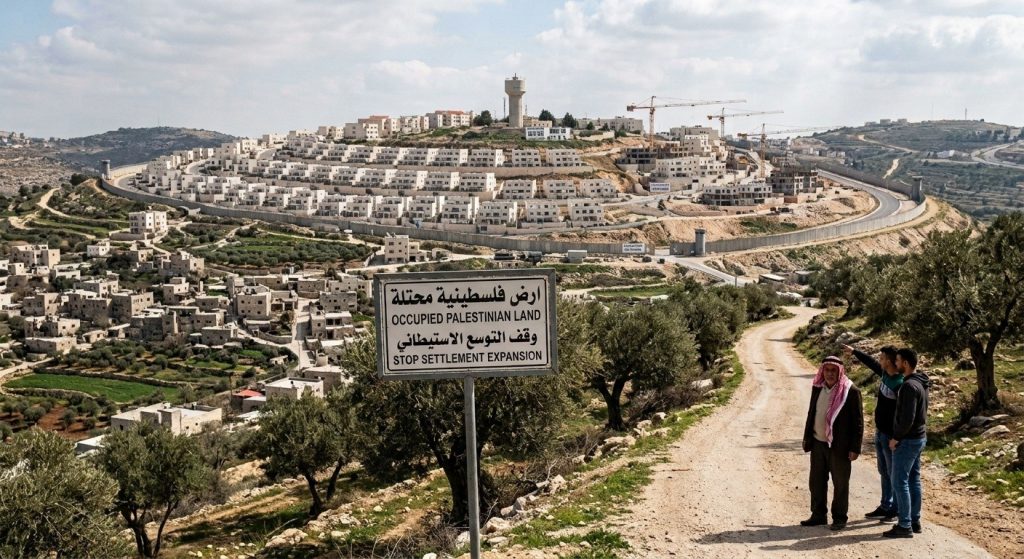
The Union for Justice Foundation stated in its latest field and legal assessment report that the developments currently unfolding in the occupied West Bank can no longer be classified as merely temporary settlement expansion or natural demographic growth. Rather, they constitute a comprehensive and carefully planned project aimed at redrawing the geography of the region in its entirety and imposing a new reality on the ground that will be difficult to reverse or dismantle in the future. The Foundation explained that the accelerating settlement activities are no longer limited to the construction of housing units or the expansion of existing settlements. Instead, they have evolved into the development of integrated engineering and spatial networks, including bypass roads that fragment Palestinian villages and cities and isolate them from one another, as well as infrastructure designed to connect settlements with the Israeli hinterland, thereby creating a continuous network for settlers at the expense of isolated Palestinian lands and communities. In addition, settlement outposts and pastoral outposts have been established and are being used as tools for the rapid seizure and direct appropriation of vast areas of land and grazing fields.
This policy is creating an entirely new geographical reality, whereby Palestinian cities and villages are transformed into isolated and fragmented enclaves surrounded by walls, road networks, and infrastructure that render geographical, social, and economic connectivity between them nearly impossible, while opportunities for a viable life continue to diminish day after day. The Foundation further noted that this geographical transformation is not the result of individual initiatives, but is carried out through direct official support, including the allocation of substantial government budgets for the development of settlements and their organizational networks. This is accompanied by an accelerated policy of demolitions and the forcible displacement of Palestinian communities, particularly in Area C and the Jordan Valley, as well as the expansion of violence and abuses perpetrated by settler groups, which are used as a field pressure tactic to compel the indigenous population to abandon their lands and grazing areas in order to facilitate their seizure. Together, these factors create a coercive environment that drives residents from their communities while steadily eroding the essential conditions of life, including access to water, agricultural land, and freedom of movement.
The violations have not been limited to the confiscation of land and the fragmentation of geography; they have also extended to a widespread network of military checkpoints and closed access points that severely restrict the daily lives of Palestinians and result in devastating humanitarian and health consequences. These checkpoints and iron gates obstruct civilians’ access to hospitals and healthcare facilities during emergencies, while the policies of closure, deliberate delays, and the obstruction of ambulances have become direct causes of the loss of numerous lives.
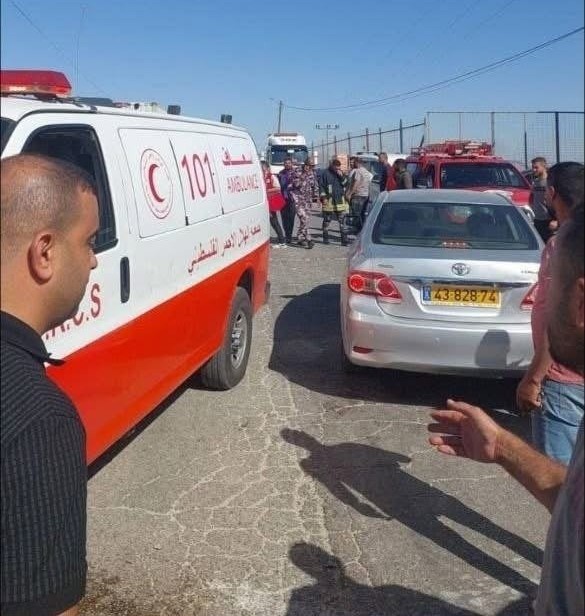
The latest of these tragic incidents occurred in the Ramallah Governorate, where a Palestinian woman died after suffering a sudden medical emergency (cardiac arrest). The ambulance transporting her was detained by Israeli military forces at a closed military checkpoint and prevented from passing and reaching the specialised medical centre in time to receive urgent treatment, resulting in her death before arriving at the hospital. This incident is merely one example of a systematic policy that has turned restrictions on movement and prolonged waiting at checkpoints into life-threatening conditions that endanger access to medical and other essential services.
The Foundation affirms that settlement activity in all its forms, together with the siege and restrictions on the movement of civilians, constitutes a grave breach of Article 49 of the Fourth Geneva Convention of 1949, which prohibits the occupying power from transferring parts of its own civilian population into the territory it occupies or taking any measures that lead to permanent demographic or geographical changes in the occupied territory. It also prohibits exposing the lives of civilians under occupation to danger. Furthermore, the Foundation emphasises that these practices are wholly incompatible with the resolutions of international legitimacy, particularly United Nations Security Council Resolution 2334 (2016), which unequivocally affirmed that the establishment of settlements in the territories occupied since 1967 has no legal validity, constitutes a flagrant violation under international law, and represents a major obstacle to the achievement of peace.
The Foundation calls upon the High Contracting Parties to the Geneva Conventions and the international community to move beyond the cycle of traditional expressions of concern and condemnation and to take concrete and practical measures to halt settlement expansion and the policies of closure and siege without delay.
The Foundation supports the imposition of a comprehensive ban on settlement products and calls for the prohibition of financial and investment dealings with institutions and companies involved in settlement construction or contributing to the infrastructure of the occupation. It also calls for the activation of accountability mechanisms to support the ongoing investigations before the International Criminal Court and the International Court of Justice, and to hold accountable individuals and entities involved in planning, implementing, and financing settlement activities, forcible displacement, and the obstruction of humanitarian relief and medical services for civilians.
The Foundation further calls for the provision of effective international protection for Palestinian civilians and communities threatened with forcible displacement and restrictions, in order to halt the policy of imposing faits accomplis and prevent the confiscation of the fundamental rights of the Palestinian people to their land.
The Foundation stresses that the continued silence of the international community regarding these policies not only contributes to the entrenchment of an unlawful system, but also directly threatens the prospects for achieving a just and lasting peace based on respect for international law and the inalienable rights of the Palestinian people.
End
