
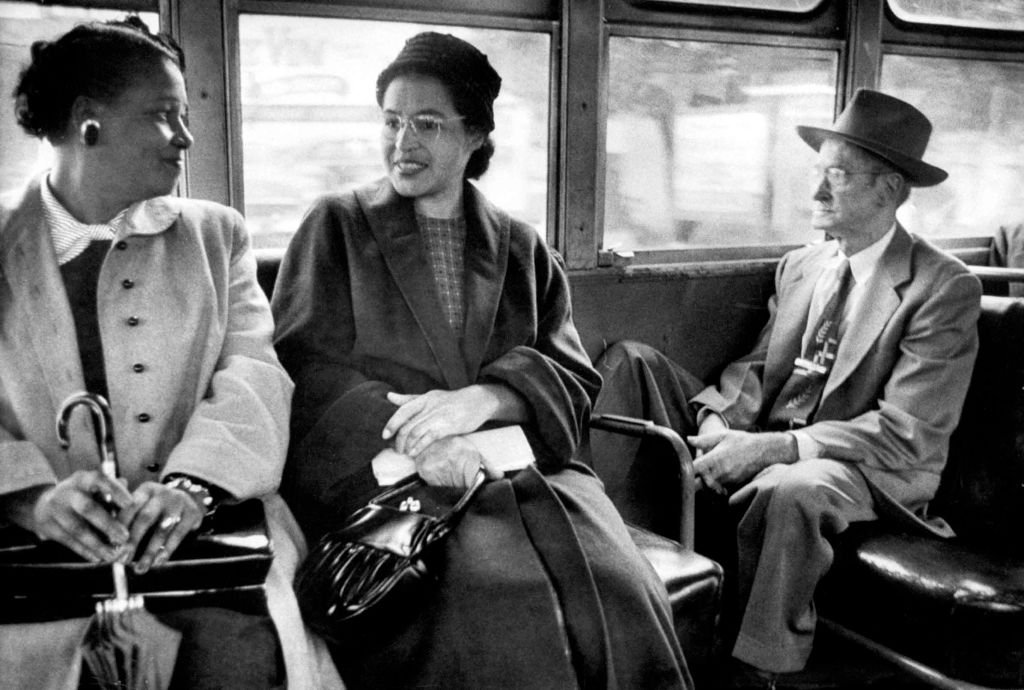
Rosa Parks: The First Lady of Civil Rights, A Symbol of Individual Courage in the Face of Discrimination
24/3/2026 – The Union for Justice Foundation
Rosa Parks is considered one of the most prominent figures in the history of the civil rights movement in the United States, and the woman whose name became associated with a pivotal moment in the struggle against racial discrimination. She was not a traditional political figure, nor did she seek fame or leadership, yet she became a global symbol of civil courage when she refused to comply with the segregation laws that forced African Americans to give up their seats on buses for white passengers. Her seemingly simple stance became the spark that ignited a widespread protest movement that helped change the course of American history.
Rosa Parks embodied the idea that social change can begin with a courageous individual stance, and that resisting injustice does not always require power or authority, but rather a deep belief in justice and human dignity. Through this stance, she became a global symbol of peaceful struggle against discrimination and a source of inspiration for movements seeking equality worldwide.
Early Life and Beginnings: Forming Awareness of Justice
Rosa Parks was born in 1913 in Tuskegee, Alabama, in the southern United States, a region that at the time was subject to a strict system of racial discrimination known as Jim Crow laws. She grew up in a social environment that divided society based on skin color, where African Americans faced extensive restrictions in education, work, and public services.
From her childhood, she witnessed the manifestations of injustice and discrimination imposed on Black people in daily life, which contributed to shaping her early awareness of issues of justice. She received her education in schools designated for African Americans, at a time when schools for white children had far superior resources.
In her youth, she engaged in social and civil rights work and joined the National Association for the Advancement of Colored People (NAACP), a rights organization aiming to end racial discrimination in the United States. She worked in this organization as the secretary of its Montgomery branch, where she participated in documenting cases of discrimination and violence against African Americans.
The Bus Incident: A Pivotal Historical Moment
On December 1, 1955, Rosa Parks was returning from work in Montgomery when she boarded a public bus. According to the segregation laws in effect at the time, Black passengers were required to give up their seats if the seats designated for white passengers were full. When the bus driver asked her to give up her seat for a white passenger, she refused to comply. Her refusal was not the result of a moment of anger but a conscious stance reflecting her rejection of the discrimination that Black communities had endured for decades.
This stance led to her arrest for violating segregation laws, but her arrest sparked a wave of anger within the African American community and became the starting point for a widespread protest movement.
Montgomery Bus Boycott: The Beginning of a Mass Movement
Following Rosa Parks’ arrest, African American community leaders in Montgomery decided to organize a comprehensive boycott of public buses to protest racial discrimination in transportation. This boycott lasted 381 days, during which African Americans refrained from using buses despite the significant difficulties they faced in commuting to work and school.
This boycott played a crucial role in the emergence of new leadership within the civil rights movement, most notably Martin Luther King Jr., who became one of the leading figures of peaceful struggle in the United States.
Ultimately, the U.S. Supreme Court issued a ruling declaring segregation on public buses unconstitutional, which was considered a major victory for the civil rights movement.
Civil Courage: The Power of an Individual Stance
Rosa Parks did not seek fame or political leadership when she refused to give up her seat on the bus, but she recognized that submitting to unjust laws meant the continuation of oppression. Her stance was a clear expression of civil courage—the ability to stand against unjust laws in defense of human dignity. Her refusal was not only a spontaneous act but also the result of long awareness of the injustices faced by African American communities.
Her stance proved that social change can sometimes begin with a simple individual act, yet capable of mobilizing an entire community when it reflects a deep sense of justice. Her refusal to submit to segregation laws sent a strong message that human dignity cannot be subjected to discrimination and that peaceful resistance can be an effective means of confronting unjust laws.
Global Impact: A Symbol of Peaceful Struggle
Rosa Parks’ influence was not limited to the United States; it transcended its borders to become a global symbol of peaceful struggle against discrimination and injustice. Her stance inspired many social movements worldwide, particularly those seeking equality and human rights through peaceful means. Her story became a frequently cited example in discussions about civil courage and the role of the individual in effecting social change.
Her experience demonstrated that change does not always require great political power, but can begin with a clear ethical stance that rejects injustice and demands justice. Through this impact, Rosa Parks became a global symbol reflecting the ability of ordinary individuals to contribute to shaping history.
Enduring Legacy: A Stance That Changed History
Rosa Parks continued her civil rights activism for many years after the bus incident, remaining a symbol of the struggle for equality until her death in 2005. She received wide recognition within the United States and abroad, being awarded numerous prizes and honors in recognition of her role in defending civil rights and promoting values of justice.
The legacy Rosa Parks left is not limited to a single historical incident; it is embodied in the moral message she carried throughout her life—that human dignity cannot be compromised. Today, her name is part of modern historical memory, symbolizing courage in the face of injustice and the ability of individual actions to effect profound societal change.
Recognition and Honors: Global Appreciation of Her Role in Civil Rights
After Rosa Parks became a symbol of the civil rights movement, she received wide recognition within the United States and abroad for her role in confronting racial discrimination. She was awarded numerous prizes and medals reflecting her historical position in the struggle for equality, including the Presidential Medal of Freedom and the Congressional Gold Medal, two of the highest civilian honors in the United States.
Her biography became part of the national memory of the United States, with her name given to numerous institutions, schools, and streets. Her stance on the Montgomery bus was considered a symbol of civil courage capable of changing the course of history, making her one of the most influential figures in the history of the struggle for civil rights.
End
