
Questions Regarding the Motives and Fears of Expanding Presidential Powers, the Encroachment of the Executive Authority, and the Termination of the Role of the Palestine Liberation Organization
26/2/2026 – Union for Justice Foundation
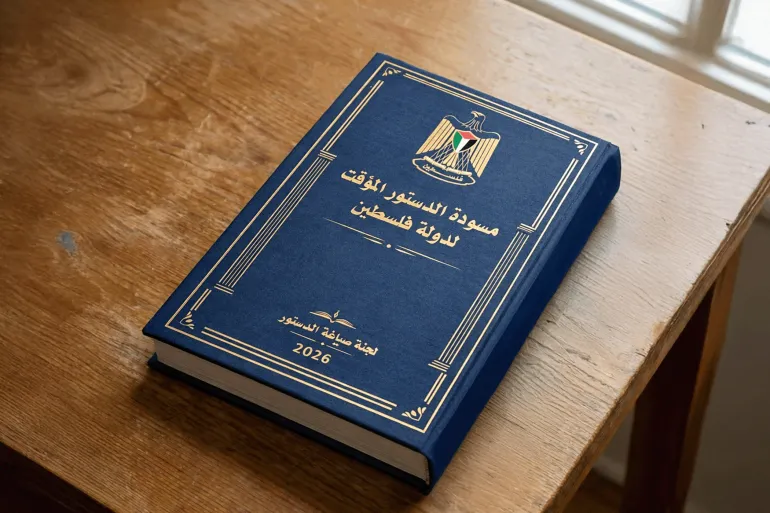
Nearly two weeks after the publication of the “Draft Palestinian Constitution,” critical and supportive voices have risen regarding this project. While some have viewed it as an important step toward the transition from authority to statehood, others have seen in its provisions numerous loopholes that entrench the president’s powers at the expense of the elected parliament, consolidate the Palestinian Authority at the expense of the broader framework (the Palestine Liberation Organization), and strengthen the executive authority over the legislative and judicial branches.
Between these two positions, a third group believes that the timing of the publication comes in response to international and external pressures that have repeatedly called upon the leadership of the Palestinian Authority, on every occasion, to undertake reforms and inject new blood into the body of the Authority, which has been weakened by the occupation’s measures and by administrative and financial corruption.
Regarding the timing, others argue that speaking of drafting a new Palestinian constitution (consisting of 13 chapters and 162 articles) amid the ongoing war of extermination in the Gaza Strip, the occupation’s measures to annex what remains of the West Bank, and the effective move toward the cancellation of the “Oslo Accords,” constitutes a detachment from reality, a non-urgent need, and an intellectual luxury that exhausts a Palestinian street already strained by numerous challenges and hardships. They maintain that the Basic Law, despite certain shortcomings, suffices at this stage.
Beyond this debate, holders of differing viewpoints agree that constitutions are not merely instruments of internal regulation for authorities; rather, they represent a political declaration addressed to the international community, a framework governing the relationship between authority and the people, and a sovereign message reflecting the state’s conception of itself and its position within the international system, within a liberation context of a state and a people still under occupation.
The Constitution Drafting Committee
Palestinian President Mahmoud Abbas had issued, last August, a decree establishing the “Temporary Constitution Drafting Committee,” chaired by Dr. Mohammed Al-Haj Qassem, with the membership of a number of partisan and judicial figures, former ministers, and specialists in legal matters, in line with the Declaration of Independence document (1988) and the principles of international legitimacy, as a step preceding the holding of general elections.
This Constitution Drafting Committee did not escape criticism. Former Deputy Speaker of the Legislative Council, Dr. Hassan Khreisheh, described it as “unprofessional,” stating that it includes political and factional figures rather than legal experts, and that drafting a constitution in all countries of the world is the responsibility of the elected parliament.
Conversely, a member of the Constitution Drafting Committee and Director of the Independent Commission for Human Rights, Ammar Dweik, stated in press remarks that the 17-member committee worked with high professionalism over a period of five months. Subcommittees emerged from it, and the articles were approved after being put to a vote.
He affirmed that the committee’s work relied primarily on the Palestinian Basic Law and also drew upon and reviewed the constitutions of several countries, such as the Tunisian Constitution, South Africa, Brazil, and others. He noted that this constitution, prior to its adoption, will be subject to a popular referendum in all places where Palestinians reside, both inside and abroad.
Expanding Presidential Powers
One of the most significant concerns raised by critics of this draft constitution is the fear of expanding the powers of the presidency and the erosion of the powers of the elected Palestinian parliament, as well as the encroachment of the executive authority at the expense of the legislative and judicial branches.
In Articles (73–85) relating to the Head of State, and Articles (80–84) concerning the formation of the government, confidence, and the dissolution of parliament, the Head of State is granted broad powers. Although the system is described as a democratic parliamentary system, its actual structure tends toward an unrestrained semi-presidential system, in the absence of clear mechanisms ensuring a balance of powers and preventing the concentration of executive authority.
We also find that Clause (79) stipulates that the Head of State may appoint a deputy, assign to him whatever tasks he deems appropriate, relieve him of his position, and accept his resignation. Article 82 further provides that the President signs and ratifies international treaties, whereas ratification is usually among the powers of the House of Representatives rather than the Head of State.
With regard to mechanisms for overseeing the executive authority, the draft, in Articles (17, 21, 22) concerning transparency and accountability, and Article (62) relating to litigation, confines itself to stating general principles without specifying oversight tools, procedures, or binding effects. This renders such oversight more formal than procedural and effective.
The concerns of the cautious camp regarding the new “Draft Palestinian Constitution” intensify with respect to the declaration of states of emergency in Articles (30, 71). The text merely refers to the restriction of rights in accordance with the law or security necessities, without defining what constitutes a state of emergency, the authority empowered to declare it, its duration, or the mechanisms for oversight. This constitutes a dangerous gateway for expanding executive powers at the expense of rights and freedoms.
The Judiciary in Jeopardy
With regard to the provisions concerning the judicial authority contained in Chapter Six of the temporary draft constitution (120–139), the Director of the Palestinian Center for the Independence of the Legal Profession and the Judiciary “Musawa,” Ibrahim Al-Barghouthi, recorded a number of observations, most notably: the absence of an explicit clause indicating the necessity of the House of Representatives’ approval of the appointment of the President of the Supreme Judicial Council; the omission of any provision affirming judges’ right to freedom of opinion and expression and to form their own associations; and the stipulation that the President selects the President of the Constitutional Court, which undermines the court’s independence.
The Authority and the Organization: A Controversial Relationship
Among the criticisms of the “Draft Palestinian Constitution,” as seen by the camp that is reserved about some of its provisions, is that it deals with the reality as though an independent state already exists. It fails to take into account the particularity of the Palestinian liberation context and does not sufficiently clarify the relationship between the political authority and the national liberation project.
Professor of Law and International Relations Raed Badawiya stated in press remarks that the draft referred to the Palestine Liberation Organization symbolically in the preamble without granting it the supreme constitutional status as the political representative of the Palestinian people, thereby entrenching the Organization’s isolation from the political system established by the constitution.
He affirmed that the supreme political reference for any Palestinian constitution must be the Palestine Liberation Organization and its National Council, while the Authority should be understood as an executive body of the future state. However, the current draft makes the existing governing institutions the central core of the political system.
He further explained that the provisions of the draft constitution ignored defining the relationship between the State of Palestine, the Palestine Liberation Organization as the supreme reference, and the Palestinian Authority—this being the structural knot of the political system since the Oslo Accords. Although the draft describes Palestine as a “state under occupation,” it does not clarify how a state under occupation will be administered in the presence of an Authority originally established to manage limited self-rule. Nor does the draft determine the fate of the Oslo Accords, the relationship between international law and the transitional reality, or the mechanisms for transforming international recognition of the state into actual sovereign practice.
Conversely, the camp supporting the Draft Palestinian Constitution holds that its various provisions observe all constitutional foundations of a democratic state. It addresses all rights and freedoms stipulated in most international charters, achieves a balance among the three branches of government, and enshrines the principle of the right to self-determination through a popular referendum in which Palestinians in the homeland and the diaspora vote on this constitution.
End
