
18/05/2026 – Union for Justice Foundation
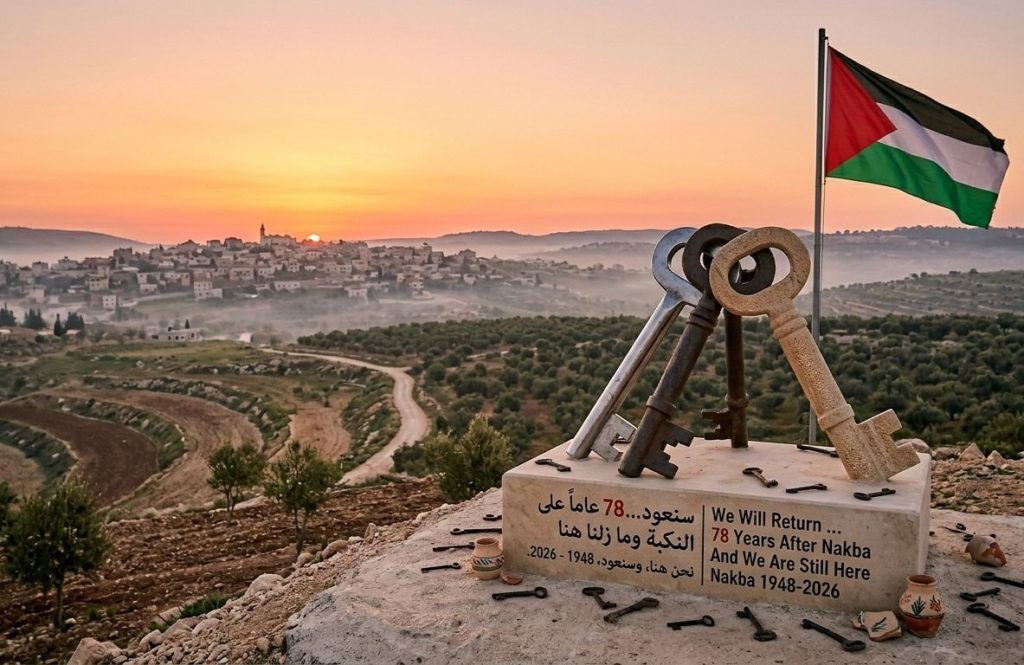
The seventy-eighth anniversary of the Palestinian Nakba passes in 2026 with the Palestinian cause still alive in all its pain, advancing with figures that leave no room for denial. The story of Palestine from 1948 to the present day is one of a struggle between an unyielding memory that refuses to be erased and an unrelenting machinery of erasure. The tragedy begins with its first figure: the displacement of nearly one million Palestinians in the year of the Nakba, who—through natural population growth and steadfast attachment to their identity—have today become more than seven million refugees. These are not merely names recorded in UNRWA registers, but millions of people scattered across refugee camps in the diaspora and within Palestine, living in confined spaces often no larger than a few square kilometers—among the most densely populated areas in the world—where the narrow alleyways of the camps stand as daily witnesses to the crime of uprooting a people from their homeland.
As for the toll of blood, the Palestinian people have offered an unbroken caravan of martyrs from the first bullet of the revolution until this very day in 2026. The documented numbers since the Nakba amount to hundreds of thousands of lives lost on frontlines of confrontation, beneath the rubble of their homes, and at deadly checkpoints. In the last decade alone, Palestine has witnessed wars and genocidal acts that caused the number of martyrs to rise at a horrifying pace, with a devastating concentration on the targeting of women and children. In every major assault, thousands of children —who had not yet reached adulthood—have been killed, pushing the proportion of child martyrs to internationally unprecedented levels. These martyrs leave behind a nation of orphans and grieving families, as well as hundreds of thousands of wounded individuals. Tens of thousands suffer from amputations or traumatic brain injuries, leaving Palestinian society facing an immense humanitarian and healthcare challenge in caring for persons with disabilities caused by successive wars.
As for the issue of prisoners, imprisonment has become part of the “personal identity” of every Palestinian. Since the Israeli occupation began in 1967, more than one million arrests have been recorded, meaning that nearly every Palestinian household has had at least one family member imprisoned. In 2026, thousands of prisoners remain detained under inhumane conditions, distributed across prisons and detention camps lacking even the most basic international standards. The figures speak of hundreds of prisoners who have spent more than twenty or thirty years behind bars, and of the “cemeteries of numbers,” where the occupation authorities continue to withhold the bodies of martyrs, depriving their families even of the right to burial and farewell. Today, the Palestinian prisoners’ movement stands as a symbol of national steadfastness, with detainees confronting illness and hunger through hunger strikes, while many falling as martyrs due to medical negligence. Hundreds entered prison healthy but emerged either in coffins or suffering from chronic illnesses.
The battle over “stone and soil” is told through the systematic policy of demolition. Since 1948, when the occupation destroyed more than 530 villages and erased them from the map, the machinery has never ceased. In occupied Jerusalem, homes are demolished on a daily basis under flimsy pretexts aimed at displacing the indigenous population and altering the demographic composition of the city. In the West Bank, entire pastoral communities are uprooted, while schools and healthcare centers are demolished. In the Gaza Strip, the scale of destruction inflicted upon residential units has reached levels reminiscent of the devastation of the Second World War, with entire neighborhoods wiped off the face of the earth and hundreds of thousands of civilians displaced after losing all the savings and possessions of a lifetime in a single airstrike. This internal displacement has created the tragedy of “repeated displacement,” where Palestinians flee from tents to shelter schools only to find bombardment pursuing them there as well.
On its seventy-eighth anniversary, and despite all these figures burdened with death and destruction, Palestine continues to prove to the world that material power, no matter how great, cannot resolve the conflict against a people who see in every martyr a seed of freedom, and in every demolished home a reason to rebuild anew. It is seventy-eight years of failed attempts to erase the existence of a people who, in 2026, prove that they remain the defining challenge in the Middle East equation, and that their rights to return, freedom, and self-determination are not merely slogans, but entitlements written in blood and in endless sacrifices.
The Union for Justice Foundation affirms that the continuation of these flagrant violations over the course of eight decades constitutes a stain on the conscience of international justice. The Foundation calls upon the international community, in all its bodies and organizations, to assume its historical, legal, and moral responsibilities to end this prolonged occupation, halt the policies of ethnic cleansing, and ensure the accountability of those responsible for these crimes before international courts. International silence is no longer an option, and justice for the Palestinian people remains the true test of the credibility of international law in today’s world.
End
