
Within a Single Year
On the Eve of the Dissolution of the Israeli Parliament, More Than 20 Anti-Palestinian Measures Issued by the Most Extreme Knesset in Israel’s History
19/07/2026 – Union for Justice Foundation
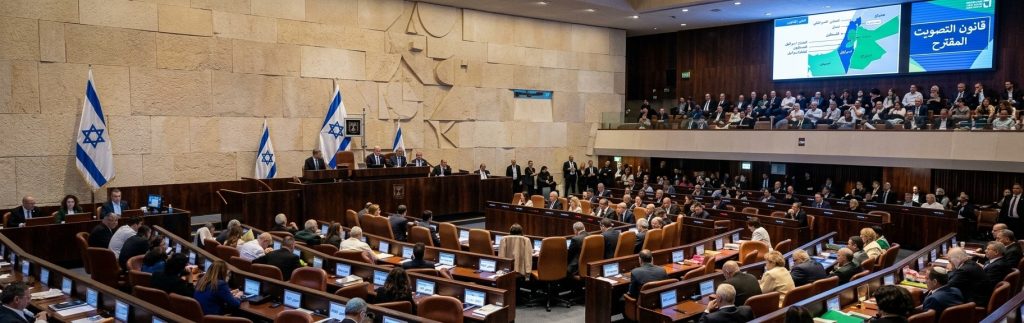
The Union for Justice Foundation stated that the dissolved Israeli Knesset issued more than 20 discriminatory decisions during the past year targeting Palestinians residing in the West Bank and the territories occupied in 1948.
The Foundation noted that the most recent Knesset was the most extreme parliament in the history of the occupying state, as it included 64 members from far-right political groups out of a total of 120 seats, enabling these parties to form the government under the leadership of Benjamin Netanyahu following the elections held in 2022.
In the early hours of last Friday, the Israeli Knesset voted to dissolve itself and scheduled the next general elections for 27 October 2026.
The Foundation added: “When examining the body of decisions issued by this Knesset, particularly during the past year, it becomes clear that the overwhelming majority of these laws carry the unmistakable character of racial discrimination and are directed against Palestinians, whether those residing in the West Bank or in the territories occupied in 1948.”
It pointed out that these decisions directly contributed to expanding settlements and confiscating Palestinian land in the West Bank through the allocation of substantial government funding, while also legalizing the killing and torture of Palestinian prisoners.
In addition, they targeted the dismantling of the United Nations Relief and Works Agency for Palestine Refugees (UNRWA), intensified restrictions on Palestinians living in the territories occupied in 1948 and on media outlets supportive of the Palestinian cause, legalized Jewish prayers inside Al-Aqsa Mosque, and continued the seizure of Palestinian clearance revenues.
Cabinet Decisions Reflect the Orientation of the Knesset
The Union for Justice Foundation continued: “Alongside these dangerous and discriminatory decisions issued by the Knesset, there have also been dozens of decisions adopted by the Israeli government (the Cabinet), which constitute a practical manifestation of the extremist parliamentary majority supporting this government within the Israeli Knesset.”
The Union for Justice Foundation reviews below the most significant decisions issued by the dissolved Knesset during the final year of its term, covering the period from July 2025 to July 2026.
On 5 July 2025, the Knesset Education Committee approved, in the second and third readings, a bill prohibiting the employment within Israel’s education system of any teacher holding an academic degree from universities in the West Bank. On 8 July, the same committee approved a bill requiring higher education institutions to prohibit any activities organized by Arab student committees that are considered supportive of “terrorist organizations” or that allegedly incite “terrorism” against Israel.
Annexation of the West Bank and the Execution of Palestinian Prisoners
On 23 July 2025, the Israeli Knesset approved the extension of a law allowing the detention of detainees from Gaza without indictment and preventing them from meeting lawyers for prolonged periods. On the same day, the Knesset also voted in favor of a bill calling for the application of “Israeli sovereignty” over the occupied West Bank. The proposal was approved by 71 Knesset members, with only 13 members voting against.
On 28 September, the Knesset National Security Committee approved a bill providing for the execution of Palestinian prisoners, in preparation for its submission to the Knesset plenum. Several weeks later, the plenum approved, in its preliminary reading, a bill to annex the West Bank and impose “Israeli sovereignty” over it.
On 22 October 2025, the Knesset plenum approved, in its preliminary reading, a bill applying “Israeli sovereignty” to the settlement of Ma’ale Adumim, one of the largest Israeli settlements in the West Bank, located approximately seven kilometers east of Jerusalem. The settlement constitutes part of the Israeli annexation project (E1 area) aimed at isolating Jerusalem from its Palestinian surroundings and fragmenting the West Bank.
Restricting the Media and Dismantling UNRWA
On 10 November 2025, the Knesset plenum approved, in its first reading, a new bill authorizing the Israeli government to shut down any foreign media outlet deemed to be “harmful to state security,” transforming what had previously been a temporary measure into permanent legislation that expands the powers of the Minister of Communications without judicial oversight.
The following day, the Knesset plenum approved, in its first reading, the bill providing for the execution of Palestinian prisoners, with 36 members voting in favor and 15 against. The bill was referred to the relevant parliamentary committee in preparation for its second and third readings.
On 19 November 2025, the Knesset approved, in its first reading, legislation halting the supply of water and electricity to UNRWA facilities and amending a previous law prohibiting any relationship between state authorities and UNRWA, thereby raising the question of whether water and electricity services fall within the scope of such prohibited relations.
On 25 November, the Knesset Foreign Affairs and Defense Committee approved, in its first reading, the proposed Law on the Elimination of Discrimination in Real Estate Purchases (2023), thereby allowing settlers to purchase land directly in the West Bank.
On 14 December 2025, the Knesset National Security Committee approved a bill permitting the closure of foreign media offices even in the absence of a declared state of emergency, in preparation for its second and third readings before entering into force.
Legalizing Jewish Prayers Inside Al-Aqsa Mosque
Several days later, the Knesset approved by 49 votes to 35 a bill entitled “Promoting Jewish Identity in the Public Sphere,” which legalizes the performance of Jewish religious rituals in public places and legitimizes Israeli control over holy sites in Jerusalem, particularly Al-Aqsa Mosque.
On 22 December 2025, the Knesset plenum approved, in the second and third readings, an extension of the law permitting the closure of foreign television channels on the grounds of “harming state security” until the end of 2027.
2026: A Continuation of Previous Decisions
Since the beginning of this year, the Israeli Knesset has continued issuing discriminatory legislation, as though racing against time before its dissolution. On 13 January 2026, the Knesset National Security Committee approved the renewal of the state of emergency in prisons and detention centers, effectively legalizing the torture and abuse of Palestinian prisoners beyond any form of international accountability or oversight.
On 30 March, the Knesset plenum approved, in the second and third readings, the Law on the Execution of Palestinian Prisoners, with 62 members voting in favor, 48 against, and one abstention.
On 11 May 2026, the Knesset approved, in the second and third readings and by a majority of 93 members, the bill concerning the prosecution of the “7 October fighters,” which provides for the death penalty and prohibits their release in any prisoner exchange agreements.
Several days later, the same body approved, in its first reading, a bill establishing an Israeli Antiquities Authority responsible for archaeological sites in the occupied West Bank, effectively placing these sites under Israeli control even where they are located within Area A under the Oslo Accords.
On 4 June 2026, the Israeli parliament gave final approval to legislation granting tax exemptions to approximately 58 settlements in the West Bank from January 2026 through the end of 2027. It should be noted that the Israeli Knesset had previously decided, last year, to increase the budget allocated to the Ministry of Settlement Affairs by 320 percent.
Legalizing the Seizure of Palestinian Funds and Restricting the Call to Prayer
On 8 June, the Knesset plenum approved, in the second and third readings, a new law expanding mechanisms for seizing Palestinian clearance revenues by allowing additional deductions from the funds owed to the Palestinian National Authority.
On 1 July, the Knesset plenum approved, in its preliminary reading, the proposed “Muezzin Law,” which effectively seeks to restrict the use of loudspeakers in mosques under the pretext of preventing “noise.” The bill was approved by 50 Knesset members, while 36 voted against.
On 8 July, the Knesset plenum approved, in its first reading, a bill authorizing the freezing of additional funds belonging to the Palestinian National Authority in an amount equivalent to the annual funds transferred by the Authority to the Gaza Strip.
The Union for Justice Foundation affirms that all decisions issued by this Knesset are null and void, as they are inconsistent with the rules of international law. The West Bank, East Jerusalem, and the Gaza Strip remain occupied territories whose geographical and demographic character may not be altered under international law.
End
