
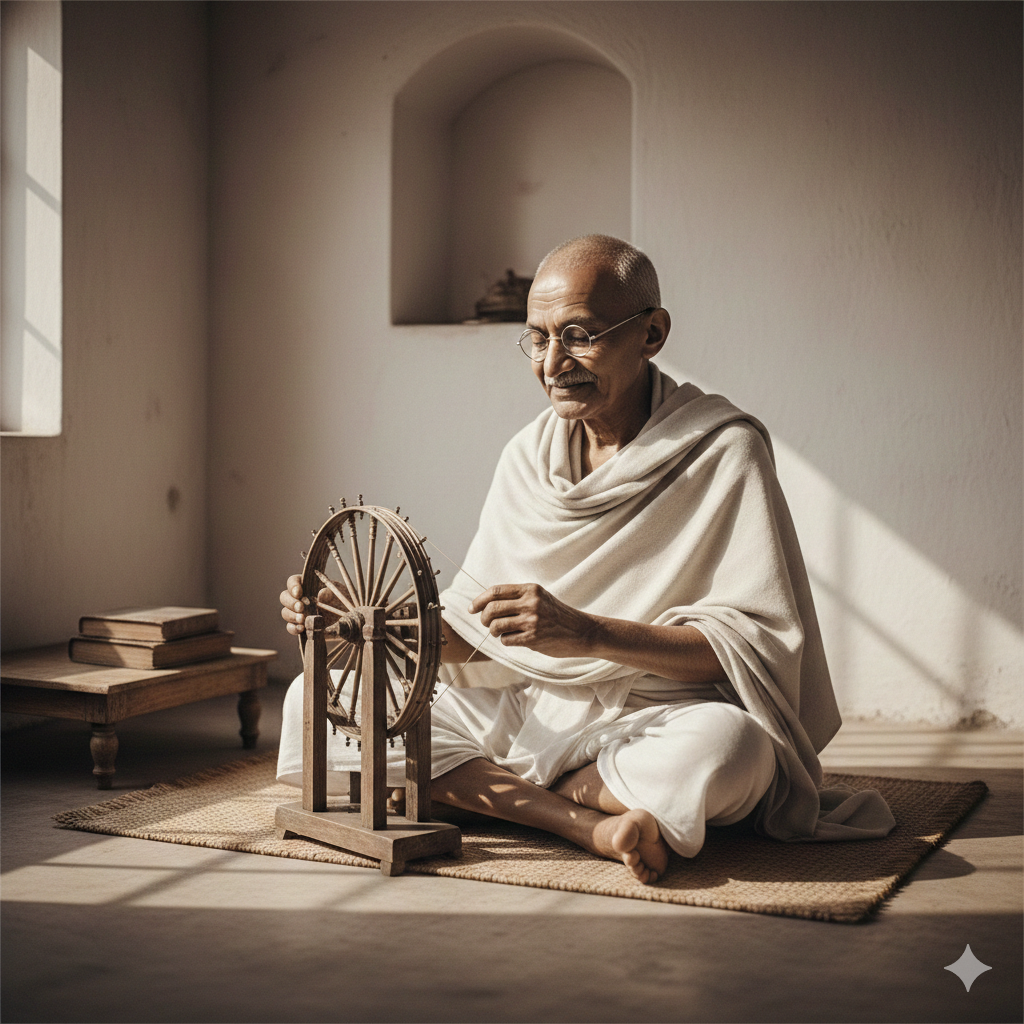
Mahatma Gandhi: A Legal Legacy in Defense of Human Dignity
21/2/2026- Union for Justice Foundation
In the record of the immortals, few names stand as testimony to the human capacity to change the course of history without bearing arms and without shedding blood. Among these names, Mahatma Gandhi emerges as one of the greatest symbols of justice in modern human history. Gandhi was neither a military leader nor the holder of conventional political power; rather, he was a living conscience who embodied the power of truth and proved that human will is capable of confronting the harshest forms of injustice through patience and faith in principles. Gandhi became a global symbol of peaceful struggle, an icon of freedom, and a source of inspiration for all peoples seeking justice without losing their humanity.
Gandhi was not merely a national leader who guided his country toward independence; he was a legal and moral thinker who redefined the concept of resistance and demonstrated that justice can be achieved through respect for the law and striving to reform it, not by undermining it. He embodied a rare model of leadership that combined strength of will, wisdom, and the ability to transform suffering into a moral force capable of changing reality.
The Emergence of an Early Human Consciousness
Mahatma Gandhi was born in 1869 in India, under a political and social reality dominated by the British Empire. He grew up in a conservative environment that instilled in him from an early age the values of honesty, discipline, and respect for others. These values profoundly shaped his character, as he learned that justice is not merely a theoretical concept, but a responsibility that must be defended.
In his youth, Gandhi was not a political leader, but a young man seeking to understand the world around him. This curiosity led him to study law, a decision that marked a turning point in his life, as he began to comprehend the nature of the relationship between law and justice and became more aware of the role of law in organizing society. Gandhi traveled to Britain to study law, where he acquired legal knowledge that enabled him to understand the nature of legal systems. He realized that law, despite its importance, can become an instrument of injustice if it is not grounded in justice. After his return, he began practicing law, believing that the law should serve as a means of protecting human beings. At this stage, Gandhi believed in the possibility of achieving justice through the law and sought to use his legal knowledge to defend the rights of others. This belief formed the foundation upon which he later built his philosophy.
The First Confrontation with Unjust Law
Gandhi’s experience in South Africa marked a decisive turning point in his life. There, he was subjected to racial discrimination and witnessed how the law could be used to entrench injustice. He realized that laws that violate human dignity cannot be considered just, even if they are in force. From that point, Gandhi began his struggle against discrimination, employing the method of peaceful resistance. He developed the concept of “Satyagraha,” which means adherence to truth, and was based on the idea that resistance to injustice must be carried out through peaceful means.
For Gandhi, nonviolence was not merely a method, but a fundamental principle. He believed that violence leads to further injustice and that justice cannot be achieved through unjust means. He proved that a person can confront injustice without resorting to force. The philosophy of “Satyagraha” was an expression of Gandhi’s belief that truth is the greatest power a human being possesses, and that adherence to it can lead to the realization of justice.
Leading a People Toward Freedom
When Gandhi returned to India, he found his country suffering under colonial injustice. He resolved to lead a peaceful resistance movement aimed at achieving independence. He called upon the people to reject unjust laws and to refuse cooperation with the colonial authority. This approach succeeded in uniting the people and gave them hope that change was possible. He also proved that peaceful resistance can be an effective means of achieving change. Civil disobedience was one of the most important methods Gandhi used in resisting injustice. This method was based on the idea that unjust laws should not be obeyed, and he believed that respect for the law does not mean acceptance of injustice. This approach helped expose injustice and compelled the authorities to reconsider their policies.
The Price of Defending Justice
Mahatma Gandhi was imprisoned several times because of his peaceful struggle and his rejection of the unjust laws imposed by colonial rule. These experiences were harsh; he was deprived of his freedom and endured difficult conditions aimed at breaking his will and forcing him to retreat from his principles. Yet imprisonment was not, for him, the end of the road; rather, it became an extension of his struggle and a space for reflection and strengthening his faith in the justice of his cause. Prison did not weaken his resolve; instead, it made him more steadfast and resolute, and more convinced that justice is worth sacrifice, and that freedom is not granted but attained through patience and faith.
Gandhi proved that prison may restrain the body, but it cannot restrain an idea or extinguish the light of truth. He emerged from every detention more powerful and influential, becoming a living symbol of moral steadfastness in the face of injustice. Thus, his suffering was transformed into a source of inspiration for his people and evidence that human will, when committed to truth, cannot be defeated by any force.
The Triumph of Truth: From Resistance to Independence
Mahatma Gandhi led his people on a long historical journey toward independence, relying on the power of collective will and deep faith in justice. This journey was not easy; the liberation movement faced enormous challenges, from repression and imprisonment to attempts to break the will of the people. Yet Gandhi remained steadfast in his position, believing that truth is stronger than any authority, and that peoples who cling to their rights cannot be defeated. Through his wise leadership, he succeeded in uniting millions of Indians around a single goal—freedom—and transformed peaceful struggle into a genuine force that compelled colonialism to recognize the people’s right to self-determination.
Mahatma Gandhi was not merely a political leader, but a legal thinker who reformulated the relationship between law and justice. He began his professional life as a lawyer who believed in the rule of law, but soon realized that laws may become instruments of injustice if they are not grounded in justice. Through his experience, he demonstrated that law does not derive its legitimacy merely from its enactment, but from its capacity to protect human dignity and achieve equality.
Gandhi contributed to consolidating the concept of civil disobedience as a legal and moral means of confronting unjust laws, affirming that respect for the law does not mean blind obedience, but also includes working to reform it when it deviates from justice. In doing so, he redefined the role of the individual, not merely as one subject to the law, but as a partner in its protection and development, leaving a legal legacy that influenced global human rights thought.
A Source of Inspiration for Humanity
Gandhi’s influence was not confined to India, but extended to the entire world, as he became a global symbol of peaceful struggle and justice. He proved that a human being can confront injustice without resorting to violence, and that the power of principles can overcome the power of authority. His philosophy inspired numerous movements seeking freedom, and he became a global model of resistance founded on truth and human dignity. His ideas became a lasting source of inspiration, demonstrating that peaceful struggle can be an effective means of achieving change, and that justice can prevail when a person adheres to his principles.
Gandhi was not merely a historical figure, but became an enduring symbol of justice and freedom. He proved that a person can change the world through faith in truth, and that true strength lies in adherence to principles. His legacy was not only the independence of a nation, but a timeless idea affirming that justice can be achieved without violence.
The name of Mahatma Gandhi will remain present in the conscience of humanity, a source of inspiration for all who believe that freedom is a right, and that truth is capable of triumph, no matter how long it takes.
End
