
Land Settlement in the West Bank: The Occupation’s Land Registry System and the Dimensions of the Struggle over Palestinian Identity and Land Ownership
3/6/2026 – Union for Justice Foundation
Land settlement is widely regarded as one of the most significant administrative, legal, and sovereign processes in the history of modern societies. In its original legal and humanitarian conception, it seeks to formalize property ownership, accurately define land boundaries, and provide landowners with definitive official title deeds that safeguard rights across generations, resolve local disputes, and promote social and economic security. In the Palestinian context, however, land settlement represents one of the most complex and consequential issues. The process began during the Ottoman era, evolved under the British Mandate, and continued in an organized manner during Jordanian administration of the West Bank until 1967. Following its occupation of the West Bank, Israel immediately issued the unjust Military Order No. 291 of 1968, which suspended all land settlement procedures previously undertaken by the Jordanian authorities. As a result, more than two-thirds of West Bank lands remained without final formal settlement, recorded only through outdated fiscal records, local sale contracts, and inherited title deeds. This freeze was a deliberate and systematic measure through which the occupying authorities sought to maintain land ownership in a state of legal uncertainty and ambiguity, thereby facilitating subsequent control over Palestinian land and its appropriation under various legal and administrative pretexts.
Against this backdrop of a critical historical turning point, an accelerated development has emerged that reflects Israel’s determination to achieve geographic and legal consolidation on the ground. This is manifested in the Israeli government’s approval of a plan to resume land settlement and registration procedures in the occupied West Bank, particularly in areas classified as Area C. As part of this process, authority over land settlement and cadastral affairs has been transferred from the Israeli Civil Administration to the Israeli Ministry of Justice and the Survey of Israel. These measures culminated recently in the official announcement of the launch of a digital Land Registry and Rights Settlement Office for the West Bank. This newly established office and digital system are far more than a technical measure or an administrative modernization intended to facilitate transactions, as Israeli official narratives seek to portray them. Rather, they constitute a comprehensive form of digital colonial engineering and an aggressive legal mechanism aimed at creating an Israeli land registry parallel to the legitimate Palestinian registry. Through the imposition of facts on the ground, this system is designed to be administered directly through electronic platforms linked to Israeli ministries and legal institutions, thereby paving the way for the elimination of Palestinian administrative authority in these areas, forcing residents and investors to rely on a legal system alien to them in order to secure their properties, and opening a new and difficult chapter in the struggle over land and the erasure of Palestinian presence.
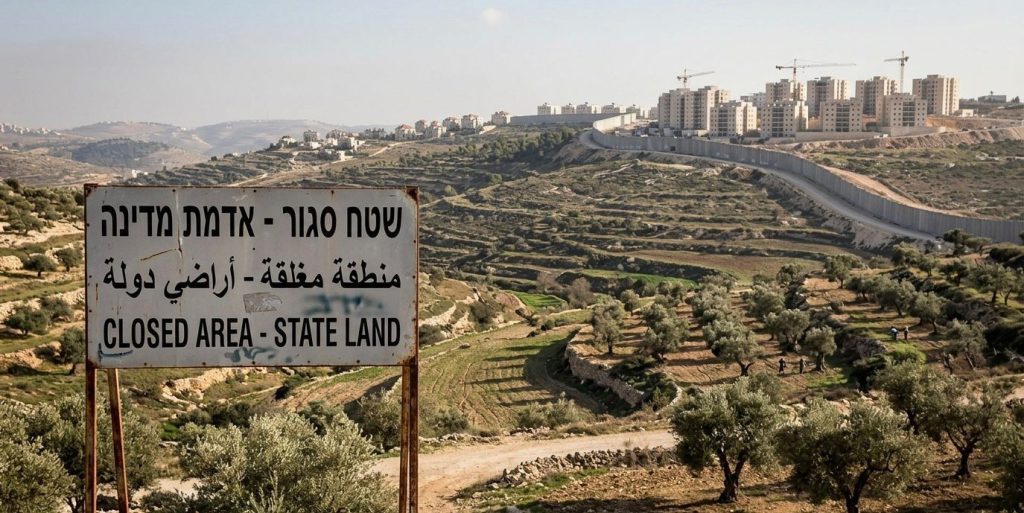
There are multiple underlying objectives behind the occupation’s rush to establish this office and impose the new land settlement system. Foremost among them is the surveying of lands not formally registered in the Land Registry (Tabo), and the declaration of vast areas as “state land” under occupation control, based on unjust and distorted interpretations of old Ottoman land laws that permit the confiscation of land if it remains uncultivated for consecutive years, despite this being the direct result of military siege and field restrictions. The project also aims to legalize settlement outposts and expand existing settlements, as the absence of land settlement procedures has long constituted a legal obstacle for settlers seeking to prove ownership of the lands on which their settlements are built before the courts. Accordingly, opening the door to the Israeli-led settlement process would enable the formal and permanent registration of these lands in the names of settlement companies or settlement councils. Moreover, the new digital system functions as a platform designed to facilitate the rapid transfer and documentation of property ownership in favor of settlers, in parallel with legislative efforts allowing them and foreign nationals to purchase land in the West Bank without any limitations or restrictions. At the same time, it coincides with intensified measures to pursue, prevent, and obstruct surveying teams and engineers affiliated with the Palestinian Land Authority and the Palestinian Land Settlement Commission from operating in Area C, including arresting them and imposing financial penalties, in order to paralyze any Palestinian counter-efforts aimed at protecting historical rights.
The implications of opening the Israeli Land Settlement Office and imposing this electronic system extend far beyond their legal dimensions, constituting an existential threat to Palestinian geography and demography. Among the most significant consequences is the acceleration and entrenchment of the creeping annexation of the West Bank and its transformation into effective legal annexation, after having previously been pursued through military measures, on-the-ground practices, and temporary land confiscations under the pretext of military necessity. The registration of land in the records of the Israeli Ministry of Justice effectively, though without formal declaration, imposes Israeli sovereignty and law over the West Bank and transforms its status from occupied territory administered under international humanitarian law into territory subject to the Israeli civil administrative apparatus. This, in turn, results in the serious loss of property belonging to Palestinian citizens and refugees due to the prohibitive conditions imposed by the occupation authorities for proving ownership. A citizen’s inability to access his or her land because of the Separation Wall or military checkpoints, or the failure to possess the documents required by the occupation authorities, automatically leads to the transfer of ownership of the land to the occupying power and the activation of the Absentees’ Property Law to confiscate the shares of original landowners residing outside Palestine and transfer them to the Israeli Custodian of Absentees’ Property, which subsequently channels them to settlements. Ultimately, this leads to the paralysis of Palestinian urban expansion, the encirclement of villages, and the suppression of natural population growth within isolated enclaves and pockets through legal realities formally recorded in the Israeli Land Registry (Tabu), which remains rejected both by the Palestinian public and by the international community.
In this complex and highly perilous context, the Palestinian Land and Water Settlement Commission, in coordination with legal and official authorities and the Bar Association, has issued strong and responsible warnings to all citizens regarding the consequences and risks of engaging with or dealing in any manner with the newly established Israeli settlement office and its affiliated electronic system. These Palestinian warnings emphasize that responding to Israeli land-settlement notices or submitting ownership documents, claims, or evidence through the system’s digital platforms constitutes a voluntary recognition of the occupation’s legal framework and discriminatory laws imposed on Palestinian land. Such engagement effectively strips citizens of the protections afforded by international law, which regards the occupation’s procedures as null and void and incapable of creating legitimate legal rights.

The Commission further warned that this digital system has been specifically designed as a sophisticated legal trap targeting land ownership. It provides the occupation authorities with an unprecedented opportunity to examine records, identify landowners and heirs residing abroad, and subsequently appropriate their shares under the Absentees’ Property Law, transferring them to settlers. Consequently, a citizen who approaches the Israeli office in good faith with the intention of safeguarding his or her land may, without realizing it, facilitate the confiscation of substantial portions of that property and their conversion into settlement outposts adjacent to the family home, consuming what remains of the family’s landholdings. Moreover, such practices risk generating severe ownership disputes that threaten social cohesion and civil peace within Palestinian communities, while simultaneously creating opportunities for fraud, forgery, and the unlawful appropriation of property rights.
The Union for Justice Foundation affirms that these Israeli measures aimed at registering and settling land in occupied territory constitute a grave and blatant violation of international humanitarian law, particularly the Fourth Geneva Convention of 1949 and the Hague Regulations of 1907, both of which categorically prohibit an occupying power from introducing permanent changes to the legal or administrative structure of territory under military occupation. The Foundation considers these steps a flagrant breach of international law and fully-fledged war crimes, as they lay the groundwork for colonial annexation and the dispossession of the indigenous population from their lands and properties.
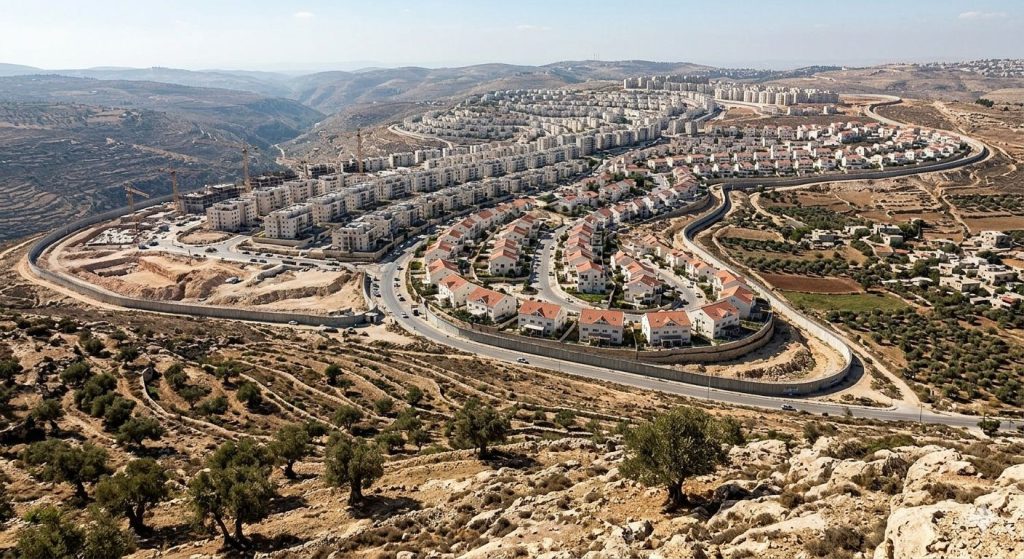
The Union for Justice Foundation concludes by emphasizing that this critical juncture requires the development of a unified national and legal strategy to confront this form of colonial engineering. Such a strategy should include intensifying land reclamation and cultivation efforts, as well as providing free legal and financial support to secure and register Palestinian property rights in official national records, so that the land remains in the hands of its rightful owners despite the extent of Israeli predatory encroachment, misrepresentation, and falsification of facts and history.
End
