25 August 2025 – Union for Justice Foundation
The occupied West Bank and Jerusalem are witnessing an unprecedented escalation in Israeli settlement activity, manifested in systematic expansion plans, land confiscation, and large-scale demolitions. These actions are backed by military and political policies designed to impose new facts on the ground and entrench the occupation’s control. This surge in settlement activity has become particularly pronounced in parallel with Israel’s ongoing war on the Gaza Strip, raising serious legal and humanitarian concerns.
Ajith Sunghay, Head of the Office of the UN High Commissioner for Human Rights in Palestine, stated: “Focusing only on Gaza does not reflect the full scale of Israeli violations. Land is being stolen daily in the West Bank and Jerusalem, while Palestinians continue to be displaced from their homes.”
Sunghay further noted that the current settlement plan seeks to eliminate what is referred to as Palestine in the territories occupied since 1967, stressing that such a course of action poses a grave threat to the establishment of a Palestinian state. He added that settlers continue their hostile actions despite the 2024 International Court of Justice ruling calling on Israel to withdraw from the occupied territories.
The actions of settlers, he explained, are reckless and greatly intensify settlement efforts, making the situation dangerous and demanding urgent international attention. Since launching its genocide in the Gaza Strip on 7 October 2023, Israel has escalated its commission of crimes paving the way for the annexation of the West Bank, including the demolition of homes, the forced displacement of Palestinians, and the expansion and intensification of settlement activity.
Settlement Expansion and the Construction of New Outposts
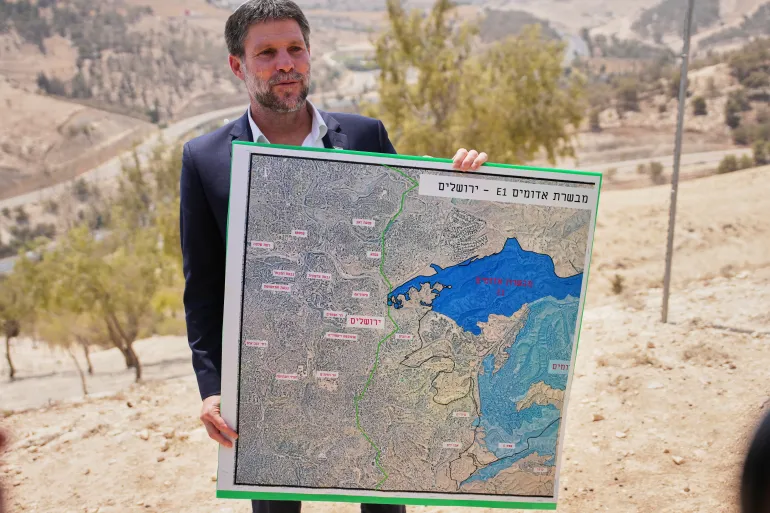
Since November 2024, the Higher Planning Council has been holding weekly sessions to promote settlement activity, reflecting an unprecedented escalation campaign. At the beginning of July 2025, the Council discussed approving the construction of 267 new settlement units in the settlements of Ganei Modi’in and Ma’ale Amos.
These plans include the construction of 150 housing units in Ganei Modi’in, located outside the separation wall—an unprecedented move that entrenches the reality of de facto annexation of occupied Palestinian lands west of the wall. This project, originally conceived more than two decades ago, was revived after the formation of the current Israeli government and is now on the verge of receiving final approval, which would amount to an official recognition of construction outside the wall as part of a systematic expansionist strategy.
On 16 July 2025, the Higher Planning Council advanced plans for the construction of 567 new settlement units in Givat Ze’ev and Beitar Illit, in addition to reopening discussions on a plan for 464 new housing units in the settlement of Talmon. On 30 July 2025, the Council also discussed a project to demolish and rebuild 350 housing units on the western side of an unspecified settlement.
During the reporting period, 59 new settlement outposts were established, most of them so-called “grazing outposts” used as tools to impose control over Palestinian lands. This figure represents an unprecedented surge compared to the historical annual average of no more than seven outposts per year between 1996 and 2022.
Land Confiscation and Bulldozing
The occupation authorities continue to confiscate Palestinian land under various pretexts. During July 2025:
– The occupation confiscated a 1.5-dunum plot of land in Khirbet al-Hadidiya in the northern Jordan Valley for the purpose of digging a water well.
– An order was issued to seize 7 dunums from the village of Jinsafut in Qalqilya Governorate, for the expansion and construction of a new military road serving the settlements of Ramat Gilad and Neve Menachem.
– On 8 July, the occupation issued a new military order to confiscate 5.7 dunums of land from the town of Al-Khader, southwest of Bethlehem, under the pretext of “security purposes.” This measure is part of a series of Israeli military orders targeting lands across the West Bank in the context of a systematic settlement expansion policy designed to impose new realities on the ground.
In addition, occupation forces and settlers cut down and destroyed 2,939 trees, most of them olive trees.
It should be noted that more than 90% of the Jordan Valley’s land area is classified by the occupation as “state land,” “nature reserves,” or “military zones”—designations deliberately used to deprive Palestinians of their right to the land.
Forced Displacement and Demolition of Homes and Structures
The first half of 2025 witnessed a sharp escalation in forced displacement resulting from demolitions carried out by the occupation authorities under the pretext of lack of building permits in Area C.
– Between 1 January and 28 July, 840 Palestinian structures were demolished, leading to the displacement of 807 people, including more than 400 children. This marks a significant increase compared to the same period in 2024, when 581 structures were demolished and 308 people displaced, and compared to 2023, when 414 structures were demolished and 546 individuals displaced.
– In Jerusalem, the UN Office for the Coordination of Humanitarian Affairs (OCHA) documented the demolition of 118 structures during the same period, under the pretext of lacking building permits, resulting in the displacement of 355 Palestinians, including 178 children. Notably, 63% of these demolitions (74 structures) were carried out by the owners themselves—sometimes with partial involvement of Israeli authorities—in order to avoid heavy fines.
– Since January 2023, the average monthly displacement of Palestinians in East Jerusalem due to demolitions for lack of permits has risen to 51 people per month, compared with 29 per month between 2019–2022, and 15 per month between 2009–2018. This reflects a rapidly deteriorating situation and a sharp increase in forced displacement.
– During the reporting period, occupation bulldozers demolished 59 homes and 46 other structures.
At the same time, settler groups—backed politically and militarily by the occupation authorities—intensified campaigns of forcible transfer against Bedouin communities in the occupied West Bank, particularly in the governorates of Hebron and Ramallah. According to a study by the Israeli organization Bimkom, 38 Bedouin communities were completely displaced from their areas of residence, while others were partially targeted, with several families forcibly uprooted.
The northern and central Jordan Valley have witnessed a dangerous escalation of settler attacks since early 2023, as part of a systematic plan to impose new realities on the ground. Over 30 cases of forcible displacement of families in the northern Jordan Valley were documented within a single year, in addition to the displacement of 29 other Bedouin communities across the West Bank since October 2023.
In Nur Shams Refugee Camp (Tulkarm), the occupation authorities issued a military order on 27 July 2025, declaring the wooded area surrounding the camp a closed military zone until 31 October 2025.
Settler Attacks and Violations
In recent years, there has been a sharp escalation in settler violations across the occupied West Bank, coinciding with Israel’s ongoing war on the Gaza Strip. In 2023, a total of 2,400 documented settler attacks were recorded, while the first half of 2024 witnessed an additional 1,250 incidents. During the reporting month alone, 465 settler assaults on Palestinian civilians and their property were documented.
These attacks included the storming and cultivation of Palestinian agricultural lands in attempts to seize control, the destruction of crops and trees, systematic assaults on Palestinian villages and towns, live fire directed at homes, the burning of vehicles, and the theft or confiscation of private property.
Settler violations have increased dramatically, from 579 incidents in 2020 to 1,444 incidents by the end of June 2025. Between January and June 2025 alone, more than 1,400 settler attacks were documented.
Among the most serious incidents was the killing of activist ‘Odeh al-Hathaleen on 29 July, when a settler opened fire on him in the village of Umm al-Khair, south of Hebron, as he attempted to stop settlers from bulldozing land near local homes. Another Palestinian was critically injured when he and other residents were deliberately run over by a bulldozer.
This assault is part of a consistent pattern of organized settler harassment targeting the village’s roughly 200 residents, who were forcibly displaced from the Naqab (Negev) in 1948 and resettled in Masafer Yatta. The occupation authorities later established the settlement of Karmel after declaring nearly 4,000 dunams of the area’s land as so-called “state land.”
Violation of the Status Quo at the Ibrahimi Mosque
During this month, Israeli Minister of Security Itamar Ben-Gvir, a far-right extremist issued a unilateral decision transferring the authority to administer the Ibrahimi Mosque to the Israeli authorities under the pretext of carrying out renovation works at the site. Pursuant to this decision, the occupation authorities will be able to implement structural changes in the mosque without any Palestinian coordination or approval. This constitutes a violation of international agreements that oblige Israel to preserve the status quo at the holy site.
The escalating settlement activity in the West Bank and Jerusalem represents a flagrant violation of international law and is designed to alter the demographic and geographic reality in the occupied territories. The construction of settlement units beyond the separation wall, systematic land confiscation, house demolitions, and the increasing settler attacks carried out with the backing of the occupation authorities, are all components of a deliberate strategy to annex Palestinian land and undermine any future solution based on the two-state principle, while depriving Palestinians of their fundamental rights to their land and property. The Union for Justice strongly condemns these grave and ongoing violations committed by the Israeli occupation authorities against the Palestinian people. We call upon the international community and all international judicial bodies to assume their responsibilities to put an end to these crimes, hold the perpetrators accountable, and guarantee the Palestinian people’s right to live in dignity and freedom on their land. A just and lasting peace cannot be achieved without ending the occupation and ensuring justice for the victims of these violations.
