As Winter Approaches…
International Calls to Facilitate the Entry of Aid and Medical Supplies into the Gaza Strip
16/11/2026 – Union for Justice Foundation
The Union for Justice Foundation has been following humanitarian and health developments in the Gaza Strip amid the continued restrictions on the entry of aid and the worsening humanitarian needs as winter approaches. This comes in light of international warnings and calls for facilitating the delivery of humanitarian and medical supplies to the Strip and protecting healthcare facilities and humanitarian workers.
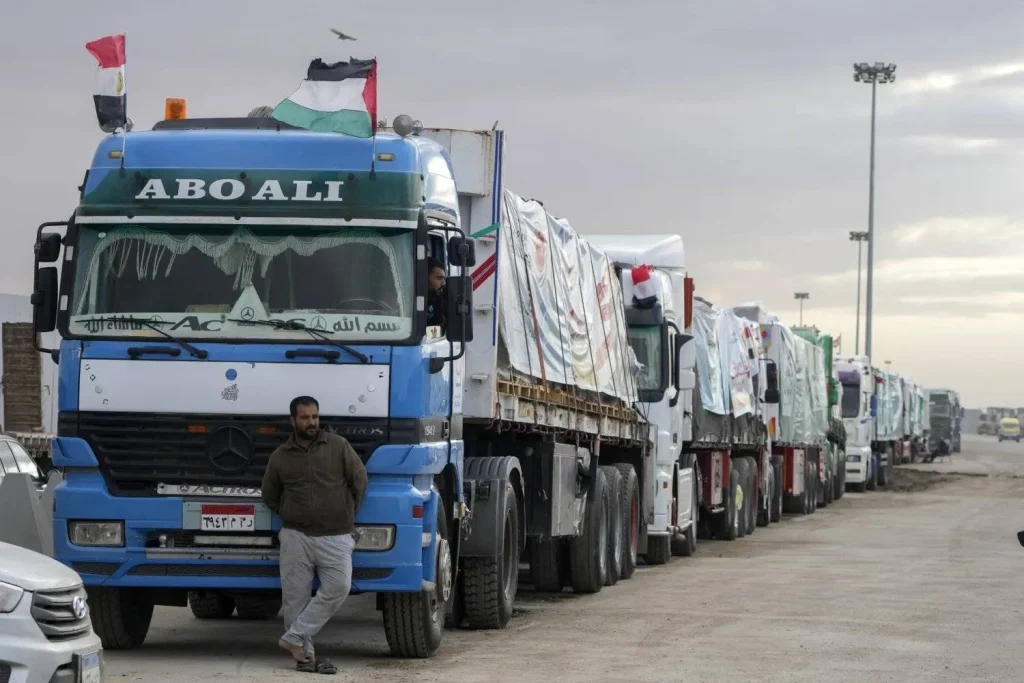
In this context, 53 countries and organizations called on the Israeli government to allow humanitarian aid to reach all parts of the Gaza Strip rapidly and without obstruction, through the available crossings and land routes, warning of a further deterioration in humanitarian and health conditions with the arrival of winter.
This came in a statement read by the United Kingdom’s Permanent Representative to the United Nations, Sarah Mackintosh, on behalf of the countries and organizations that joined the Call to Action on Health and Humanitarian Access to the Gaza Strip, led by the United Kingdom, Qatar, and Jordan.
Speaking during a briefing to journalists outside the Security Council chamber, Mackintosh said that a very large number of Gaza’s residents still lack adequate shelter as winter approaches, exposing them to the risks of hypothermia, respiratory infections, waterborne diseases, and other preventable illnesses.
She warned that restrictions on the entry of essential shelter materials and other life-saving supplies are hindering humanitarian organizations’ ability to respond on the scale required.
In the presence of representatives of the participating countries, she added that the comprehensive peace plan, endorsed by Security Council Resolution 2803, stipulates the immediate entry of full humanitarian aid into Gaza at levels no lower than those agreed upon on 19 January 2025, stressing that this has yet to be achieved.
International Calls to Facilitate the Humanitarian Response
The call issued by the 53 countries and organizations included a set of demands aimed at improving humanitarian access and strengthening the response to the escalating needs in the Strip. The most prominent demands were:
-Ensuring the full and stable operation of the Egyptian and Jordanian humanitarian corridors.
-Approving the entry of additional essential materials, including items classified as “dual-use” materials, particularly those related to shelter, fuel, water, sanitation, and healthcare supplies, in order to prevent further deterioration in public health.
-Reactivating the medical referral pathway to hospitals in East Jerusalem and the West Bank for patients and injured people whose conditions cannot be adequately treated inside Gaza.
-Ensuring the protection of healthcare workers, healthcare facilities, and medical transport.
-Protecting reported humanitarian sites and ensuring the safety of humanitarian and civilian personnel and infrastructure.
-Opening transparent and urgent criminal investigations into attacks targeting workers in the healthcare and humanitarian sectors.
-Allowing high-level international delegations and journalists access to the Gaza Strip.
The British Ambassador reaffirmed the participating countries’ commitment to supporting humanitarian efforts in Gaza by assisting with urgent preparations to address the challenges of the winter season.
She also reiterated the vital role of the United Nations and its agencies, the International Federation of Red Cross and Red Crescent Societies, and other neutral international humanitarian organizations in delivering humanitarian assistance, in accordance with Security Council Resolution 2803.
Shelling of Nasser Medical Complex Leaves Dead and Injured
In a related development, the World Health Organization said that the surgical department at Nasser Medical Complex was shelled in the early morning hours of Thursday, resulting in the deaths of six people, including a healthcare worker, patients, and their companions, and injuring at least 27 others.
The organization reported that accounts indicated that the surgical department had sustained extensive damage, describing the shelling as another deadly attack on the healthcare sector in Gaza.
It added that reports indicated damage to other floors of the hospital, including the operating rooms, recovery unit, and intensive care unit, noting that assessments of the full extent of the damage were still underway.
The organization recalled that since October 2023, it has documented 1,056 attacks on healthcare facilities in Gaza, resulting in the deaths of 1,010 people and the injury of another 1,725.
World Health Organization: Health Needs Remain Enormous
The World Health Organization warned that health needs in the Gaza Strip remain enormous and are expected to increase with the arrival of winter. It renewed its call for humanitarian aid to be allowed in without obstruction and for the entry of additional medical and humanitarian supplies into the Strip to be facilitated.
The organization’s Director-General, Dr. Tedros Adhanom Ghebreyesus, stressed that healthcare facilities in Gaza are a lifeline for the population and must be protected and never used for military purposes or subjected to attacks. He emphasized that peace is the best medicine.
United Nations Warns of the Consequences of Continued Violence
For his part, the Officer-in-Charge of the United Nations Special Coordinator for the Middle East Peace Process, Ramiz Alakbarov, expressed deep concern over the Israeli airstrike on Nasser Medical Complex.
Alakbarov recalled that international humanitarian law obliges all parties to respect and protect medical personnel and healthcare facilities, including hospitals, which must not be targeted or used for military purposes.
He noted that continued violence and the recent escalation of military operations are exacerbating the immense humanitarian suffering in Gaza and threatening the increasingly fragile ceasefire agreement.
He renewed his call for humanitarian aid to be allowed in rapidly, safely, and without obstruction, including the entry of durable shelter materials and winter supplies, in order to alleviate the suffering of residents as the coldest months approach.
In a separate development, the United Nations Deputy Spokesperson, Farhan Haq, said that a strike had occurred near United Nations facilities in Deir al-Balah, where UN staff members are based, adding that all of them were confirmed to be safe.
Rainfall and Storms Worsen Humanitarian Conditions
Coinciding with these developments, the United Nations Office for the Coordination of Humanitarian Affairs (OCHA) reported that the United Nations and its partners continue to respond to the impact of storms and heavy rainfall that struck the Gaza Strip over the previous weekend.
The office explained that, as of Wednesday, UN partners had provided tents, plastic sheeting, blankets, and other essential supplies to approximately 1,800 families. This represents around one-third of the 5,200 families whose urgent needs had been assessed.
It added that partners had also worked to drain standing water and clean sewage channels and affected areas. However, these efforts represent only the beginning of the rainy season, which is expected to continue for several months.
Across the Gaza Strip, families face the risk of exposure to stagnant water contaminated with sewage, as a result of damage to sewage networks in displacement sites and low-lying areas.
OCHA warned that available water pumps, sandbags, and other materials and equipment are insufficient to meet all needs. It also pointed to the continued prevention of the entry of laboratory supplies and essential medical equipment, which is hindering the early detection of disease outbreaks and the response to them—a risk that increases significantly during the winter.
The Union for Justice Foundation affirms that these developments reflect the scale of the humanitarian and health challenges facing the residents of the Gaza Strip, amid damage to healthcare facilities and infrastructure and shortages of essential supplies. They underscore the need to ensure the delivery of humanitarian and medical aid without restrictions or obstruction, and to provide protection for healthcare facilities and humanitarian workers, in order to meet the population’s basic needs and alleviate their suffering, particularly as winter approaches.
