27/6/2026 – Union for Justice Foundation
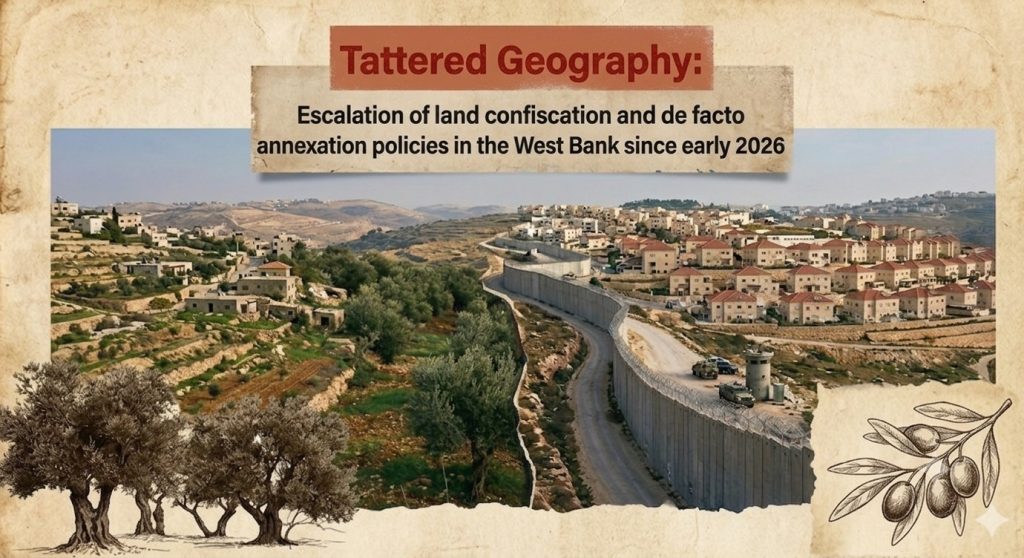
The Union for Justice Foundation stated that the first months of 2026 have witnessed an unprecedented escalation in the pace of Palestinian land confiscation across the West Bank through a complex network of military orders and official declarations under which thousands of dunums of privately owned and common lands have been converted into so-called “State Land” or “Closed Military Zones.” This systematic expansion represents a new peak in the policy of gradually appropriating Palestinian geographical space and fragmenting the territorial continuity between governorates. At this stage, the Israeli authorities are treating the entire West Bank as an open arena for settlement expansion, without regard for the previous administrative divisions. The traditional distinctions between Areas A, B, and C, established under the political agreements, have effectively been erased. The current policy is based on extending military and civil authority into the heart of cities and towns that are administratively under full Palestinian control, transforming any geographical area into a direct target for seizure, annexation, and settlement-related urban and security expansion, thereby completely eliminating any legal status previously enjoyed by those areas.
When examining the geographical distribution and the scale of land confiscated since the beginning of this year, it becomes evident that Jericho and the Jordan Valley Governorate has been subjected to the largest and most dangerous confiscation schemes. Israeli authorities declared more than 11,000 dunums in the Al-Auja area and its surroundings as State Land, making it the largest single declaration of its kind in decades. The primary objective is to secure absolute control over the Jordan Valley corridor and completely isolate the West Bank from its eastern border. It was followed by Nablus Governorate, particularly the southern and eastern villages of Aqraba, Beita, Majdal Bani Fadel, and Qaryut, where military orders confiscated approximately 3,500 dunums under the pretext of “urgent military purposes” and expanding the sphere of influence of surrounding settlements such as Eli, Shilo, and Itamar, depriving farmers of access to the olive groves that constitute their principal source of livelihood.
The central and southern governorates of the West Bank were likewise not spared this wave of confiscation. In Ramallah and Al-Bireh Governorate, confiscations were concentrated in the lands of the villages of Ni’lin and Deir Qaddis, in addition to extensive areas surrounding the settlement of Beit El and the northern parts of the governorate. Approximately 2,200 dunums were targeted there, with large portions allocated for the construction of alternative settlement roads and security buffer zones. In Bethlehem Governorate, approximately 1,700 dunums were confiscated from the lands of Al-Khader, Battir, and Nahalin to complete the Greater Jerusalem plan and connect the Gush Etzion settlement bloc to Jerusalem, directly threatening sites inscribed on the World Heritage List. In Hebron Governorate, operations were concentrated in Masafer Yatta and the eastern parts of the city, where more than 1,900 dunums were seized under direct military orders to expand pastoral settlement outposts and the security zones surrounding settlements established on Palestinian-owned land.
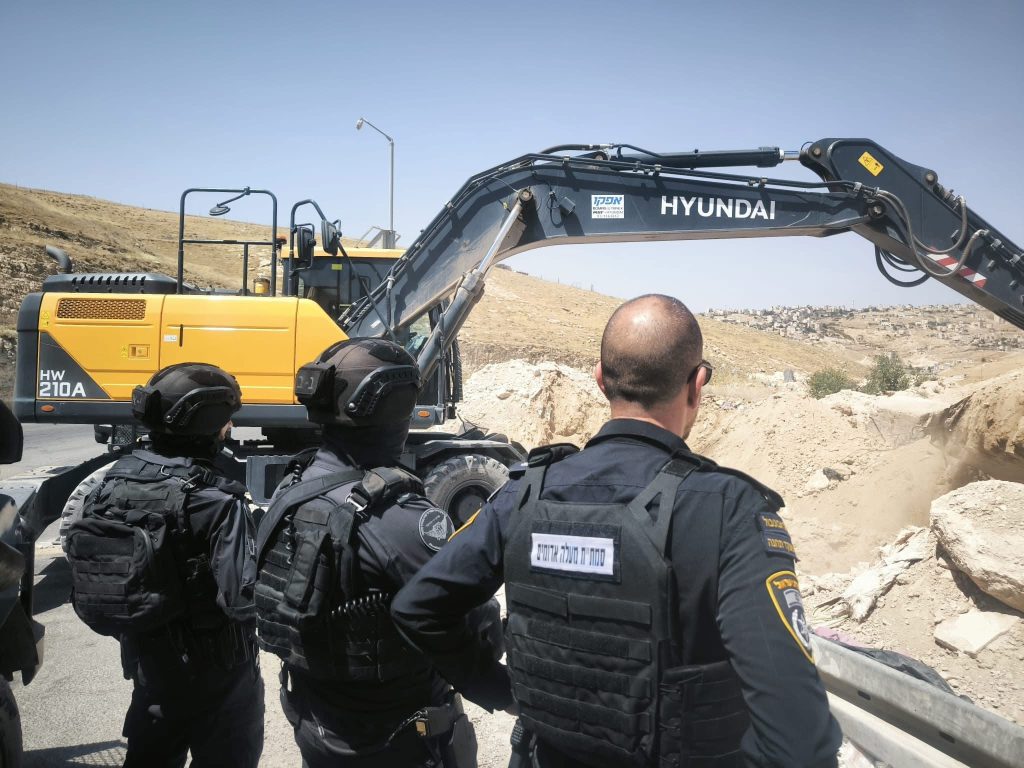
This comprehensive policy has also extended to the northernmost part of the West Bank in Jenin Governorate, where confiscation orders targeted seven dunums of strategically important land adjacent to the city and its surroundings. Although modest in size compared with other confiscated areas, the significance of these lands lies in their strategic location, which is being used to reinforce the Israeli military presence, tighten control over the governorate’s main entrances, and impose a security belt that obstructs commercial movement and the natural urban expansion of local communities. This constitutes a clear example of the abandonment of previous land classifications, as land in Jenin is now being targeted despite its former security and civil status.
With regard to Closed Military Zones, this legal and military instrument has been activated extensively since the beginning of the year to prevent any Palestinian presence in areas designated for confiscation. Military orders have converted more than 8,500 dunums in the foothills of the southern Hebron Mountains and the northern Jordan Valley into “Firing Zones” and closed military training areas. These orders entail the forced displacement of Bedouin and pastoral communities and prohibit all agricultural and construction activities within those areas. Similar orders have also been applied to areas surrounding the Separation Wall and major settlements, where hundreds of dunums in the vicinity of Salfit, Tulkarm, and Qalqilya have been designated as closed military zones. Their Palestinian owners are prohibited from entering them except through rare and special permits, thereby paving the legal way for their future incorporation into settlements after they are deemed “uncultivated” for prolonged periods due to the systematic military prohibition on access.
The Union for Justice Foundation affirms that these practices constitute a clear and flagrant violation of Article 49 of the Fourth Geneva Convention, which prohibits the occupying power from transferring parts of its own civilian population into the territory it occupies. They also violate Article 53 of the same Convention, which prohibits the destruction of private or public property unless such destruction is rendered absolutely necessary by military operations. The conversion of thousands of dunums into “State Land” and their allocation for settlements and military installations violates the fundamental principle of the inadmissibility of the acquisition of territory by force and exceeds the temporary powers granted to a belligerent occupation under the 1907 Hague Regulations, which require the occupying power to preserve the existing situation and administer public property solely as a usufructuary, without altering its geographical or demographic character. Consequently, these large-scale confiscations amount to war crimes under the Rome Statute of the International Criminal Court.
In light of this grave legal and humanitarian deterioration, the Union for Justice Foundation issues an urgent appeal to the international community, the United Nations, and the High Contracting Parties to the Geneva Conventions to move beyond verbal condemnation and adopt effective measures that compel the occupying power to halt these plans immediately. The Foundation further calls upon the international community to activate international accountability mechanisms by supporting the ongoing investigations before the International Criminal Court, imposing economic and diplomatic sanctions on Israeli institutions and companies that contribute to financing and expanding settlements, and prohibiting the importation of products originating from settlements established on confiscated land. The Foundation also urges international bodies to work collectively to provide urgent international protection for the Palestinian people and their property and to compel the occupying power to comply with relevant United Nations resolutions, foremost among them Security Council Resolution 2334, as well as the advisory opinion of the International Court of Justice, which affirms the illegality of the settlement presence in the occupied Palestinian territory and the obligation to dismantle it together with all of its consequences.
End
