
3/3/2026 – Union for Justice Foundation
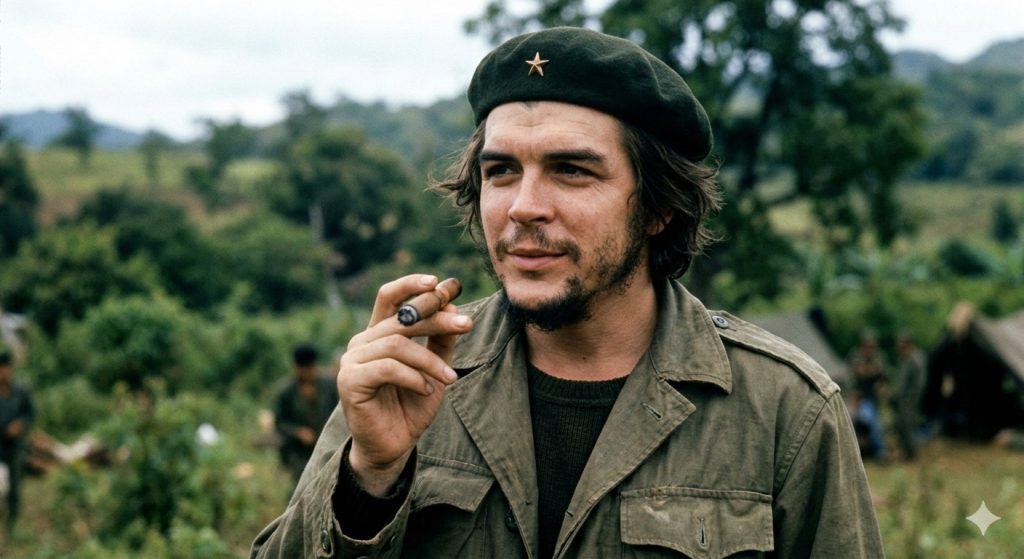
In the course of modern history, rarely has a person transformed into both a visual and intellectual symbol as happened with Che Guevara. He was not merely a military or political leader; he became a global image of rebellion, a face engraved in the memory of revolutionary movements around the world. His name became associated with the Cuban Revolution, with the struggle against imperialism, and with the idea of social justice that transcends the boundaries of states and continents. Che was not simply a man who bore arms; he was a visionary thinker who believed that social injustice cannot be remedied through partial reform, but through radical change.
Guevara embodied the model of the revolutionary who rejects half-measures and who saw in revolution a means to redistribute power and wealth, and to build a more equal society. Between admiration and criticism, his name has remained present in political and intellectual debates to this day.
Upbringing and Early Beginnings: The Formation of an Early Revolutionary Consciousness
Che Guevara, who was born as Ernesto Guevara in 1928 in Argentina, was not at the outset a revolutionary bearing arms, but a young man who studied medicine and sought to understand human suffering from a scientific and humanitarian perspective. He grew up in an educated family with progressive political inclinations, which allowed him early exposure to literature and political thought, and contributed to shaping his critical awareness. Despite his chronic suffering from asthma since childhood, he was known for his spirit of challenge and adventure, which drove him to undertake long journeys across Latin America during his university years there. He did not only witness physical illness; he saw with his own eyes extreme poverty, exploitation, and sharp social inequality between classes. These field experiences were the spark that moved him from studying the treatment of individuals to thinking about the treatment of societies, and from the medical profession to the path of revolution. Thus, his political consciousness gradually took shape until he became one of the most prominent symbols of rebellion in the twentieth century, and a global image of revolution in the face of imperialism and social injustice.
From Doctor to Revolutionary: The Intellectual and Political Transformation
Che Guevara’s transition from studying medicine to revolutionary activism was not a passing decision, but the result of an intellectual path shaped by direct experience. During his travels in Latin America, he witnessed poverty, exploitation, and class disparity, and realized that people’s suffering was not merely individual cases requiring medical treatment, but the product of an unjust political and economic system. From here, he began to see that the remedy for real pain does not lie in prescribing medicine, but in changing the conditions that produce social injustice.
He was influenced by Marxist thought, and considered that social justice requires radical change in the structure of power and the economy, not superficial reforms. Thus, he transformed from a doctor seeking to treat individuals into a revolutionary who believed in the necessity of rebuilding society on more equal foundations. He saw in revolution a means to achieve human dignity, believing that defending justice may require confronting the existing order with full courage.
The Cuban Revolution: A Moment of Historical Transformation
Che Guevara joined Fidel Castro and the 26th of July Movement, and participated in the armed struggle against the Batista regime in Cuba. He played a pivotal role in the battles that led to the victory of the revolution in 1959. He was not merely a fighter, but a military commander characterized by strict discipline and deep faith in the revolution’s objectives.
After the revolution’s victory, he assumed governmental positions, including the presidency of the Central Bank and the Ministry of Industry, and sought to implement his economic vision based on social justice and the abolition of class privileges. However, his experience in governance revealed the significant challenges facing the transformation of revolutionary ideas into practical policies.
Revolutionary Thought: Social Justice and Anti-Imperialism
Che Guevara was not merely a fighter on the battlefield, but the proponent of an integrated intellectual project that sought to redefine the concept of revolution in the twentieth century. He wrote about guerrilla warfare as a political tool before being a military one, and believed that a small group of organized fighters could ignite broad popular consciousness if the appropriate social conditions were present. He did not believe that revolution always requires a prior majority; rather, he saw that revolutionary action itself can create that majority.
He believed that revolution is not a local event confined within the borders of a particular state, but a global project aimed at dismantling the system of economic and political domination exercised by major powers over developing countries. In his view, social injustice was not isolated from imperialism, but a direct result of it, as economic dependency deepens poverty and entrenches inequality. From this perspective, Guevara became a global symbol of anti-imperialism, particularly in Latin America and Africa, where his ideas resonated with peoples who suffered from exploitation and external intervention.
The African Experience and the Attempt to Export the Revolution
Che Guevara did not confine himself to his role in the Cuban Revolution, but considered that its success should serve as a model capable of being replicated elsewhere. In the mid-1960s, he headed to the Congo to support a revolutionary movement there, believing that international solidarity was an essential part of the revolutionary project. However, the experience revealed to him the complexities of political and social realities, as he faced weak organization, internal divisions, and differing cultural contexts.
Although the experience did not achieve its objectives, it reflected his determination to turn revolution into a transnational project. He did not see failure as the end of the idea, but as a lesson in understanding the complexities of change. This stage demonstrated that exporting revolution is not merely the transfer of a model, but a process requiring deep understanding of local realities.
Bolivia: The End That Created the Legend
In 1967, Guevara moved to Bolivia, seeking to ignite a new revolutionary spark in the heart of South America. However, the conditions were not favorable; he faced political isolation, weak popular support, and intense military pursuit. After a series of limited confrontations, he was captured, and then executed on 9 October 1967 after a swift trial.
Yet his death did not end his presence; rather, it granted him a greater symbolic dimension. The image captured by the photographer Alberto Korda became one of the most famous photographs in the world, and turned into a global symbol of rebellion. Thus, his tragic end contributed to consolidating his image as a revolutionary legend that transcends the political event itself.
The Controversy Surrounding His Personality and Legacy
Che Guevara remains a controversial figure. For some, he is a symbol of social justice and sacrifice for principles; for others, he represents a model of armed revolutionary approach that led to bloody conflicts and political tensions. This controversy reflects the complex nature of his personality, which combined intellectual idealism with strict realism.
Despite differing assessments, his presence in global consciousness cannot be denied. He has become a cultural symbol that transcends the immediate political context, and his image has turned into an icon used to express rejection and protest, even by those who do not adopt his Marxist thought. The continued debate surrounding him confirms the depth of his impact on contemporary history.
The Global Legacy: Between Symbol and Reality
Che Guevara was not merely a leader in a fleeting revolutionary moment; he became a lasting symbol of the idea of radical change. He embodied the model of a person who chooses a difficult path in defense of his convictions, believing that justice is worth sacrifice. Yet his legacy remains linked to a persistent question: can social justice be achieved through armed revolution, or does the path to change pass through other means?
Whether we agree with his vision or disagree with it, Che Guevara remains one of the most influential figures of the twentieth century, and a global symbol of rebellion in the face of injustice. He left behind an intellectual and political legacy that continues to be the subject of debate, but in any case, it is an inseparable part of the history of revolutionary movements in the world.
End
