30 Demolition Operations Since the Beginning of April
23 April 2025 – Union for Justice
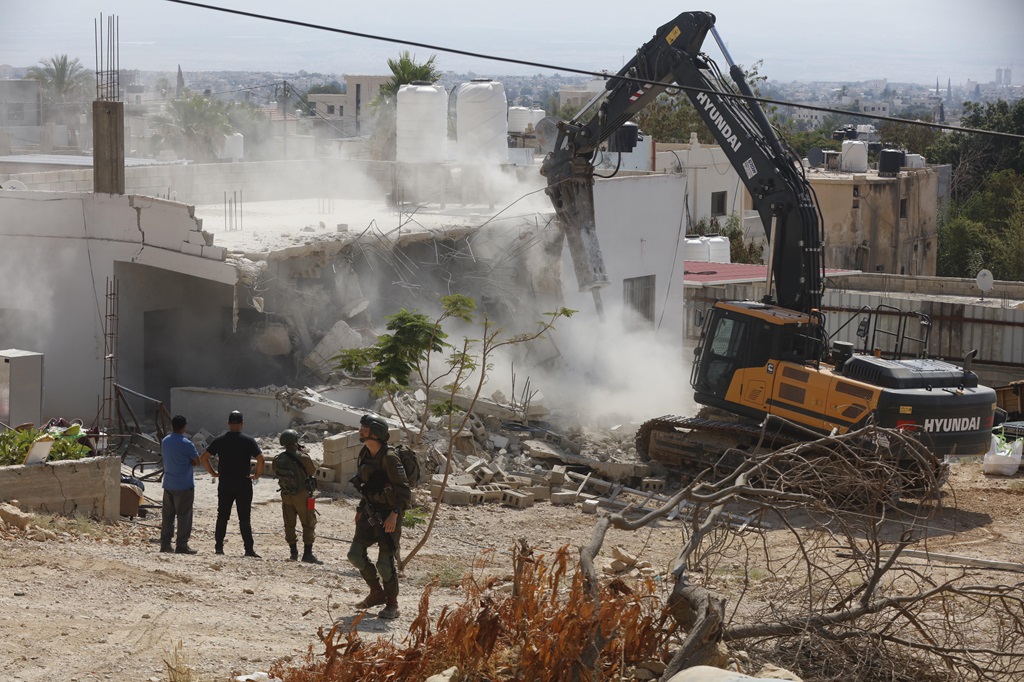
What the occupation once demolished in a month, it now demolishes in a single day; what it used to demolish in a year is now accomplished in a month. Such is the tragic scene of demolitions and destructions targeting Palestinian structures in the West Bank, amid an Israeli perception that it is acting with impunity and faces no form of international accountability.
Information collected by the Union for Justice indicates a continuous and significant increase in the Israeli army’s demolition and destruction of Palestinian homes and facilities in the West Bank. According to the Union for Justice, between 1 and 22 April of this year, Israeli forces conducted 30 demolition and destruction operations in the West Bank.
These demolitions were distributed as follows: 7 in the Jerusalem Governorate, 6 in Hebron, 3 in Tulkarm, 3 in Jenin, 3 in Ramallah, 2 in Salfit, 2 in Bethlehem, and 1 each in Nablus, Qalqilya, the Jordan Valley, and Tubas.
According to the Union for Justice, these demolitions affected multi-story buildings, commercial shops, tents, mobile homes, agricultural rooms, livestock pens, water reservoirs, and walls. Some structures had been standing for several years, while others were still under construction.
As a result, dozens of Palestinian families have been displaced from their homes and left homeless, in addition to suffering extensive financial and moral harm.
Human rights reports indicate that in March 2025 alone, the occupation authorities carried out 58 demolitions in the West Bank, affecting 87 structures, including 39 inhabited homes, 6 uninhabited homes, 26 agricultural facilities, and other properties. During the same period, 46 additional structures received demolition notices. Tulkarm Governorate recorded 20 notices, followed by Jenin with 8, Bethlehem with 6, and Hebron with 6 more.
Weak Pretexts and Justifications
The occupation often cites the pretext of “building without a permit” or “construction in Area C” to justify demolitions. In other cases, demolitions target Palestinian structures located near settlements or military sites belonging to the Israeli army.
On multiple occasions since the beginning of April, the Israeli army has carried out demolitions by means of explosives at the homes of martyrs or detainees who conducted operations against Israeli targets, under the guise of “punitive measures.” These demolitions and destructions have also been repeatedly conducted in Jenin, Tulkarm, and Nur Shams refugee camps in the northern West Bank for approximately three months.
Additionally, occupation authorities—particularly in Jerusalem—compel residents to demolish their own homes under the pretext of lacking permits. If they refuse, occupation bulldozers demolish the homes and impose steep financial penalties on the owners.
The Jerusalem municipality refuses to grant building permits to Palestinians and either demolishes their homes or compels them to do so themselves, in blatant contravention of international law.
The Union for Justice affirms that the escalating Israeli demolitions in the West Bank undermine Palestinian food security and aim to restrict building and natural growth in Palestinian towns and villages. The occupation also intends to displace Palestinians, rendering the West Bank uninhabitable and isolating them in confined enclaves, thereby providing a secure environment for Israeli settlements and enabling their extension and expansion.
The Union for Justice notes that the right to housing is protected under all national constitutions, laws, and international conventions and must not be violated. It further stresses that demolition operations constitute “war crimes” and “crimes against humanity,” punishable under international law. These demolitions represent among the most egregious violations and crimes, causing devastating repercussions for Palestinian livelihoods, their economy, and their children’s future.
End of Document
