Children Pay the Price: The Withholding of Clearance Revenues and Its Impact on Education and Health in Palestine
5/10/2026 – Union for Justice Foundation
The withholding of Palestinian clearance revenues and the deduction of portions of them by Israel constitutes one of the most prominent manifestations of the chronic financial crisis facing the Palestinian Authority. With the repetition and continuation of this measure, it has become a factor placing pressure on the ability of Palestinian public institutions to fulfill their basic obligations toward the civilian population. The repercussions of this policy are not limited to the financial aspect or to the government’s ability to manage its budget, but extend directly and indirectly to economic and social rights, foremost among them the right to education and the right to the enjoyment of the highest attainable standard of health.
Clearance revenues are one of the most important sources of public revenue for the Palestinian Authority and constitute a major resource for financing public expenditures, including employee salaries, the financing of vital sectors, and basic services. Therefore, the disruption of the transfer of these revenues or the deduction of portions of them has a cascading impact on the ability of public institutions to continue performing their functions, and exacerbates the economic and social vulnerability of the population, particularly groups that rely more heavily on public services.
Over the past years, Israel has continued to withhold clearance revenues or deduct portions of them based on various political and security justifications, including objections to certain areas of Palestinian expenditure, particularly allocations provided to prisoners, wounded persons, and their families. These measures have turned Palestinian public revenues into an instrument of political and financial pressure, at a time when resources allocated to public services are expected to remain separate from pressure measures that may have direct effects on the civilian population.
The Palestinian Authority has repeatedly demanded the release of the full clearance revenues without deductions, and has also called on international states and donor entities to intervene to mitigate the repercussions of the financial crisis. However, the continuation of the crisis has narrowed the room for maneuver available to public institutions and pushed the Palestinian government to take exceptional financial measures aimed at managing the severe liquidity shortage and limiting the widening deficit.
One of the most prominent manifestations of this crisis has been the partial payment of public employees’ salaries, which in some periods fell to extremely low levels. This directly affected the economic situation of families that depend on public employment. The impact of these measures has not remained confined to government employees, but has extended to broad sectors of the local economy as a result of reduced purchasing power, declining consumption, and the accumulation of obligations and debts, thereby increasing pressure on Palestinian families and their ability to meet their basic needs, including food, medicine, transportation, and education.
The crisis has also contributed to weakening domestic economic activity, as declining and irregular employee incomes lead to reduced demand for goods and services, affect small businesses and service providers, and increase levels of economic and social vulnerability. Thus, the public revenue crisis becomes a crisis with broad societal effects, extending beyond government institutions to families, children, workers, business owners, and the most vulnerable sectors.
Education Amid the Financial Crisis
The education sector is among the sectors most sensitive to financial crises, given its reliance on regular funding, salaries, and operational resources. With the beginning of the 2026–2027 academic year, Palestinian education faced financial repercussions that affected the regularity of the educational process, amid the salary crisis, scarce resources, and increased operational needs. The crisis led to exceptional arrangements regarding the working hours of teachers and education-sector workers, including reducing working days in some cases and delaying the regular start of classes. This raised serious concerns about schools’ ability to implement the educational plan and curricula on a regular basis. These measures should not be viewed merely as temporary administrative arrangements, as their continuation may lead to the accumulation of educational gaps that are difficult to compensate for, particularly among children in the basic education stages.
This issue is particularly important given the existence of other factors placing pressure on the Palestinian education system, including restrictions on freedom of movement, military checkpoints, road closures, and attacks affecting students and teachers in some areas, in addition to the security risks surrounding a number of Palestinian communities.
Taken together, these factors make it more difficult for students and teachers to reach schools and may lead to disruptions or reductions in school attendance. They may also prompt some families to keep their children at home out of concern for their safety. In areas exposed to settler attacks or pressures affecting the stability of residential communities, access to regular education becomes more complicated, increasing the risks of interruption of schooling and educational dropout.
From the perspective of children’s rights, these repercussions must not be treated as temporary economic losses. The right to education is closely linked to the child’s right to development, protection, and participation in society, and any prolonged disruption of the educational process may have lasting effects on children’s future and their social and economic opportunities.
Public Health Under Pressure from Funding Shortages
The health sector has likewise not been spared the repercussions of the financial crisis. Limited financial resources have increased pressure on public health institutions and affected their ability to provide medicines and medical supplies, attract specialized medical personnel, maintain vital equipment and devices, and ensure the continuity of health services at the required level.
The seriousness of these repercussions increases in light of the population’s growing health needs and the health system’s declining ability to respond to them. Shortages of medicines and medical consumables are not merely an administrative problem, but may become an issue that directly affects patients’ lives and safety, particularly patients who require continuous treatment or medicines that cannot be dispensed with.
Some marginalized and remote areas also face additional difficulties in accessing primary healthcare services and equipped medical facilities. Some patients, including children and older persons, are forced to travel long distances to access specialized services amid movement restrictions, difficulties in transportation, and deteriorating economic conditions for families.
This deterioration in health conditions is one of the direct and cumulative consequences of the financial crisis affecting public institutions, which has been exacerbated by the continued withholding of clearance revenues. However, assessing the health situation must also take into account other factors affecting the Palestinian health system, including restrictions on movement, damage to infrastructure, and growing humanitarian needs, making the financial crisis a central factor within a set of interconnected factors.
Children Facing the Consequences of the Crisis
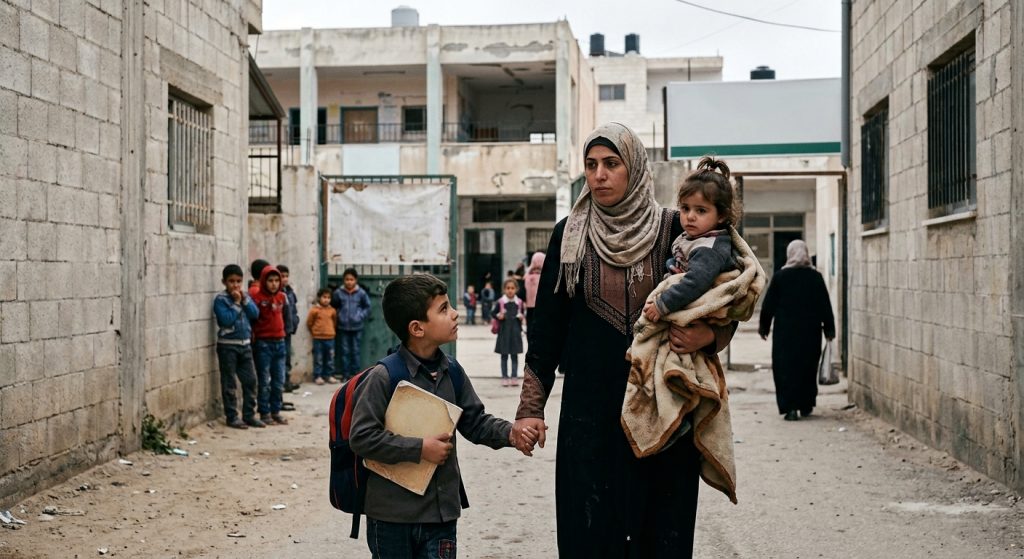
The most serious aspect of the financial crisis lies not only in the size of the deficit in the public budget, but in the transfer of the effects of this deficit into the daily lives of the population, foremost among them children. A child who does not receive regular education, faces difficulty accessing treatment or medicine, or lives in a family that has lost a significant portion of its purchasing power due to irregular income, indirectly bears the cost of a financial and political crisis that they had no role in creating.
Therefore, protecting children requires that they not be burdened with the consequences of political or financial measures taken by the parties to the conflict. The situation becomes even more serious when the effects of these measures accumulate across education, health, food, and social protection, potentially creating long-term effects on children’s physical, psychological, and educational development.
The continuation of economic and social pressures can also deepen families’ sense of instability, affect their ability to plan for their children’s future, increase levels of poverty and social vulnerability, and weaken society’s ability to provide a stable and safe environment for new generations.
Clearance Revenues Between Financial Obligation and Legal Responsibility
From the perspective of international human rights law, policies of withholding clearance revenues and their resulting effects raise serious concerns regarding the extent to which the economic and social rights of the civilian population are respected, particularly the right to education and the right to the enjoyment of the highest attainable standard of health.
The International Covenant on Economic, Social and Cultural Rights guarantees the right to education and the right to the enjoyment of the highest attainable standard of health. The Convention on the Rights of the Child also imposes specific obligations to protect children and ensure their best interests and fundamental rights. These rights do not mean that a state is required to achieve all outcomes immediately under all circumstances; however, it remains obligated to take appropriate measures, use the maximum of its available resources, ensure non-discrimination, and protect the most vulnerable groups.
The principle of the best interests of the child also requires that the protection of children and their rights be a fundamental consideration in decisions and policies affecting them. Accordingly, any economic or political measure that foreseeably results in depriving large numbers of children of education, healthcare, or basic needs must be seriously assessed from the perspective of human rights and international law.
In this context, the withholding of clearance revenues cannot be assessed separately from its practical consequences. The issue is not merely a financial dispute over the amount of revenues or the mechanism for transferring them, but also the impact of these measures on the ability of public institutions to provide essential services to the civilian population.
Characterizing this policy as collective punishment is a legal question that requires consideration of the nature, purpose, and effects of the measure and the circumstances surrounding it. Article 33 of the Fourth Geneva Convention prohibits collective penalties, and the prohibition includes punitive measures directed against persons because of acts they have not individually committed. Therefore, the mere existence of a collective effect is not, by itself, sufficient to establish the legal characterization of “collective punishment”; rather, it is necessary, among other elements, to examine whether the measure was adopted with the intent of punishing the population or collectively pressuring them because of acts for which they do not bear individual responsibility.
Accordingly, the continued withholding of revenues on which the financing of public services depends, if it is established that this is being used as a means of exerting pressure on the civilian population or collectively punishing them, may raise the issue of compatibility with the international prohibition of collective punishment, in addition to other obligations arising under international humanitarian law and human rights law. This assessment does not detract from the right of any state to take measures permitted by international law to address security risks, but it emphasizes at the same time that measures taken in the context of occupation or conflict cannot be separated from obligations concerning the protection of the civilian population and the prohibition against targeting them collectively.
Responsibility of the International Community
The continuation of the Palestinian financial crisis does not place responsibility solely on Palestinian institutions, but also imposes a responsibility on the international community to protect public order and basic services for the civilian population, in accordance with the rules of international law. Relevant states and international entities should work to ensure that the financial resources necessary to provide basic services to the civilian population are not used as a means of pressure that undermines their fundamental rights. Financial oversight and transparency mechanisms should also be strengthened, and access to resources for vital sectors, particularly health, education, and social protection, should be ensured.
At the same time, addressing the crisis should not be limited to providing temporary financial assistance to cover the deficit, but should instead address the structural causes that leave Palestinian public finances continuously vulnerable to political shocks and external measures. The withholding of Palestinian clearance revenues is no longer merely a financial issue, but has become part of a broader crisis affecting the ability of public institutions to provide basic services to the civilian population. The effects of this crisis are clearly visible in education and health, where funding shortages disrupt the educational process, increase pressure on healthcare personnel and institutions, and reduce the ability to provide necessary medicines, supplies, and services, while families and children bear a significant portion of the cost of this crisis.
From a human rights perspective, protecting fundamental rights should not stop at the limits of figures and budgets, but must include protecting people from the disproportionate effects of economic and political measures. This is particularly important when it concerns children, whose best interests and fundamental rights must be at the center of any policy or measure affecting their lives.
Accordingly, the continued withholding of clearance revenues requires serious legal and human rights consideration that takes into account the nature, objectives, and effects of the measure on the civilian population. If it is established that these funds are being withheld or deducted with the intent of exerting collective pressure on the population or punishing them for acts for which they do not bear individual responsibility, this raises a serious concern regarding the prohibition of collective punishment, in addition to the potential issues concerning economic and social rights and the rules applicable in the context of occupation.
The Union for Justice Foundation emphasizes that protecting the right to education, health, and a dignified life cannot be made dependent on political disputes or unilateral financial measures. Accordingly, the international community is called upon to take more effective steps to ensure the protection of the civilian population, work toward the release of Palestinian revenues due, and prevent their use in a manner that undermines basic services, while ensuring transparent and independent mechanisms for monitoring the management of public resources.
At its core, the issue is not merely a matter of money, but a matter of rights, lives, and the future of an entire society. Therefore, the continued use of public financial resources as an instrument of political pressure requires serious legal and human rights accountability and guarantees that the financial deficit does not become a means whose costs are borne by the health, education, and dignity of Palestinian children and families.
End
