

The E1 Settlement Project: Between Legal Characterization and Political Position in Light of the 2024 Advisory Opinion of the International Court of Justice
1 /9/ 2026 – Union for Justice Foundation
The E1 settlement project has once again brought to the forefront one of the most sensitive issues in the Palestinian-Israeli conflict, not only because of its political implications for the future of a negotiated settlement, but also because of the fundamental legal questions it raises concerning the rules governing belligerent occupation, the prohibition of settlement and annexation, the prohibition against acquiring territory by force, the right of the Palestinian people to self-determination, and the territorial integrity of the occupied territory.
The legal characterization of the project assumes even greater significance in light of the advisory opinion issued by the International Court of Justice (ICJ) on 19 July 2024 concerning the legal consequences arising from Israel’s policies and practices in the Occupied Palestinian Territory, including East Jerusalem. The opinion represented a significant development in clarifying the legal consequences arising from occupation, settlement, annexation, and the permanent exercise of control over occupied territory.
It is therefore necessary to distinguish between two matters that are often conflated: the legal characterization of the project under the rules of international law, and the political position regarding it in light of its impact on the Palestinian-Israeli conflict.
First: What Is the E1 Project? Clarifying the Term and Its Characterization
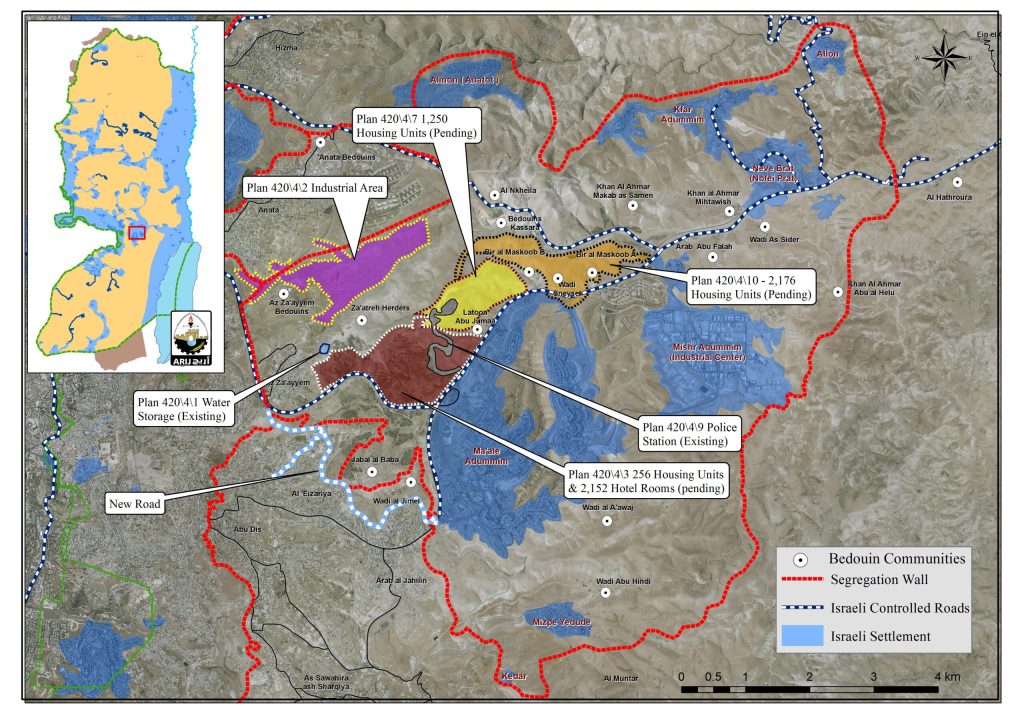
Strictly speaking, E1 is not an independent, stand-alone Israeli settlement. Rather, it is a settlement planning area located east of Jerusalem, in the area between occupied East Jerusalem and the settlement of Ma’ale Adumim.
Accordingly, the more precise academic and legal terminology is “the E1 settlement project” or “the settlement plan in the E1 area,” rather than “E1 settlement.”
During 2025, the Israeli authorities approved plans for approximately 3,401 settlement housing units in the area, with the stated objective of linking Ma’ale Adumim to occupied East Jerusalem. The United Nations has warned that implementation of the project would have a profound impact on the geographical contiguity between the northern and southern parts of the West Bank, as well as on the territorial connection between East Jerusalem, Ramallah, and Bethlehem. The significance of E1 therefore lies not merely in the number of housing units involved, but also in the project’s location and its broader territorial and demographic implications.
Second: The Legal Status of the Land on Which the Project Is Located
Under international law and the established position of the United Nations and the International Court of Justice, the area targeted by the project lies within the Palestinian territory occupied since 1967. Under international law, occupation does not transfer sovereignty over the territory to the occupying power. The authority exercised by an occupying power is temporary in nature and constrained by the law of occupation; it does not confer upon the occupying power a right to acquire sovereignty or permanently reshape the occupied territory for its own benefit.
In its 2024 advisory opinion, the International Court of Justice affirmed that occupation does not confer upon the occupying power a title to sovereignty over the occupied territory, and that any attempt to acquire sovereignty over such territory is contrary to the prohibition on the use of force and the resulting principle that territory may not be acquired by force.
Accordingly, the legal status of E1 is not determined by the designation or terminology used by the Israeli authorities in relation to the land, but rather by the objective status of the territory under international law, namely, as part of the Occupied Palestinian Territory.
Third: The E1 Project and the Fourth Geneva Convention of 1949
The Fourth Geneva Convention relative to the Protection of Civilian Persons in Time of War, dated 12 August 1949, constitutes one of the principal legal instruments governing the issue of settlements in occupied territory. Of particular relevance is Article 49(6), which provides that:
“The Occupying Power shall not deport or transfer parts of its own civilian population into the territory it occupies.”
This provision is directly relevant to the E1 project, as the establishment of residential units intended to facilitate the transfer and settlement of civilians belonging to the occupying power within occupied territory falls within the scope of the prohibition established by Article 49(6).
The International Court of Justice addressed this issue in its 2024 advisory opinion, affirming that Israel’s transfer of settlers to the West Bank and East Jerusalem, as well as its maintenance of their presence there, is contrary to Article 49(6) of the Fourth Geneva Convention. Importantly, the Court clarified that the prohibition does not require the transfer of the occupying State’s civilian population to be carried out by physical force. In other words, measures by which the State encourages its civilian population, and provides infrastructure and incentives facilitating their relocation to occupied territory, fall within the scope of the issue addressed by Article 49(6).
If, moreover, implementation of the project is accompanied by the displacement of Palestinians from the area, Article 49(1) would also become relevant, as it prohibits the forcible transfer of protected persons, whether individually or collectively.
In 2024, the Court considered that forcible transfer is not limited to the direct use of physical force; it may also occur where the conditions imposed upon a population create a situation in which individuals are left with no genuine choice other than to leave.
This issue is particularly significant with regard to Palestinian Bedouin communities in the vicinity of E1, including Khan al-Ahmar. In May 2026, the Office of the United Nations High Commissioner for Human Rights warned of the risk of forcible transfer associated with eviction and settlement expansion in the area.
Fourth: The 1907 Hague Regulations and the Principle of Temporary Administration of Occupied Territory
The administration of occupied territory is also governed by the rules set forth in the Hague Regulations annexed to the Fourth Hague Convention respecting the Laws and Customs of War on Land, dated 18 October 1907. Three provisions are of particular relevance:
Article 43: Requires the occupying power to respect the laws in force in the occupied territory unless absolutely prevented from doing so.
Article 46: Requires respect for private property and expressly provides that private property may not be confiscated.
Article 55: Treats the occupying power merely as an administrator and usufructuary of public buildings, real estate, forests, and agricultural estates belonging to the State in the occupied territory, requiring it to safeguard the capital of such properties and administer them in accordance with the rules of usufruct.
These provisions establish a fundamental principle: occupation constitutes temporary administration; it does not confer sovereignty or a basis for permanent ownership.
In 2024, the International Court of Justice concluded that Israel’s policies concerning land, including the confiscation or appropriation of extensive areas for the purpose of expanding settlements in the West Bank and East Jerusalem, are inconsistent with Articles 46, 52, and 55 of the Hague Regulations.
Fifth: E1 and Settlement Activity in Light of Security Council Resolution 2334 (2016)
United Nations Security Council Resolution 2334, adopted on 23 December 2016, is of particular importance in this context. The Security Council affirmed that the establishment by Israel of settlements in the Palestinian territory occupied since 1967, including East Jerusalem:
“has no legal validity and constitutes a flagrant violation under international law.”
The Council called upon Israel to immediately and completely cease all settlement activities. It further affirmed that it would not recognize any changes to the 4 June 1967 lines, including with regard to Jerusalem, other than those agreed upon by the parties through negotiations.
Accordingly, from a legal perspective, E1 does not constitute a case separate from the broader legal regime governing Israeli settlements, even though its location gives it exceptional geopolitical significance.
Sixth: The Most Significant Development — The 2024 Advisory Opinion of the International Court of Justice
The significance of the advisory opinion issued by the International Court of Justice on 19 July 2024 lies in the fact that it went beyond reaffirming the illegality of Israeli settlements. It addressed the broader legal framework governing occupation, settlement, annexation, and the permanent exercise of control over occupied territory.
1. The Settlements and the Regime Associated with Them Are Unlawful
The Court affirmed that the Israeli settlements in the West Bank and East Jerusalem, as well as the regime associated with them, have been established and are being maintained in violation of international law. As a matter of legal principle, this conclusion applies to the E1 project insofar as it constitutes a project for establishing and expanding an Israeli civilian settlement presence within occupied territory.
2. Permanent Control and De Facto Annexation
The Court went further, examining whether Israel’s policies extend beyond the administration of occupation to the imposition of permanent control over the territory. It found that settlement activity and the infrastructure associated with it, the wall, the exploitation of natural resources, the extension of Israeli law, and other measures serve to entrench Israeli control, particularly in East Jerusalem and Area C.
The Court considered that these policies are designed to remain in place indefinitely and to produce effects that are difficult to reverse, and concluded that they amount to the annexation of large parts of the Occupied Palestinian Territory.
This is where the significance of E1 becomes particularly apparent: the legal issue is not merely the construction of residential units. Rather, the project must be assessed in light of its impact on the entrenchment of permanent control and the reshaping of the occupied territory.
3. The Right of the Palestinian People to Self-Determination
The Court affirmed that the right of the Palestinian people to self-determination is a fundamental right and that, in the context of foreign occupation, it has a peremptory character under international law. The Court also linked self-determination with the territorial integrity of the Palestinian people, thereby protecting that right against measures that result in the fragmentation of the population and undermine the unity of the territory over which the right to self-determination is exercised.
The location of E1 therefore assumes considerable legal significance, and not merely political significance, because the United Nations has warned that implementation of the project would sever territorial contiguity between the northern and southern parts of the West Bank and seriously affect the territorial continuity of the Occupied Palestinian Territory. Accordingly, the project’s effects may also be examined from the perspective of their impact on the territorial integrity associated with the right to self-determination.
4. The Illegality of the Continued Israeli Presence
Among the most significant findings of the 2024 advisory opinion is that the Court did not confine itself to declaring certain individual practices unlawful. It concluded that violations relating to the prohibition against acquiring territory by force and the right of the Palestinian people to self-determination, together with annexation and the imposition of permanent control, render Israel’s continued presence as an occupying power in the Occupied Palestinian Territory unlawful.
The Court emphasized that the illegality concerns the Occupied Palestinian Territory as a whole, namely the territory occupied by Israel in 1967, rather than merely separate parts of it. The Court determined that Israel is under an obligation to bring to an end its unlawful presence in the Occupied Palestinian Territory as rapidly as possible.
5. Obligations Relating to Settlements
By a majority of fourteen judges to one, the Court determined that Israel is under an obligation:
“to cease immediately all new settlement activities, and to evacuate all settlers from the Occupied Palestinian Territory.”
The Court also found an obligation to provide full reparation for the injury caused by internationally wrongful acts and explained that restitution includes, inter alia, the restitution of land and property confiscated and the evacuation of settlers.
This conclusion places the establishment of new settlement units in E1 in direct conflict with the obligation identified by the Court to cease all new settlement activities.
Seventh: E1 Between De Facto Annexation and Permanent Alteration of the Territory
A degree of academic precision is essential here. It would not be legally accurate to state automatically that “E1 itself constitutes annexation” merely because there is a plan to construct housing units there. A more accurate formulation is that the project may constitute an element or instrument within a broader policy aimed at entrenching permanent control and effecting de facto annexation, particularly when considered together with the network of settlements, roads, infrastructure, and other administrative and territorial measures.
This characterization is more consistent with the approach adopted by the International Court of Justice in 2024, which examined the cumulative effect of policies and practices rather than treating an individual construction project in isolation from its broader context.
In August 2025, the Office of the United Nations High Commissioner for Human Rights characterized the final approval of the E1 plan as another unlawful step toward entrenching the annexation of the occupied West Bank, including East Jerusalem.
Eighth: The Distinction Between Legal Characterization and Political Position
This distinction is essential to avoid conflating law and politics.
Legal characterization: When we state that the establishment of Israeli settlements and the transfer of Israeli civilians into them within the Occupied Palestinian Territory violate international law, we are making a legal determination based, inter alia, on the Fourth Geneva Convention of 1949, the Hague Regulations of 1907, rules of customary international law, United Nations Security Council Resolution 2334 (2016), and the jurisprudence of the International Court of Justice in its 2004 and 2024 advisory opinions.
Accordingly, the illegality of settlement activity does not depend on the success or failure of political negotiations, nor does it depend on the acceptance or rejection of a two-State solution within any international diplomatic framework.
Political position: By contrast, stating that E1 “destroys the two-State solution” or constitutes an “existential threat to the two-State solution” entails a political and geopolitical assessment of the project’s implications for a particular framework of settlement.
The United Nations Secretary-General has indeed used this characterization, warning in August 2025 that the project poses an existential threat to the two-State solution because of its impact on territorial contiguity between the northern and southern parts of the West Bank. However, the illegality of settlement activity does not derive from its threat to the two-State solution. Even if the political model proposed for resolving the conflict were to change, the legal rules concerning the prohibition of settlement, annexation, the acquisition of territory by force, forcible transfer, and the right to self-determination would remain independently applicable.
This is the central point: Rejecting E1 because it obstructs the two-State solution is a political position; whereas stating that the establishment of settlements and the transfer of the occupying power’s civilian population into E1 violate international law constitutes an independent legal characterization.
Ninth: The Current Legal Status of the Project
According to the latest United Nations information, the Israeli authorities approved plans in 2025 for the construction of 3,401 settlement housing units in E1, with the aim of linking Ma’ale Adumim to occupied East Jerusalem. In May 2026, the Office of the United Nations High Commissioner for Human Rights also warned of measures targeting the eviction of Khan al-Ahmar and of settlement expansion in the area.
The Secretary-General’s report issued in June 2026 likewise affirmed that all Israeli settlements and their associated infrastructure lack legal validity and constitute a flagrant violation of international law, while warning against measures that deepen Israeli administrative and territorial control over the West Bank. Accordingly, the legal debate concerning E1 is no longer confined to a hypothetical question regarding a future project; rather, it concerns advanced planning and settlement measures that must be assessed in light of the obligations identified by the International Court of Justice.
Tenth: The Final Legal Characterization of the E1 Project
In light of the foregoing, it may be concluded that the E1 project raises five principal areas of legal unlawfulness:
First: The establishment of settlement housing units intended to facilitate the transfer and settlement of civilians belonging to the occupying power within occupied territory is contrary to Article 49(6) of the Fourth Geneva Convention of 1949.
Second: The appropriation of land or its allocation for the settlement project is subject to the strict limitations set forth in the 1907 Hague Regulations, particularly Articles 43, 46, and 55. Occupation cannot serve as a basis for permanent ownership or sovereignty.
Third: The project forms part of settlement activity that the Security Council, in Resolution 2334 (2016), affirmed has no legal validity and constitutes a flagrant violation of international law.
Fourth: In view of E1’s location and its potential impact on the territorial contiguity of the Palestinian territory, the project raises concerns regarding interference with the territorial integrity of the Palestinian people and their right to self-determination, in accordance with the framework affirmed by the International Court of Justice in 2024.
Fifth: When E1 is considered within the context of a broader policy aimed at creating permanent facts on the ground, linking settlements to Israel, and entrenching control over Area C and East Jerusalem, it may constitute an element of a policy of de facto annexation and the entrenchment of permanent control, as addressed by the International Court of Justice in its advisory opinion.
The gravity of the E1 project lies not only in the fact that it constitutes a large-scale settlement project east of Jerusalem, nor merely in its potential political impact on the two-State solution. Rather, its significance lies in its place within a broader legal framework concerning the nature of occupation and the limits of the authority of the occupying power. International law does not confer sovereignty over occupied territory upon an occupying power, nor does it permit an occupying power to use its military presence to effect permanent territorial and demographic changes or to transfer its civilian population into the territory it occupies.
The 2024 advisory opinion of the International Court of Justice placed these principles within a clearer legal framework: the settlements and the regime associated with them are unlawful; the transfer and continued presence of settlers are contrary to the Fourth Geneva Convention; policies aimed at establishing permanent control may amount to annexation; the right of the Palestinian people to self-determination and the territorial integrity of their territory must be respected; Israel’s continued presence in the Occupied Palestinian Territory is unlawful and must be brought to an end as rapidly as possible; and all new settlement activities must cease and settlers must be evacuated.
Accordingly, the precise legal characterization of E1 should not be reduced to the phrase “a threat to the two-State solution.” While this characterization is politically significant, it does not exhaust the project’s legal dimensions. A more accurate legal approach is to regard E1 as a settlement project located within occupied territory, subject to the prohibition of settlement and to the rules governing the protection of property and civilians under occupation, while assessing its territorial and demographic effects within the broader context of the prohibition of annexation and permanent control, as well as the obligation to respect the unity of the Palestinian territory and the right of the Palestinian people to self-determination.
The distinction is therefore fundamental: the two-State solution constitutes a political option and framework for resolving the conflict, whereas the prohibitions against settlement, annexation, and the acquisition of territory by force, together with respect for the right to self-determination, constitute international legal obligations whose validity does not depend upon the adoption of any particular political model for resolving the Palestinian-Israeli conflict.
End
