
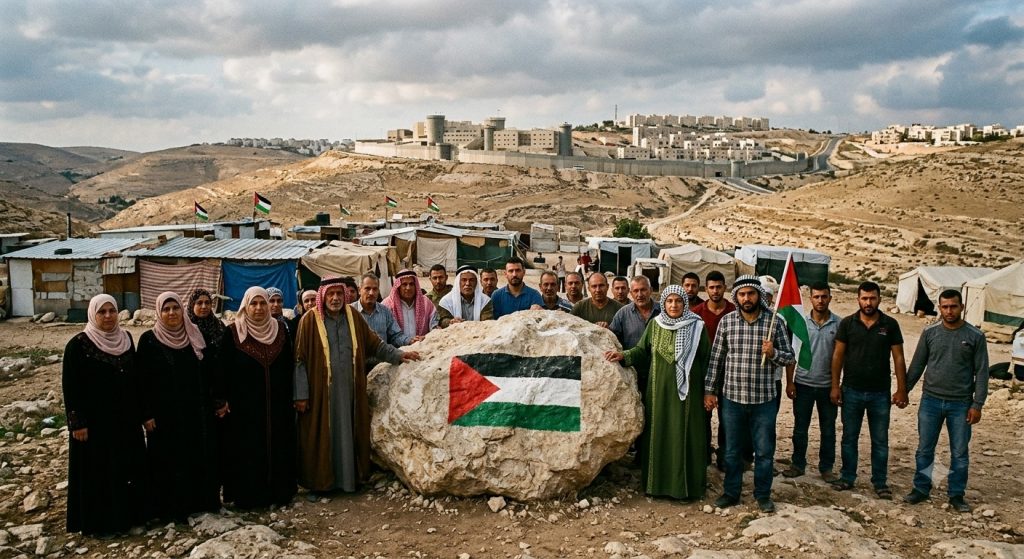
Khan al-Ahmar: The Battle for Palestinian Existence and the Rock of Defiance Against Settlement Expansion and Political Blackmail
11/7/2026 – Union for Justice Foundation
Today, the Bedouin village of Khan al-Ahmar is facing one of the most dangerous phases of Israeli targeting, which has recently gone beyond the usual administrative pretexts to become an instrument of direct political retaliation led by the highest levels of the occupation government.
In an escalatory step reflecting the depth of the legal and political crisis facing the leaders of the occupation, Israeli Finance Minister Bezalel Smotrich issued a vindictive response to the issuance of an arrest warrant against him by the International Criminal Court, describing it as a declaration of war and launching a series of direct threats to target the Palestinian Authority economically and politically. He immediately translated his anger into action by signing an order to evacuate the village of Khan al-Ahmar, exploiting his security powers. This blatant linkage between international judicial prosecution and the punishment of an unarmed Palestinian residential community conclusively proves that the issue of Khan al-Ahmar has never been about unlicensed construction, as the occupation claims, but rather a geographical and demographic battle aimed at erasing the Palestinian presence in strategic areas.
The Union for Justice Foundation views with grave concern this blatant escalation, which links the fate of an entire village and the forced displacement of its two hundred residents to the recklessness of Israeli officials and their retaliatory reactions to international justice.
This steadfast Bedouin community is not merely a collection of tents and simple wooden shacks, but an integral part of Palestinian history and geography. The village was named Khan al-Ahmar after the red color of the limestone rocks mixed with iron oxide in the area. It is home to a historic Ottoman caravanserai and an ancient site associated with monks and merchants, whose historical and religious significance extends to ancient narratives referring to the passage of the Good Samaritan nearby. Today, the village is inhabited by approximately two hundred people, most of whom belong to the Jahalin Bedouin tribe, whose collective memory carries a prolonged Nakba since they were forcibly expelled by Zionist militias from their original homes in the Tel Arad area of the Naqab in 1952. They eventually settled in this semi-desert area east of Jerusalem along the highway leading to Jericho, preserving their pastoral way of life and remaining firmly attached to their land despite harsh conditions, the deliberate deprivation of basic services, and continuous persecution by surrounding settlements such as Ma’ale Adumim and Kfar Adumim.
The exceptional strategic importance of Khan al-Ahmar lies in its location at the heart of the area known by Israel as the E1 settlement plan, an expansionist project through which the occupation seeks to connect the settlement of Ma’ale Adumim with West Jerusalem. This would effectively seal off Jerusalem’s eastern gateway to Palestinians, separate the northern West Bank from its southern part, sever geographical continuity, and eliminate any possibility of establishing a contiguous and viable Palestinian state. This makes Khan al-Ahmar the last line of defense and the rock of steadfastness upon which the dreams of settlement expansion and the liquidation of the Palestinian cause are shattered.
Since 2009, the occupation authorities have repeatedly attempted to demolish the village and forcibly remove its residents under the same ready-made pretext of construction without permits in Area C, while ignoring the fact that Palestinians are systematically denied such permits by every possible means. The residents confronted the occupation’s bulldozers with their bare chests and, in cooperation with international organizations, established a school for their children that has become an international symbol of defiance. Although the Israeli Supreme Court issued an unjust ruling in 2018 ordering the evacuation and demolition of the village, the legendary steadfastness of its residents, the broad public and diplomatic solidarity surrounding them, together with the stern warnings issued by the International Criminal Court, which considers the forcible transfer of protected persons in occupied territory a war crime under the Rome Statute, prevented the demolition from being carried out over the past years and created a legal shield protecting the village.
In light of this dangerous turning point, the direct threats, and the actual orders signed by Smotrich to evacuate and destroy the village, the Union for Justice Foundation stresses that expressions of concern and verbal condemnation by the international community are no longer sufficient or acceptable to stop this arrogance. The Foundation calls upon the international community, including all UN bodies and governments, to take immediate and decisive action by imposing deterrent sanctions on the leaders of the occupation and transforming international arrest warrants into genuine measures of political and economic isolation to prevent them from committing further war crimes as a form of collective punishment. The international community must also dispatch field monitoring missions to provide immediate protection for the residents of Khan al-Ahmar and the surrounding Bedouin communities, while intensifying legal proceedings against the occupation before the International Court of Justice and the International Criminal Court, considering any harm inflicted upon the village as renewed evidence of the crime of ethnic cleansing. Major powers should exert maximum diplomatic and economic pressure, including suspending partnership and trade agreements with the occupation authorities, alongside providing direct financial and legal support to strengthen the resilience of the residents on their land and immediately rebuild whatever is demolished. This would send a clear message to the occupation that the international community will not allow international law to be dismantled or human rights to be sacrificed on the altar of Israel’s internal political calculations, and that remaining silent in the face of the crime of evacuating Khan al-Ahmar would amount to the final destruction of what remains of the credibility of international justice.
End
