

25/6/2026 – Union for Justice Foundation
The Union for Justice Foundation stated that Jenin Governorate is witnessing the most significant and dangerous military and geopolitical transformation since the signing of the Oslo Accords in 1993, as the Israeli army has taken the unprecedented step of establishing permanent military camps and positions deep inside areas classified as Area “A”, which, under the agreements, fall under the full civil and security control of the Palestinian Authority.
The Foundation affirmed that this systematic entrenchment became strikingly evident after the commander of the Israeli army’s Central Command signed, on 7 May 2026, an order expropriating Palestinian land for the establishment of a permanent military camp near Jenin Refugee Camp—a step that formally and effectively eliminates any remaining practical effect of the previous political agreements on the ground. In an attempt to justify this measure in the face of legal challenges, the Israeli army claimed in its response to the Israeli High Court of Justice that the camp would serve as an alternative to stationing Israeli forces inside Palestinian civilians’ homes and would facilitate the redeployment of troops in the area as part of a long-term strategic vision. However, informed sources closely following the case confirmed to the Foundation that the construction of this permanent camp forms part of a deeper and more dangerous agenda: providing a defensive plan and direct military support for settlers who have already begun returning to and expanding within the Jenin area following the repeal of the Disengagement Law. Observers indicate that the greatest concern lies not merely in the camp itself, but in its connection to a broader process aimed at restoring settlements north of Jenin, particularly in the former settlements of Ganim and Kadim, which were evacuated in 2005.
The policy of land expropriation and military entrenchment has not been confined to the refugee camp but has extended to the surrounding countryside and towns of Jenin. Palestinians living in the village of Aaba, east of the city, now face a genuine threat to their agricultural lands and economic projects following the occupation’s commencement of infrastructure works for the establishment of a new military camp on their land. Israeli bulldozers advanced along a road that serves as a vital lifeline for the eastern villages of Jenin and established a military camp covering approximately 22 dunums on land in the town of Aaba. The land is originally owned by residents of the neighboring town of Qabatiya and was expropriated under a military order issued in mid-May. What deeply concerns residents is not only the concrete walls rising before their eyes and consuming their fields, but also the implications of these newly established military barracks: the closure of roads and restrictions on movement, denial of access to agricultural greenhouses, sheep grazing areas, and family recreational and tourism facilities that had been preparing for the summer season. This constitutes a direct and devastating threat to the livelihoods and economic investments that residents have built and depended upon for many years. Shepherds who rely on the adjacent valley for grazing their flocks will also be severely affected, as they will no longer be able to access these areas, forcing them to bear additional financial burdens by purchasing animal feed, thereby increasing production costs and dealing a severe blow to their economic resilience.
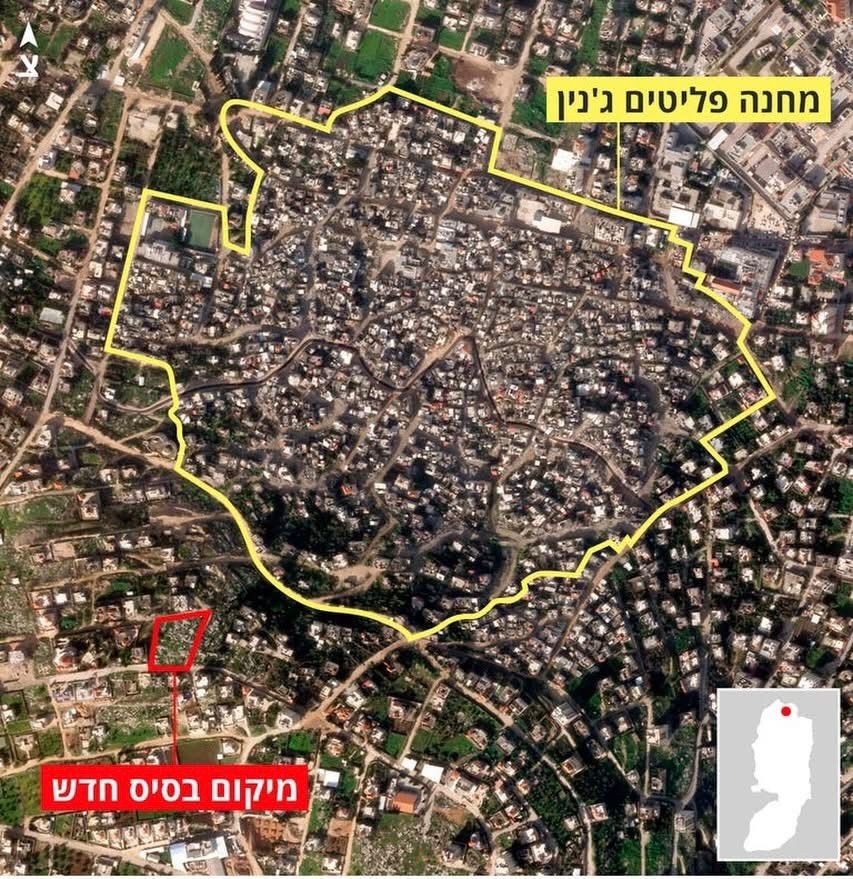
The Union for Justice Foundation stressed that the Israeli army’s justificatory response before the High Court conceals a harsh humanitarian tragedy that Jenin Governorate has endured. The occupation has forcibly displaced residents, subjected them to forced transfer, and carried out blatant attacks against Palestinian property and construction in the area, using the designation of the area as a “combat zone” as a pretext to grant itself the legal and military justification for establishing a military site, which in reality constitutes infrastructure for launching military vehicles to protect the settlement construction planned for the area and facilitate its return. Field testimonies confirm that the army’s claim that these camps were established to end the practice of seizing civilians’ homes amounts to an implicit admission of the grave violations committed against the population. During repeated military incursions, dozens of peaceful homes were forcibly transformed into military barracks and sniper positions after their owners had been expelled, while entire families were confined to small rooms and used as human shields. As part of this punitive policy, occupation forces frequently set fire to and completely destroyed these homes after withdrawing from them and removing their military equipment, leaving behind charred walls and burned memories, transforming residential apartments that had once been full of life into rubble and ashes, fueling public anger and deepening the material and psychological losses suffered by residents. These practices have caused the displacement and homelessness of entire families who have not crossed the thresholds of their homes for two full years, either because their homes were completely destroyed and entire neighborhoods rendered uninhabitable, or because their houses are located along direct confrontation lines and routes that have become permanent deployment points for military vehicles. The establishment of these permanent military camps therefore institutionalizes the displacement that has continued for the past two years and effectively extinguishes the hopes of residents of ever restoring their normal lives, after Jenin had remained free from the scourge of settlements for two decades. What is taking place today reflects the occupation state’s manipulation and fragmentation of the governorate’s geography through territorial division and renewed settlement construction.
In conclusion, the Union for Justice Foundation reiterates the established position of international law regarding these measures, noting that international humanitarian law, particularly the Fourth Geneva Convention of 1949, expressly prohibits an occupying power from confiscating or destroying private property except where such destruction is rendered absolutely necessary by military operations. It further prohibits any permanent or structural changes in occupied territory that serve settlement interests or consolidate the occupying power’s long-term control, considering such practices to constitute war crimes under international law. Accordingly, the Foundation calls upon the international community, the United Nations Security Council, and the International Criminal Court to assume their legal and moral responsibilities by taking immediate and urgent action to halt the confiscation orders, dismantle these permanent military camps, impose effective sanctions on the occupying authorities to stop the policy of creeping annexation and the imposition of faits accomplis, and protect Palestinian civilians, their livelihoods, and their property from this military and settlement expansion that is redrawing the geographical map of the northern West Bank by force.
End
