

March 26, 2026 – Union for Justice
The events of October 7 were not merely a military turning point in the Palestinian struggle; they were instrumentalized as a pretext exploited by the occupation to impose a comprehensive blockade aimed at breaking the resilience of Palestinian society by attacking its very means of livelihood. The decision to prevent hundreds of thousands of workers from reaching their workplaces within the Green Line (the occupied Palestinian interior) cannot be considered a routine security measure. Rather, it is a deliberate and systematic policy of collective punishment, intended to dismantle the Palestinian economic structure entirely.
At a time when more than 200,000 workers depended directly on the labor market within the Green Line, this sudden ban cut off the primary source of income for thousands of families, causing an almost complete paralysis in purchasing power and pushing society into an unprecedented state of recession and extreme poverty. This reflects a calculated intent to exhaust Palestinian society and entrap it in cycles of debt and deprivation, undermining its ability to meet even the most basic needs.
This harsh reality has transformed the life of the Palestinian worker into an ongoing daily struggle. Caught between the burden of mounting debts and the urgent need to secure minimal subsistence for their families, many workers have been forced into what can only be described as “journeys of death,” traversing valleys and rugged mountainous terrain. What is happening today along the separation wall and border areas goes beyond mere restriction; it reaches the level of organized pursuit resembling a human hunt, involving live ammunition, police dogs, and drones used to track workers who carry nothing but their work tools and the hope of living with dignity. Some workers have already been killed at the wall while attempting to reach their workplaces, and others lost their lives while climbing the wall after falling from it. Official statistics since the beginning of 2026 indicate that more than 15 workers have been killed, either due to direct gunfire or fatal incidents resulting from the chases, a scene that underscores the scale of the tragedy and raises serious questions amid international silence.
The severity of these policies was clearly demonstrated in a recent incident in Masafer Yatta, where a search for work turned into a field tragedy. Occupation forces, using military vehicles, surrounded transport vehicles carrying more than fifty workers and pursued them along mountainous roads lacking even the most basic safety conditions. During this pursuit, live ammunition was fired directly at the workers, causing vehicles to overturn and crash.
This resulted in the martyrdom of a 30-year-old worker, who was striving to earn his daily bread and support a young daughter, in addition to injuring dozens of others with varying degrees of severity, some from gunfire and others from the crashes caused by the pursuit.
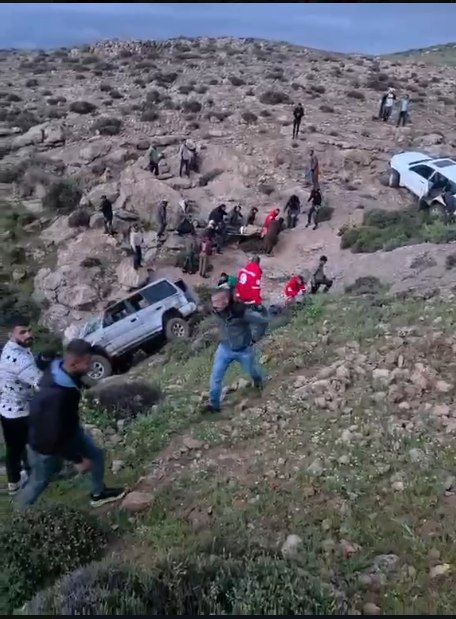
Field testimonies indicate that both soldiers and settlers deliberately obstructed medical assistance to the injured. The martyr was left bleeding on the ground without rescue, and no one was allowed to approach him for hours until he died, in a blatant violation of the most basic humanitarian principles. Eyewitnesses also reported that some workers managed to flee the scene, but they were in extreme exhaustion and psychological shock due to the horror they witnessed.
Describing this incident as a “traffic accident” is a distortion of reality, as it represents a fully-fledged crime resulting from deliberate military conduct aimed at deterring and intimidating workers and preventing them from attempting to break the economic blockade imposed upon them.
The Union for Justice affirms that these practices constitute a serious violation of international humanitarian law, particularly the Fourth Geneva Convention, which prohibits collective punishment of civilian populations. Using livelihood as a tool of pressure and turning work routes into life-threatening zones constitutes a clear violation of the right to work and the right to a dignified life. The institution also maintains that the occupying forces are legally obliged to protect civilian populations, and that policies of restriction and pursuit are part of a systematic attempt to weaken the Palestinian economy and push it toward collapse, serving policies of oppression and displacement.
The Union for Justice calls for the urgent establishment of an independent international commission of inquiry to investigate incidents involving the targeting of workers and to hold those responsible accountable. It also urges the International Labour Organization to act urgently to protect the rights of Palestinian workers and ensure their safe access to workplaces. In this context, the institution recommends establishing an emergency fund to support Palestinian workers in the occupied interior who have lost their sources of income, and to systematically document all violations committed against them—especially in areas such as Masafer Yatta—in preparation for presenting this evidence before competent international courts.
The right to a dignified life must not be fraught with the risk of death, and a morsel of bread must not be seized at gunpoint, while justice—still absent—remains the price Palestinian workers pay each day with their lives.
End
