
12/06/2026– Union for Justice Foundation
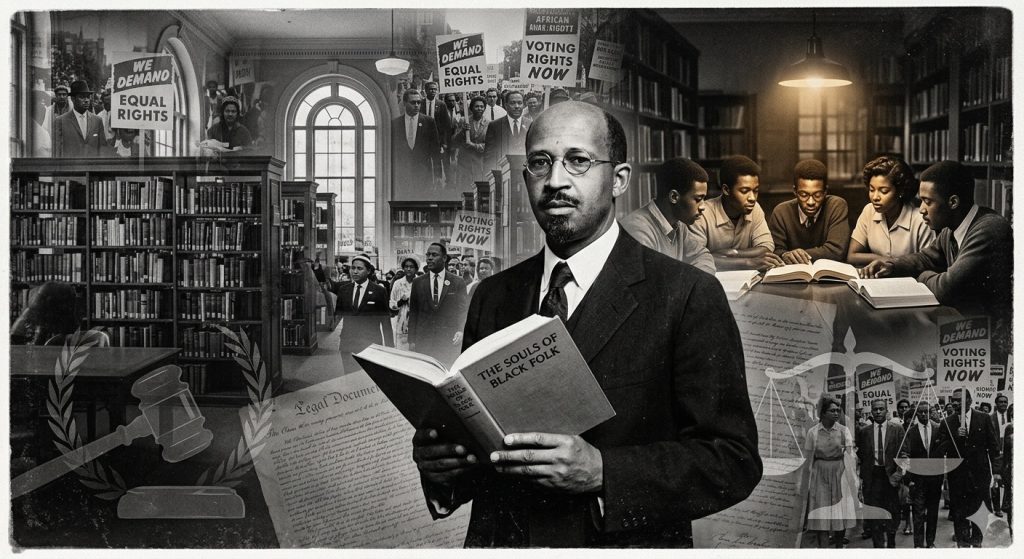
W. E. B. Du Bois (1868–1963) is regarded as one of the most influential Black intellectuals and activists in American history and a pivotal figure in shaping the modern civil rights discourse in the United States. Bridging academic scholarship and political activism, Du Bois distinguished himself as a sociologist, historian, writer, and civil rights advocate. He was also among the leading founders of the National Association for the Advancement of Colored People (NAACP), which later became one of the foremost organizations defending the rights of Black Americans.
Du Bois’s activism emerged during the period following the formal abolition of slavery in the United States. However, the legal end of slavery did not bring about genuine equality. Southern states continued to enforce the segregationist laws known as the Jim Crow Laws, which institutionalized discrimination in education, employment, housing, and public transportation, while keeping Black Americans in a position of marginalization and exclusion. Within this context, Du Bois recognized that the problem extended beyond the mere denial of certain rights to Black people; rather, it lay in the existence of an entire intellectual, cultural, and legal system that justified such deprivation and continually reproduced it.
Knowledge in Confronting Racism
W. E. B. Du Bois grew up in an environment that afforded him educational opportunities superior to those available to most Black individuals in his era. This advantage enabled him to recognize the profound contradiction between the democratic principles professed by the United States and the lived reality of Black Americans. As he moved through American and European universities and engaged with modern social thought, his critical consciousness deepened. He began to understand the condition of Black people not merely as a moral or humanitarian issue, but as one fundamentally shaped by power, knowledge, economics, and broader social structures.
Du Bois was among the earliest thinkers to employ scientific research in the study of Black life in the United States. At a time when some scholarly works sought to explain social inequality on racial grounds, he produced field studies and statistical analyses demonstrating that the poverty and marginalization experienced by Black Americans were the result of long-standing historical policies of exclusion and discrimination, rather than any inherent racial factors. Through this approach, he transformed knowledge into a tool for challenging racist discourse and advocating for justice and equality.
One of his most significant intellectual contributions is the concept of “Double Consciousness,” which describes the psychological and social condition experienced by Black individuals who perceive themselves both through their own self-identity and through the racist lens imposed upon them by society. This condition leads to a persistent sense of internal division, where the struggle is not limited to the pursuit of civil rights, but extends to the defense of dignity, humanity, and identity. Through this concept, Du Bois demonstrated that racism operates not only through laws and institutions, but also through its profound influence on the formation of both individual and collective consciousness.
Legal Struggle and the Global Dimension
W. E. B. Du Bois did not limit himself to intellectual and academic production; he also co-founded the National Association for the Advancement of Colored People (NAACP), which adopted a strategy based on the use of law, political action, and media engagement to confront racial discrimination. This approach represented a significant turning point in the history of the civil rights struggle in the United States, as the law itself became a battleground for securing rights and dismantling systemic forms of discrimination.
Du Bois believed that constitutional texts proclaiming freedom and equality lose their meaning if they are not translated into tangible rights enjoyed by all citizens without discrimination. He therefore emphasized the contradiction between the United States’ declared principles and the practices that denied Black Americans full participation in political, social, and economic life.
W. E. B. Du Bois did not confine his focus to the United States; rather, he linked the struggle of Black Americans to anti-colonial and anti-racist movements around the world. He was one of the foremost supporters of Pan-African unity and national liberation movements, viewing the suffering of Black peoples as part of a global structure of domination and racial hierarchy. In this sense, his intellectual project acquired an international dimension, making him one of the earliest thinkers to conceptualize justice and human rights as universal issues that transcend geographic boundaries.
Du Bois left a profound legacy in thought, politics, and human rights. He contributed to a more comprehensive understanding of racism as an integrated social, cultural, and legal system. His ideas also influenced numerous anti-discrimination movements and helped shape the development of studies concerned with identity, social justice, and political representation.
The experience of W. E. B. Du Bois demonstrates that the struggle for rights does not rely solely on direct political confrontation; it also requires the construction of a critical consciousness capable of understanding the roots of injustice and the mechanisms through which it persists. He recognized that racism is not merely an individual behavior or an isolated legal practice, but rather an integrated system produced by institutions, laws, and prevailing cultural norms.
From this perspective, he linked knowledge and liberation as inseparable processes and made scientific inquiry a tool for exposing and resisting discrimination. His project was not based merely on the demand for formal equality, but on redefining the position of the Black individual within American society as a full citizen endowed with rights and dignity. Consequently, his legacy remains central to contemporary debates on social justice and human rights, and he is regarded as one of the foremost thinkers who transformed knowledge into an active force in confronting injustice and advancing the principles of freedom, equality, and human dignity.
End
