
23/1/2026 – Union for Justice Foundation
The Union for Justice Foundation stated that the number of Palestinian journalists held in Israeli prisons has recently risen to 41, following the arrest of Palestine TV correspondent Ali Dar Ali the day before yesterday, after he was summoned for interrogation by Israeli intelligence.
The foundation explained that the detained journalists are distributed as follows: 31 from the West Bank, including two female journalists, and 10 from the Gaza Strip, while the fate of three journalists from Gaza remains unknown, with no information as to whether they are among the dead or are being held in detention.
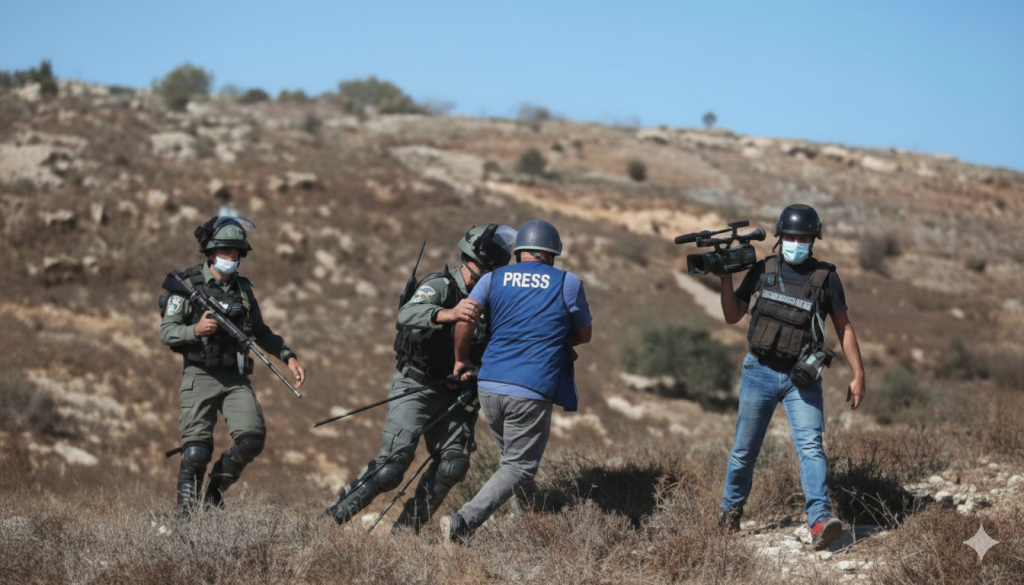
It added that since the beginning of the war on the Gaza Strip on 7 October 2023, the Israeli occupation has placed Palestinian journalists on a list of targets, subjecting them to arrest, persecution, and restrictions in the West Bank, and to killing and liquidation in the Gaza Strip.
The foundation noted that the occupation has killed 260 journalists since the start of the war, the latest of whom were killed yesterday, Wednesday, when a vehicle carrying three journalists—Abdul Raouf Shaat, Mohammad Salah Qashta, and Anas Ghanim—was bombed in Al-Zahra city in central Gaza. This figure has been described as the most deadly and dangerous toll for journalists in modern-era conflicts and wars.
In addition to killing, arresting, and assaulting Palestinian journalists while they perform their field coverage, as well as confiscating their equipment, the occupation authorities impose house arrest and home confinement on journalists, as in the cases of Jerusalem-based journalist Bayan Al-Ja‘ba and journalist Sumayya Jawabra from the city of Nablus.
Closure of Satellite Channels and Banning Journalists from Entering Gaza
Over recent months, the occupation authorities issued a decision to close Al Jazeera and ban it from covering events. In December, the Israeli Knesset General Assembly approved, in its second and third readings, an extension of a law allowing the closure of foreign media channels under the pretext of “harming state security,” opening the door to shutting down other satellite channels.
Since 7 October 2023, the occupation authorities have also continued to bar foreign journalists from entering the Gaza Strip to cover developments there.
Returning to the issue of journalists’ arrests, the Union for Justice Foundation reported that among the detainees are two female journalists: Farah Ahmad Abu Ayash (26), detained since 5/8/2025, and Ashwaq Mohammad Awad (25), detained since 30/12/2025, both from the town of Beit Ummar, north of Hebron.
According to the foundation, a number of journalists held in Israeli prisons suffer from various health conditions, including journalist Ali Samoudi (59) from Jenin, who has been under administrative detention since 29/4/2025.
The foundation noted that Samoudi, a correspondent for Al-Quds local newspaper, has lost more than 40 kilograms of his body weight and suffers from scabies, diabetes, high blood pressure, stomach ulcers, continuous gum bleeding, and urinary tract infections, in addition to having been subjected to beatings and humiliation at his place of detention in Megiddo Prison.
Among the imprisoned journalists is also photojournalist Moath Ibrahim Ammarna (39) from Dheisheh Refugee Camp near Bethlehem, detained since 20/8/2005, who suffers from various health problems.
In 2019, Ammarna sustained a serious injury when Israeli forces fired metal-coated bullets at him while he was covering clashes in the town of Surif, northwest of Hebron, resulting in the loss of his left eye and shrapnel lodging in the wall of his brain.
In October 2023, the occupation re-arrested Ammarna and placed him under administrative detention. During his detention, he suffered from medical neglect, particularly as he had diabetes, which exacerbated his health condition, before he was re-arrested again in August of last year.
Incitement: A Ready-Made Charge
Among the detained journalists is Dr. Mahmoud Fatafta, a media professor at the Arab American University from Bethlehem, detained since 29/5/2024.
According to the Union for Justice Foundation, the occupation authorities charged Fatafta—like most journalists—with “incitement,” a charge that lacks clear and specific legal standards and is highly malleable and open to interpretation. It has become a tool used by the occupation authorities to suppress Palestinians, particularly influential figures, opinion-makers, and journalists, silencing their voices and breaking their pens.
The occupation authorities prefer to place most of these journalists under arbitrary administrative detention, due to the absence of indictments against them, and routinely extend their detention periods, sometimes for more than two years.
A few days ago, journalist Mujahid Bani Muflih, an editor at Ultra Palestine, was transferred to hospital just three days after his release from Israeli prisons, following a severe deterioration in his health due to brain hemorrhage and dangerously high blood pressure, after prolonged suffering from medical neglect and ill-treatment during his detention.
The Longest-Serving Imprisoned Journalist
Journalist Munther Khalaf Muflih (50) from the village of Beit Dajan, east of Nablus, is considered the longest-serving imprisoned journalist. He is serving a 33-year prison sentence, holds a bachelor’s degree in journalism from An-Najah National University, is a member of the Palestinian Journalists Syndicate, and has authored numerous published articles, studies, and research papers.

Missing Journalists
Two journalists from the Gaza Strip—Nidal Al-Wahidi and Haitham Abdulwahid—remain forcibly disappeared, with no information about their fate since contact with them was lost on 7/10/2023. Journalist Ahmed Issam Al-Agha has been in the same situation since his arrest inside the Gaza Strip on 3/3/2024.
The Union for Justice Foundation affirms that the Israeli targeting, killing, and arrest of Palestinian journalists due to their media work constitutes a blatant violation of international law and a grave breach of international humanitarian law. Journalists are classified as civilians and are entitled to full protection under the Geneva Conventions and United Nations protocols.
They must not be targeted as military objectives, and their deliberate targeting constitutes a crime under the Rome Statute of the International Criminal Court. Moreover, attacks on journalists should not be viewed merely as isolated crimes, but rather as acts that fall within a more severe category of violations under the aforementioned legal frameworks.
The foundation concluded that the ultimate aim of this targeting is to conceal the crimes committed by the occupation authorities and to prevent the transmission of images and narratives to Arab and international public opinion.
End
