
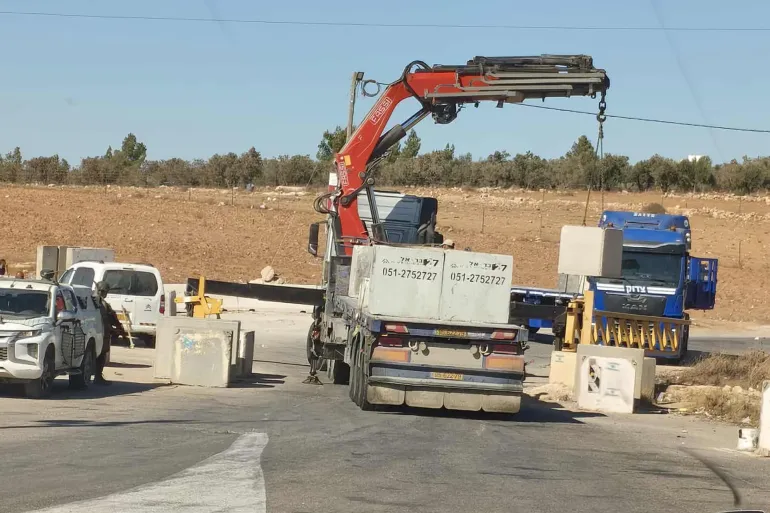
More than 920 barriers and gates
“Union for Justice”: The occupation added 10 new gates and barriers in the West Bank last month
6/4/2026 – Union for Justice Foundation
The “Union for Justice Foundation” stated that the Israeli occupation authorities added ten new gates and barriers last month at the entrances to Palestinian villages and towns in the West Bank.
It indicated that the total number of these barriers and gates has reached approximately 921, including 252 gates installed after October 7, 2023.
Jerusalem and its surrounding areas accounted for a significant share of these gates, numbering approximately 88. They were particularly concentrated at the entrances of Jerusalem-area villages such as Qalandia, Al-Ram, Hizma, Anata, Mikhmas, and Al-Eizariya, as well as in the vicinity of Al-Isawiya and Jabal Al-Mukabber. In addition, permanent checkpoints remain stationed at the entrances to the Old City and the gates of Al-Aqsa Mosque.
The “Union for Justice” added: “Through monitoring and follow-up, it has become evident that on March 1st, the occupation army installed an iron gate at the only entrance to the village of Deir Jarir, east of Ramallah. On the 5th of last month, it installed four new gates at the entrances to the villages of Bardala, Kardala, and Ein Al-Beida in the northern Jordan Valley, as well as at the entrances to the villages of Al-Zubeidat and Marj Na’ja, north of Jericho.”
On the 6th of last month, occupation forces closed the main entrance to the village of Al-Tira, southwest of Ramallah, with earthen berms, following a large-scale raid on the village, during which numerous homes were stormed, and residents were subjected to field interrogations.
On March 8th, the occupation army closed secondary roads in the village of Al-Lubban Al-Sharqiya, south of Nablus, using concrete barriers, after having closed the village’s main entrance months earlier with an iron gate and concrete blocks.
On the 30th of last month, the occupation army installed two iron gates east of the village of Atuf, south of Tubas, separating the Atuf plain from the Al-Baqi’a plain, thereby isolating 32 Palestinian families. On the same day, the Israeli army placed an iron gate at the entrance to Ush Ghrab, east of Beit Sahour, west of Bethlehem, which connects Beit Sahour, the town of Za’tara, the village of Al-Shawawra, and the main road leading to Hebron.
The installation of barriers and iron gates has not been limited to occupation soldiers; settlers have also taken on this role. On March 30th, settlers installed an iron gate in the “Al-Nawamis” area south of the village of Sarta, west of Salfit.
It added: “These barriers and gates hinder the freedom of movement of citizens within a single governorate and between different governorates, obstruct geographical connectivity between Palestinian cities, villages, and camps, and impose additional financial and time burdens on Palestinian citizens, alongside daily suffering.”
The “Union for Justice” affirmed that the continued placement of these barriers and gates, along with ongoing Israeli closures in the occupied West Bank, aims to isolate Palestinians, entrench a system of geographical segregation, undermine the foundations of normal life, and amounts to unjustified collective punishment.
It noted that the occupation seeks, through the installation of these military barriers and gates—beyond the pretext of weak security justifications—to transform Palestinian areas into what effectively resembles large prisons, where the population can be controlled and isolated.
The “Union for Justice foundation” stressed that Article (33) of the Fourth Geneva Convention of 1949 clearly prohibits collective punishment, and that the policies of closure and blockade imposed on Palestinians constitute a direct violation of this provision.
It continued: “Article (12) of the 1966 International Covenant on Civil and Political Rights guarantees every individual the right to freedom of movement and choice within the borders of a state. Accordingly, Israeli restrictions on movement in the West Bank constitute a blatant violation of this article. Article 13 of the 1948 Universal Declaration of Human Rights also affirms every person’s right to freedom of movement within the borders of each state.”
The West Bank constitutes approximately 21% of the area of historic Palestine and includes 11 governorates: Hebron, Ramallah and Al-Bireh, Bethlehem, Nablus, Jericho, Jenin, Tubas, Jerusalem, Tulkarm, Salfit, and Qalqilya.
Since October 7, 2023, the Israeli occupation has intensified its blockade on the exits of Palestinian villages in the West Bank, leading in some cases to the closure of roads connecting them to neighboring communities.
The occupation has justified its blockade of West Bank areas citing “security concerns”, however, months have passed during which iron gates and barriers have become a de facto reality serving Israeli plans aimed at eliminating the Palestinian presence there.
In addition to turning Palestinian areas into isolated cantons, Israeli barriers and gates have economic repercussions, including restricting Palestinians’ access to agricultural lands, Area “C,” and areas near settlements, thereby facilitating settler attacks and land seizure as part of efforts to entrench Israeli annexation policies.
According to a study issued by the Palestine Economic Policy Research Institute (MAS), the iron gates and barriers spread across the West Bank result in the loss of hundreds of thousands of working hours monthly and impose heavy additional costs on the transportation sector.
The study states that Palestinians in the West Bank lose approximately 191,146 working hours daily due to being forced to take alternative routes as a result of closures and military checkpoints. This amounts to more than 4.2 million hours monthly, equivalent to approximately 526 full-time workdays across the overall labor market.
These financial losses are estimated at approximately 2.8 million shekels per day, exceeding 62 million shekels monthly, assuming 22 working days per month and an average hourly wage of 14.8 shekels.
The study further explains that the additional distances traveled by public transport vehicles lead to significant fuel consumption, estimated at around 71,000 shekels per day.
End
