
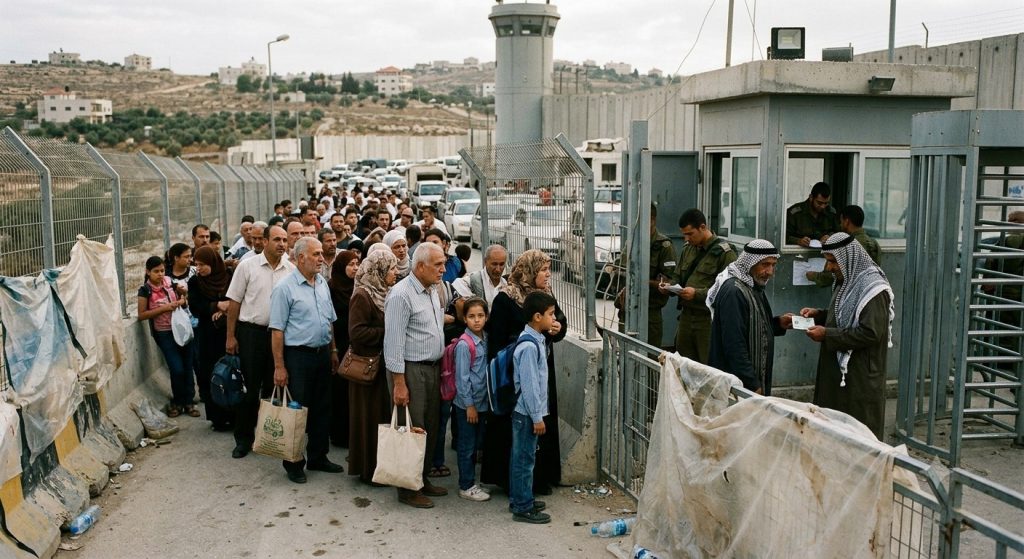
A Thousand Checkpoints and Gates Fragment the West Bank
“Union for Justice”: Israeli Occupation Checkpoints Constitute Collective Punishment and Daily Humiliation Against Palestinians
8/7/2026 – Union for Justice Foundation
The Union for Justice Foundation stated that the Israeli occupation authorities continue to use checkpoints, inspection points, and military gates spread throughout the West Bank as a form of collective punishment against Palestinians.
The Foundation pointed out that the death of the four-month-old infant, Ahmad Ma’rouf Zaid, last Sunday, after his transfer to the hospital was delayed because he was prevented from passing through an Israeli checkpoint west of Ramallah, has once again drawn attention to the Israeli checkpoints that fragment the West Bank, as well as to similar incidents that have resulted in the deaths of Palestinians.
In January 2025, Iman Mohammad Jaradat (45), from the town of Sa’ir in the Hebron Governorate, died after the occupation forces prevented her from passing through the “Beit Anun” checkpoint northeast of Hebron, following a severe heart attack.
In March 2025, Salah Mohammad Suhail, from the town of Deir al-Ghusun in the Tulkarm Governorate, died after suffering a heart attack while waiting for hours at the Barta’a military checkpoint northwest of Jenin.
In April 2025, nurse Manar Farah Issa Amtir (28), from Hebron, died after her heart stopped out of fear when her vehicle collided with an Israeli military checkpoint near Halhul, north of the city.
Over the past years, dozens of Palestinians have been killed after Israeli occupation soldiers opened fire on them under the pretext that they had attempted to carry out stabbing or ramming attacks, a justification that is consistently invoked to legitimize the killing of Palestinians.
A Frightening Experience and Psychological Distress
The Foundation added: “Palestinians believe that passing through an Israeli checkpoint is a frightening experience that may end in death merely because soldiers suspect any movement or behavior by a Palestinian attempting to cross to the other side of the checkpoint, whether by vehicle or on foot.”
It continued: “In addition to the fear of being killed, many Palestinians fear arrest while crossing these checkpoints, especially if they are former prisoners in Israeli occupation prisons or relatives of martyrs.”
Arrests at checkpoints are often accompanied by prolonged detention for hours under the scorching sun or in the rain, physical assault, humiliation, abuse by Israeli occupation soldiers, and the confiscation of money, vehicles, and mobile phones carried by those arrested.
These checkpoints restrict citizens’ freedom of movement within the same governorate and between different governorates, disrupt the geographical connection between Palestinian cities, villages, and refugee camps, impose additional financial and time burdens on Palestinians as a result of travel, and isolate dozens of Palestinian families in separated enclaves.
A journey that would normally take no more than half an hour can turn into several hours because of waiting at checkpoints and the arbitrary decisions of Israeli occupation soldiers to open or close them for the slightest reasons. Throughout the waiting period, Palestinians remain in a constant state of psychological stress and anticipation.
In many cases, the occupation has installed checkpoints and military gates at the entrances to agricultural lands belonging to Palestinian farmers, particularly in the Jordan Valley, depriving them of access to lands covering thousands of dunums, transforming them from green farmland into barren wasteland, causing losses estimated at millions of dollars, and depriving them of their only source of income.
The occupation has not limited the installation of these checkpoints and military gates to the entrances of Palestinian cities, towns, and villages; it has also extended them to within the cities themselves, particularly in Jerusalem and Hebron.
For example, last May, the Israeli army installed an iron gate at the entrance to the Old City of Hebron adjacent to Osama bin Munqidh School, which the occupation had converted into a religious institute for training rabbis, and erected a military watchtower on the Old Municipality building in the city. This means that the freedom of movement of residents within the city itself has become far from easy.
Movement Through Checkpoints Is a Necessity, Not a Choice
Tens of thousands of Palestinians are forced to pass daily through Israeli checkpoints stretching from the city of Jenin in the far north of the West Bank to Hebron in the south, whether for work, education, medical treatment, social reasons, or to travel between the territories occupied in 1967 and those occupied in 1948.
The Israeli occupation authorities frequently invoke security justifications to legitimize the establishment of these checkpoints and the installation of iron gates. However, these claims appear inaccurate and are contradicted by the reality on the ground.
According to the monitoring and documentation of the Union for Justice, many of these checkpoints are located in Palestinian towns and villages classified as “quiet” according to the Israeli security agencies’ own assessments. Moreover, some of these checkpoints are only a few kilometers apart, and many of them could easily be removed.
The Foundation affirms that Israeli checkpoints, in all their forms and sizes, whether permanent or mobile, have become a systematic tool for controlling and regulating the daily lives of Palestinians, rather than merely serving as ordinary inspection points.
Article (33) of the Fourth Geneva Convention of 1949 explicitly prohibits collective punishment. Accordingly, the closure and siege policy imposed on Palestinians constitutes a direct violation of this provision. Likewise, Article (13) of the 1948 Universal Declaration of Human Rights stipulates that everyone has the right to freedom of movement within the borders of each State.
Furthermore, Article (12) of the 1966 International Covenant on Civil and Political Rights guarantees every individual the right to freedom of movement within the territory of a State. Consequently, the Israeli restrictions on movement in the West Bank constitute a flagrant violation of this provision.
The Union for Justice stresses that the Israeli military checkpoints and closures throughout the occupied West Bank are intended to isolate Palestinians into “cantons” to facilitate control over them. They represent the entrenchment of a system of geographical segregation and the undermining of the basic requirements of normal life.
According to the Foundation’s documentation, by mid-2026, the occupation had established approximately 920 permanent checkpoints across the various governorates of the West Bank, including around 260 gates installed after 7 October 2023.
These figures do not include the dozens of earth mounds and concrete blocks that Israeli occupation bulldozers place at the entrances to Palestinian towns and villages during military incursions, which local residents remove immediately after the Israeli operation ends.

60 New Gates in One Year
The Union for Justice documented the installation of (49) new iron gates by the occupation during the second half of last year and the first half of the current year: (12) in Bethlehem Governorate, (8) in Ramallah and Al-Bireh Governorate, (7) in Jericho and the Jordan Valley, (6) in Jerusalem Governorate, (5) in Salfit, (4) in Hebron, (3) in Tubas, (2) in Nablus Governorate, and one each in Jenin and Tulkarm.
The installation of iron gates was not limited to the Israeli occupation forces. Israeli settlers also carried out the same practice, installing (11) additional gates: (8) at the entrances to agricultural roads in the lands of Al-Khader town south of Bethlehem, one in the “Al-Nawamis” area south of the village of Sarta west of Salfit, another in the Old City of occupied Jerusalem between Souq Al-Qattanin and Bab Al-Hadid, and another on Wadi Al-Qelt Road in the Al-Murashahat area west of the city of Jericho.
The following is a list of the iron gates installed by the occupation during the period from 1/6/2025 to 1/6/2026, according to the monitoring and documentation of the Union for Justice:
14/6/2025: The Israeli occupation army installed an iron gate at the northern entrance to the town of Sinjil, north of Ramallah, which is the only entrance leading to the town. This came months after a red iron gate had been installed at the town’s eastern entrance, leaving the town surrounded by two iron gates and a fence.
14/6/2025: The Israeli occupation army installed an iron gate at the entrance to Duma, south of Nablus. This is the only entrance to the village, which has no direct roads connecting it to neighboring villages due to its geographical location, making this entrance the residents’ only lifeline.
15/6/2025: The Israeli occupation army installed a new iron gate east of Bethlehem beneath the bridge connecting Beit Ta’mar and Za’tara.
16/6/2025: The Israeli occupation army installed two iron gates at the eastern and western entrances to the town of Hizma, east of Jerusalem.
17/6/2025: The Israeli occupation army installed an iron gate in the area between the town of Kifl Haris and the village of Haris, northwest of Salfit.
17/6/2025: The Israeli occupation army installed an iron gate at the entrance to the town of Deir Ballut, west of Salfit.
18/6/2025: The Israeli occupation army installed an iron gate at the entrance to Khirbet Al-Deir leading to the town of Janata in the Bethlehem Governorate, and also placed earth mounds at the entrance to the Sha’ab Al-Sani’ area within the town.
18/6/2025: The Israeli occupation army installed a new iron gate in both directions at the entrance to the town of Anata, northeast of Jerusalem, in addition to another gate that had already been erected years earlier at the town’s southern entrance, known as the “Tablas” entrance.
19/6/2025: The Israeli occupation army installed an iron gate at the main entrance to the town of Beit Lid, east of Tulkarm, and completely closed it.
2/9/2025: The Israeli occupation army installed an iron gate on the main road leading to the Arab Society Hospital northwest of Beit Jala, west of Bethlehem.
2/9/2025: The Israeli occupation army installed an iron gate at the main and only entrance connecting the village of Husan and the town of Nahalin near the “Bridge” area west of Bethlehem. This is expected to completely paralyze residents’ movement and make access to the center of Bethlehem much more difficult.
2/9/2025: The Israeli occupation army installed three iron gates at the southern, western, and southeastern entrances to the village of Al-Minya, southeast of Bethlehem.
8/9/2025: The Israeli occupation army installed two iron gates at the eastern entrance leading to the Route 90 junction and at the northern entrance near the Military Training Authority close to the town of Al-Auja, at the entrances to Jericho Governorate.
8/9/2025: The Israeli occupation army installed a new iron gate at Bethlehem’s eastern entrance (Qabr Halawa), separating the towns of Dar Salah and Al-Ubeidiya from the city of Bethlehem.
9/9/2025: The Israeli occupation army installed a new iron gate on the bypass road leading to the town of Beit Ummar, north of Hebron, adjacent to Al-Arroub College, with the aim of isolating the town from its surroundings whenever the gate is closed, coinciding with the construction of a new settler road to the south.
14/9/2025: The Israeli occupation army installed a new iron gate at the entrance to the town of Al-Ram, north of occupied Jerusalem, further worsening residents’ suffering in entering and leaving the town and in traveling between Palestinian villages, towns, and cities.
15/9/2025: The Israeli occupation army installed an iron gate at the entrance to the town of Mikhmas, northeast of occupied Jerusalem.
15/9/2025: The Israeli occupation army installed an iron gate at the southern entrance to the village of Zabda, west of Jenin, on the road linking the governorates of Jenin and Tulkarm, restricting the movement of approximately 7,000 residents of the village and the neighboring communities of Dhahr Al-Abd, Khirbet Mas’ud, and Qaffin.
15/9/2025: The Israeli occupation army installed an iron gate in the “Ush Ghrab” area northeast of Beit Sahour on the road leading to the town of Za’ghra and the village of Al-Shawawra east of Bethlehem.
15/9/2025: The Israeli occupation army installed an iron gate at the main and only entrance to Wadi Fukin, a town with a population of approximately 1,500 residents, west of Bethlehem.
16/9/2025: The Israeli occupation army installed a new iron gate at the entrance to the town of Al-Eizariya, southeast of occupied Jerusalem, effectively cutting off a major strategic road linking the northern and southern West Bank.
16/9/2025: The Israeli occupation army installed a new iron gate at the entrance to the town of Al-Lubban Al-Gharbi, west of Ramallah.
16/9/2025: The Israeli occupation army installed an iron gate at the entrance to the city of Rawabi, north of Ramallah.
18/9/2025: The Israeli occupation army installed an iron gate at the entrance to the road connecting the village of Harmala and the town of Tuqu’, southeast of Bethlehem.
21/9/2025: The Israeli occupation army installed an iron gate on the closed Beit Dajan Road east of Nablus near the settlement outpost west of the village, isolating dozens of dunums of land and preventing residents from accessing the artesian water well serving the towns of Beit Dajan and Beit Furik.
26/9/2025: The Israeli occupation army installed an iron gate at the main entrance to the town of Turmus Ayya, north of Ramallah.
29/9/2025: The Israeli occupation army installed an iron gate on the eastern side of the village of Atouf, east of Tubas.
17/11/2025: The Israeli occupation army installed two new iron gates near the entrance to the town of Deir Ballut, west of Salfit, one leading toward the village of Rafat and the other toward the village of Al-Lubban Al-Gharbiya.
24/11/2025: The Israeli occupation army installed an iron gate at the main entrance to the town of Beit Ur Al-Foqa, west of Ramallah, forcing residents to take much longer routes to reach their homes and workplaces.
24/11/2025: The Israeli occupation army installed a new iron gate in Khirbet Deir Razeh, south of Hebron.
10/2/2026: The Israeli occupation army installed an iron gate on Ain Shibli Road north of Jericho in preparation for relocating the so-called “Al-Hamra” checkpoint on the road connecting Nablus, Tubas, and Jericho.
17/2/2026: The Israeli occupation army installed an iron gate near the bridge of the town of Al-Zawiya, west of Salfit, obstructing residents’ movement, particularly since the site is a vital passage linking the town to several neighboring villages and towns.
23/2/2026: The Israeli occupation army installed an iron gate between the towns of Beit Ummar and Surif on the western side of Beit Ummar in Hebron.
25/2/2026: The Israeli occupation army installed an iron gate beneath the Deir Dibwan Bridge east of Ramallah.
1/3/2026: The Israeli occupation army installed an iron gate at the only entrance to the village of Deir Jarir, east of Ramallah.
5/3/2026: The Israeli occupation army installed two iron gates at the entrances to the villages of Bardala, Kardala, and Ain Al-Bayda in the northern Jordan Valley.
5/3/2026: The Israeli occupation army installed two iron gates at the entrances to the villages of Al-Zubeidat and Marj Na’ja, north of Jericho and the Jordan Valley.
30/3/2026: The Israeli occupation army installed two iron gates east of Atouf, south of Tubas, separating the Atouf Plain from the Al-Baqi’a Plain, resulting in the isolation of approximately 32 Palestinian families.
30/3/2026: The Israeli occupation army installed an iron gate at the entrance to Ush Ghrab, east of Beit Sahour, west of Bethlehem, on the road leading to the city of Beit Sahour, the town of Za’tara, the village of Al-Shawawra, and the main road linking Bethlehem and Hebron Governorates.
16/4/2026: The Israeli occupation army installed a new iron gate at the northern entrance to the city of Al-Bireh.
20/5/2026: The Israeli occupation army installed an iron gate at the entrance to the Old City of Hebron adjacent to Osama bin Munqidh School, which the occupation converted into a religious institute for training rabbis, and erected a military watchtower on the Old Municipality building in the city.
End
