
Union for Justice: Between Bulldozers Uprooting Olive Trees and Settlers Stealing the Harvest
27/10/2025 – Union for Justice
In the West Bank, settler attacks—carried out under the protection of the occupation army—continue to escalate, with bulldozers uprooting olive trees and settlers stealing the harvest. This grim scene reflects a systematic policy targeting both the people and the land. What is happening is no longer a series of isolated violations, but part of a continuous chain of crimes aiming to uproot the very foundations of Palestinian existence and destroy the sources of life that symbolize resilience and identity.
The West Bank is witnessing one of the harshest periods of assault on both the land and its people. The daily scenes are repeated: bulldozers uprooting olive trees and settlers stealing crops under the protection of the occupation army. This is no longer just passing news; it has become a systematic policy intended to empty the land of its rightful owners and sever the roots of life that Palestinians have depended on for generations.
The olive tree—symbol of Palestinian steadfastness—is uprooted in broad daylight, turning once-green landscapes into deliberate destruction. What is unfolding is nothing short of a war on identity: every broken branch is a memory erased, every stolen olive a stolen livelihood. Dozens of villages across the West Bank witness daily uprooting, vandalism, and crop theft while farmers stand helpless before machinery of domination, prevented from reaching their land or assaulted when attempting to defend it.
These actions are not isolated incidents, as some claim, but a connected series repeated at the start of each olive harvest season—a recurring attempt to sever the bond between Palestinians and their land.
Olive Trees… A Symbol of Steadfastness Under the Bulldozers
In just one month, nearly 3,000 olive trees were uprooted in one area alone, part of a wave of systematic destruction affecting thousands of agricultural dunams. Reports and statistics indicate that the monthly number of olive trees destroyed or uprooted in the West Bank ranges between 2,500 and 10,000—shocking figures reflecting the scale of environmental, economic, and humanitarian catastrophe taking place.
On 7/10/2025, a group of settlers destroyed more than one hundred olive trees in Khirbet Umm al-Khair in Masafer Yatta. These figures are not mere cold statistics—they represent painful stories of families losing their only source of livelihood, of lands that witnessed their history and steadfastness. With every new uprooting, deeper roots of defiance and determination grow in the hearts of Palestinians, for the land is not merely property but identity, dignity, and existence.
The assault on the olive tree is an assault on the collective memory of Palestinians. It is the tree inherited from grandparents, planted for children and grandchildren, and celebrated during harvest season as if it were a national holiday. Thus, when this tree is uprooted, Palestinians feel as if part of their heart has been removed. Despite the profound sorrow that accompanies the sight of bulldozers tearing out roots, hope remains alive in every Palestinian hand that replants what was destroyed—a scene that captures the true meaning of resilience.
Stealing the Harvest Under Army Protection
The theft of olive harvests has also become part of the daily series of attacks. Settlers do not stop at destroying trees; they also sneak in to pick the olives before their owners do—often in broad daylight and in front of cameras—while farmers are prevented from entering their lands under flimsy “security” pretexts.
The harvest, for which the farmer toiled all year, is stolen and then sold in Israeli markets as if it were their own produce. It is a double theft: of land, labor, and history.
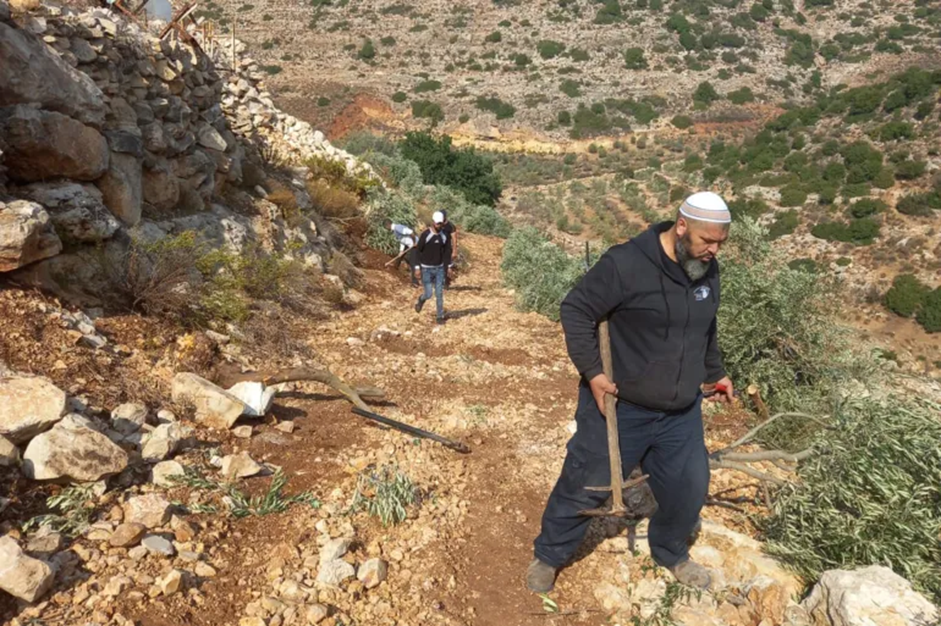
Despite all this devastation, Palestinians confront aggression with love—they plant ten trees for every one destroyed, turning their pain into a quiet act of resistance. They know that the land is not protected by weapons alone but by holding onto it, cultivating it, and remaining on it. Each olive season becomes a battleground between those who plant life and those who plant destruction—yet the farmer always triumphs simply because he remains. He waters his trees with his sweat and tears and says: “This is my land. This is my tree. And here I will stay.”
The olive harvest season in the West Bank has become a chapter of challenge. Families, young and old, gather in the fields despite the danger. They pick the olives with unbroken hope, sing for the land, and sink their roots deeper into it. For every tree uprooted, hundreds of stories of steadfastness and generosity are born. Land nourished with patience never dies, and the olive tree—centuries old—does not know defeat.
What is happening today in the West Bank is not merely an attack on agriculture; it is an attempt to erase an entire identity. But Palestinians continually show that those born on this land will not abandon it, and that the olive tree will always bear witness to their resilience—its roots deep in the soil, untouched by wind or bulldozer.
A Systematic Crime Under International Law
The destruction of trees and the theft of agricultural harvests in the West Bank constitute a blatant violation of international humanitarian law and a war crime under the Fourth Geneva Convention of 1949, which prohibits an occupying power from destroying or seizing private property except for imperative military necessity—something that clearly does not apply to what is happening in the Palestinian territories.
The Rome Statute of the International Criminal Court also classifies the wide-scale, unjustified destruction or seizure of property as a war crime requiring accountability. Repeated UN resolutions affirm that exploiting natural resources in occupied territories is illegal, meaning that every uprooted tree and every stolen harvest is a violation of international law and an assault on the Palestinian people’s right to their land and resources.
These crimes require urgent action from international bodies to halt the violations, hold perpetrators accountable, and guarantee Palestinians’ rights to their land, property, and natural resources. Such crimes do not expire, and they stand as evidence of systematic injustice carried out in broad daylight, awaiting international justice to restore the rights of the land and its people.
Despite all this destruction, Palestinians continue to cultivate their land as an act of daily resistance, believing that the roots reaching deep into the earth are stronger than any bulldozer—and that the olive tree will remain a witness to their steadfastness, no matter how long the occupation lasts.
