
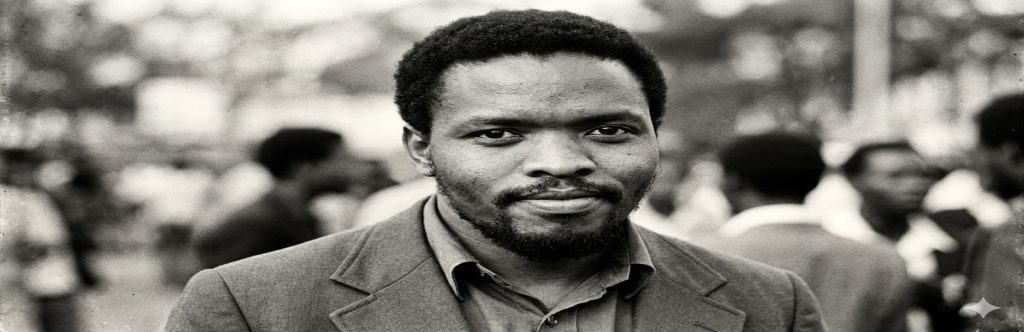
The Liberation of Consciousness as a Condition for Freedom and the Reconstruction of Dignity under Apartheid
28/4/2026 – Union for Justice Foundation
Steve Biko is considered one of the most prominent figures of intellectual and political struggle in South Africa during the era of racial segregation (apartheid). He is the founder of the “Black Consciousness Movement,” which constituted a qualitative transformation in the course of resistance to racial discrimination.
Biko was born in 1946 and lived under a strict legal system based on racial segregation, where Black people were deprived of their most basic civil and political rights within a legislative framework aimed at entrenching the dominance of the white minority. Biko did not confine himself to participation in conventional political struggle; rather, he presented a profound intellectual project that focused on liberating the Black individual from the sense of inferiority instilled by the system in his consciousness. He argued that oppression is not limited to material control but extends to shaping the individual’s perception of the self. From this perspective, Biko shifted the locus of struggle from the street to the mind, establishing a vision that sees true liberation as beginning internally, before it is realized in political reality.
The Legal Framework of Racial Discrimination in South Africa
Biko’s project cannot be understood without examining the legal nature of the apartheid system, which was not merely a discriminatory policy but a comprehensive legislative system that reorganized society on the basis of race. Laws such as the “Population Registration Act” and the “Group Areas Act” were enacted, which forcibly classified individuals according to their racial affiliation, determined their places of residence, restricted their movement, and deprived them of their political rights. Within this framework, the law was not an instrument of justice but a means of legitimizing discrimination and transforming it into a daily reality. Thus, Biko realized that confronting this system could not be limited to political protest but required dismantling the psychological foundation that leads the victim to accept this reality as an inevitable fate.
From Personal Experience to Political Consciousness: The Formation of Biko’s Thought
The “Black Consciousness Movement” was established in the late 1960s as a reaction to the dominance of traditional political discourse, which often marginalized the role of Black people themselves in leading their struggle. However, Biko did not merely reject this marginalization; he sought to construct an alternative discourse that redefined the Black self as an independent agent rather than a subordinate one. The movement was based on a simple yet profound idea: that liberation begins when a person recognizes their value and rejects the stereotypes imposed upon them. Accordingly, the movement was not a traditional political organization but a space for reshaping collective consciousness through education, discussion, and community work, in a manner that reinforces a sense of dignity and belonging.
“Black Is Beautiful”: From a Cultural Slogan to a Philosophical Thesis
Biko’s famous statement “Black is Beautiful” was not merely a slogan but a condensed expression of a philosophical project aimed at overturning the standards of beauty and value entrenched by the racist system. In a society in which beauty and value are measured according to white standards, redefining the self becomes an act of resistance in itself. Through this slogan, Biko sought to make it a tool for liberating the self from the inferiority complex and to establish the conviction that Black identity is not a burden but a source of strength. This transformation in consciousness was not merely symbolic; it had a practical effect in enhancing self-confidence and encouraging individuals to participate in collective action, thereby creating a new dynamic of struggle.
The Psychological and Legal Dimension: When Consciousness Becomes a Condition for the Activation of Rights
Biko’s thought provides an important contribution to linking the psychological and legal dimensions, as he argues that rights, no matter how formally stipulated, remain ineffective if the individual is not aware of their value and prepared to defend them. In the context of apartheid, where the laws themselves were instruments of oppression, consciousness becomes a primary condition for challenging these laws. From this perspective, Biko’s project can be read within a broader framework related to “legal empowerment,” which assumes that individuals do not merely know their rights but also possess the psychological and social capacity to claim them. This approach opens the door to rethinking the relationship between law and society, where reforming legal texts alone is insufficient; individuals must also be empowered to use them.
Biko’s intellectual influence did not escape the attention of the authorities, who saw in his project a real threat to the foundations of the system. He was subjected to surveillance, arrest, and banning from political activity, within policies aimed at silencing any opposing voice. Repression reached its peak in 1977, when Biko died while in detention as a result of torture, in an incident that clearly exposed the nature of a system that did not hesitate to use violence to silence thought. From a legal perspective, this incident constitutes a blatant violation of the right to life and the prohibition of torture, both of which are fundamental rights in international law. Moreover, Biko’s killing contributed to increasing international pressure on the apartheid system and brought renewed attention to the necessity of holding the state accountable for its actions.
Legacy and Impact: From South Africa to the World
Despite his short life, Biko left behind a profound intellectual legacy that transcended the borders of South Africa. His ideas became a source of inspiration for liberation movements around the world, particularly those confronting various forms of discrimination and cultural domination. The concept of “Black Consciousness” also contributed to the development of broader discussions on identity, dignity, and justice across multiple fields, from politics to culture. His influence lies not only in what he said but in the way he redefined struggle as a comprehensive process encompassing the mind, the self, and society.
The experience of Steve Biko affirms that the struggle for freedom is not limited to overthrowing regimes or amending laws; rather, it requires, prior to that, the reconstruction of the human being from within, as the primary agent in the process of change. He realized that the most dangerous success an oppressive system can achieve is not merely imposing control by force, but entrenching it within the consciousness of the victims, such that domination becomes accepted or invisible. From this perspective, his call for the “liberation of consciousness” emerged as the foundational step of any emancipatory project, as rights cannot be effectively exercised unless their holders recognize their value and believe in their entitlement to them.
Within this framework, Biko’s thought transcends the South African context to raise a broader issue concerning the relationship between law and consciousness. Laws, no matter how just they may be in theory, remain incapable if they do not find a society capable of activating and defending them. Moreover, oppressive systems may instrumentalize the law itself to confer a formal legitimacy upon discrimination, which makes critical consciousness a necessity for exposing this contradiction. Thus, Biko’s legacy reinforces the idea that dignity is not granted from outside but is reclaimed through the individual’s awareness of the self, and that true freedom begins when a person refuses to define themselves according to standards imposed by others.
End
