
A Symbol That Transcends Time
20/11/2025 – Union for Justice Foundation
In the register of the immortal, only a few names are inscribed with ink so radiant that time cannot erase it. Nelson Mandela is not merely a name in the history of South Africa—he is the living conscience of humanity, a global symbol of the struggle for dignity, and an icon of freedom that transcends geography and race.
“Madíba,” as he was lovingly known, was not simply a politician or a head of state. He was a living embodiment of the power of human will in the face of the harshest forms of injustice, and proof that forgiveness is stronger than vengeance. Mandela remains one of the most influential figures in modern human history—a rare leader who united firmness in principle with compassion in action, turning years of suffering into an inexhaustible moral force.
He was not just a political leader defending the rights of his people; he became a global voice crossing borders and languages, a universal symbol of freedom, justice, and peaceful resistance.
The Spark of Resistance Against Apartheid
Mandela was not born a symbol; he was shaped by the harsh conditions of his homeland. He grew up in a world where a human being was defined by skin color, under the weight of the oppressive apartheid system in South Africa. This system did not only deny Black people their political and economic rights—it sought to crush their very dignity.
From his youth, Mandela joined the struggle, becoming part of the African National Congress (ANC). Inspired by Gandhi, he began with peaceful resistance. But when legitimate demands were met with bullets and brutal repression, he realized that the regime understood only the language of force—its own language—leading him to help establish the ANC’s armed wing.
27 Years in Prison: The Longest Battle Behind Bars
Mandela’s greatest test came with his arrest and trial on charges of conspiring to overthrow the government. In the famous Rivonia Trial in 1964, he stood defiant and delivered his immortal words:
“I have fought against white domination, and I have fought against black domination. I have cherished the ideal of a democratic and free society in which all persons live together in harmony and with equal opportunities. It is an ideal which I hope to live for and to achieve. But if needs be, it is an ideal for which I am prepared to die.”
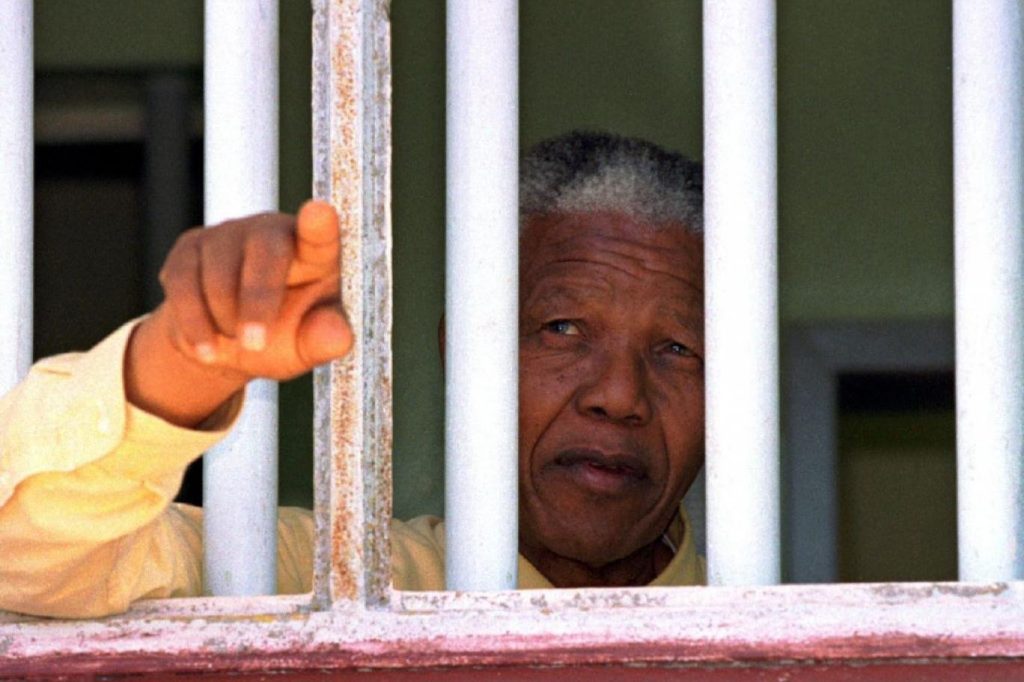
He was sentenced to life imprisonment. Thus began 27 years behind bars, most of them spent in a cramped cell on Robben Island. Those years were harsh, but they forged within him a deeper resilience and wisdom. His principles did not waver, nor did his will break. On the contrary, Mandela emerged from prison more capable than ever of leading his people toward freedom, already a global symbol of moral resistance.
In prison, Mandela was not defeated—he transformed. His cell became a university; he evolved from a revolutionary fighter into a wise statesman and philosopher. He studied law, learned the language of his jailers (Afrikaans), not to conquer them, but to understand them and eventually speak with them. They could imprison his body, but never his ideas or his resolve.
From Opposing “Unjust Law” to Building the Rule of Law
In legal philosophy, the debate over the relationship between law and justice remains constant. Is law binding simply because it is enacted by a ruling authority (legal positivism), or does it derive legitimacy from higher moral principles (natural law)?
The life and struggle of Nelson Mandela offer perhaps the most powerful case study of this debate in the twentieth century. Mandela was not only a political activist; he was a lawyer who began his career believing deeply in the rule of law—only to confront a legal system designed to institutionalize injustice.
The Lawyer: Fighting From Within the System
In 1952, Mandela and Oliver Tambo founded the first Black law firm in Johannesburg. At that time, their struggle was entirely legal, not armed.
The firm became the first line of defense for victims of apartheid laws. Day after day, Mandela confronted discriminatory legislation such as the Pass Laws restricting Black movement, and the Group Areas Act imposing forced residential segregation.
At this stage, Mandela used the law as a shield, pushing legal procedures and exploiting gaps within apartheid statutes to challenge the system from within. He practiced legal positivism to its limits, searching for pockets of justice within a system designed to deny it.
The Accused: Challenging the Legitimacy of the Law
The decisive turning point in Mandela’s legal journey came when he moved from being a defense lawyer to being a defendant. The Treason Trial (1956) and the Rivonia Trial (1964) marked crucial shifts.
Here, Mandela ceased using apartheid law and began attacking its legitimacy. In his 1964 courtroom address, he did not argue innocence under apartheid statutes—he questioned the very legality of the system.
His plea embodied natural law theory: laws that violate human dignity and enshrine racial discrimination are morally void and thus not binding. His message was clear: the system prosecuting him lacked legitimacy because it represented oppression, not justice.
The Legislator: Building a Constitutional Legacy
After 27 years in prison, Mandela emerged to face his greatest legal challenge: dismantling apartheid’s legal apparatus and constructing an entirely new framework.
He did not seek revenge—despite having every reason to. Instead, he pursued restorative justice, expressed through two major legal tracks:
1- Transitional Justice:
The Truth and Reconciliation Commission was a unique legal innovation. It was not a criminal tribunal like Nuremberg but an approach that prioritized truth over punishment. Perpetrators could receive conditional amnesty in exchange for full disclosure. The philosophy: truth is essential for reconciliation, and justice is not necessarily equivalent to retribution.
2- Constitutional Foundation:
Mandela’s greatest legal legacy is South Africa’s 1996 Constitution—today considered one of the world’s most progressive. As president, he oversaw its creation and adoption. It guaranteed not only political rights but also social and economic rights—housing, healthcare, education—as enforceable constitutional rights. Most importantly, it enshrined the rule of law, binding even the government, and established a powerful Constitutional Court to enforce these principles.
From “Outlaw” to “Law-Maker”
Mandela’s journey represents a complete transformation of the legal concept: lawyer, political prisoner deemed an outlaw by an unjust regime, and finally, nation-builder who redefined justice for his country.
His legal legacy is not just text in a constitution—it is living evidence that law must serve justice and human dignity, or it loses its reason for existing.
From Political Prisoner to President Who United a Nation
After his release in 1990, Mandela led South Africa through a difficult transition that ended with the fall of apartheid and the first democratic elections in 1994. He became South Africa’s first Black president in its first truly democratic vote.
His presidency was not about ruling—it was about reconciliation. He refused retaliation despite decades of oppression, laying the foundations of a citizenship-based state and transforming the country from a battlefield into a global model of transitional justice.
A Global Role Model and an Enduring Legacy
What makes Mandela a “timeless symbol” is not only his struggle but the way he behaved after victory. He became a global role model—not only for the oppressed seeking freedom, but for leaders everywhere.
He proved that forgiveness is not weakness but the highest form of strength. He did not cling to power; he served a single term and stepped aside, helping establish a modern democratic state. Even after retirement, he dedicated his life to fighting poverty, HIV, and defending children’s rights through his foundation.
Mandela was no saint—and he rejected that label himself. He was a human being faced with impossible choices, and he chose the hardest ones. His life teaches that hatred is the true prison, and real freedom lies in the ability to forgive.
“Madíba” will remain alive in humanity’s memory—not just as a hero from South Africa, but as a moral compass for the entire world.
Mandela’s influence did not stop at South Africa’s borders; he inspired the whole world. His resilience, humility, humanity, and ability to reach out to adversaries made him an eternal symbol invoked whenever the world speaks of freedom and human rights. Many described him in words that became a lasting prophecy:
“His body may leave us, but the ideas he carried will forever beat in the conscience of humanity.”
Mandela stands as an example for all peoples seeking freedom, and for every person who believes that justice may be delayed but never dies. His journey is proof that sacrifice is not an end in itself, but a path toward a better future—and that true greatness lies in remaining faithful to one’s principles, no matter the cost.
End.
