
Union for Justice Foundation: Khirbet al-Fakhit as a Witness to the Intensifying Demolitions and Forced Displacement in Southern Hebron
18/11/2025 – Union for Justice Foundation
Khirbet al-Fakhit, located in the Masafer Yatta area south of Hebron, is one of the communities targeted by the Israeli High Court’s May 2022 decision permitting the forced displacement of its residents on the grounds that the area lies within a designated firing zone and military training area. While Palestinians are prohibited from building, expanding, or even placing a single stone, Israeli settlement outposts continue to expand on the very same land, receiving full services—including water, electricity, and paved roads—under the protection of the Israeli army and with direct support from settlement organizations.
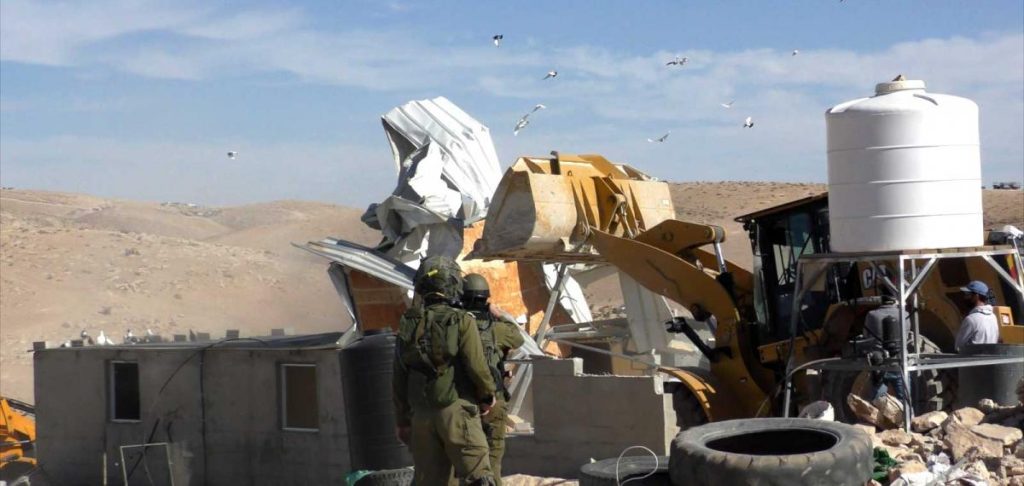
On the morning of Wednesday, 12 November 2025, Israeli forces stormed the hamlet accompanied by military vehicles and large bulldozers. The raid came without prior notice and without giving the family any time to remove their belongings or save their property. The forces sealed off the area, prevented residents from approaching or filming, and assaulted family members who attempted to reach their possessions before the demolition began.
Bulldozers then carried out the demolition in full, destroying a home consisting of three rooms, a kitchen, and a bathroom. A water cistern used for drinking and agriculture was also ruined, along with the family’s rain-harvesting water tanks—their only source of water. The house had been standing for 15 years. When the demolition was over, the family was left homeless, sleeping in the open under the cold skies of the region, while their children’s toys and schoolbooks lay scattered under the rubble—silent witnesses to the violence and brutality of the attack. Despite this, the family insists on remaining on their land and refuses to leave under any circumstances, considering it an inherent right that cannot be relinquished.
This demolition constitutes a blatant violation of international humanitarian law. Masafer Yatta is classified as occupied territory, and the occupying power is prohibited from destroying private property except in cases of absolute military necessity—conditions that clearly do not apply here. Preventing the family from removing their possessions, assaulting its members, and stripping them of their right to housing all constitute clear violations of the Fourth Geneva Convention and human rights treaties, including the rights to adequate housing, physical security, and a dignified life.

The demolition carried out in Khirbet al-Fakhit, in the Masafer Yatta area south of Hebron, is a direct and unequivocal breach of both international humanitarian law and international human rights law. The area is recognized as occupied territory under the Fourth Geneva Convention of 1949, which prohibits the occupying power from destroying or seizing private property unless such measures are absolutely required by military operations—a condition that is not met in this case.
Furthermore, preventing the family from retrieving their belongings and assaulting residents during the demolition represent additional violations of the occupying power’s obligations to protect civilians and uphold their dignity, as stipulated in Article 27 of the Fourth Geneva Convention. Leaving the family—mostly children—without shelter or the ability to salvage their possessions also constitutes a form of collective punishment prohibited under Article 33 of the same convention.
From a human rights perspective, these actions violate Article 11 of the International Covenant on Economic, Social and Cultural Rights, which guarantees every individual the right to an adequate standard of living, including adequate housing. They also contravene international standards prohibiting forced eviction without offering suitable alternatives, compensation, or humanitarian protections.
In light of this, the demolition and the accompanying measures of coercion, obstruction, and humanitarian neglect constitute grave violations that may amount to war crimes under the Rome Statute of the International Criminal Court, given that they were carried out without military necessity and without ensuring the protection of affected civilians.
End.
