Wide-scale demolitions of entire neighborhoods and villages…
10/6/2025 – Union for Justice Foundation
Since its occupation of the remaining Palestinian territories in 1967, Israeli authorities have pursued a policy of demolishing Palestinian structures under various pretexts. At times, they cite construction without permits, building in military zones near settlements and army camps, or the prohibition of construction in Area C under the Oslo Accords.
Israeli authorities have also used home demolitions as a punitive measure against those accused of attacks. The occupation has demolished Palestinian structures under the false pretext that they were used as hideouts or shelters by Palestinian resistance fighters. Demolitions continue across vast areas in northern West Bank refugee camps.
Regardless of the justification given by the occupation to rationalize the demolitions—which have become a routine part of daily life for Palestinians—the outcome remains the same: suffering, and the singular Israeli goal of pressuring Palestinians to leave, effectively emptying Palestinian areas of their inhabitants to ensure a Jewish majority, particularly in Jerusalem.
38 Demolition Operations
Data collected by the Union for Justice indicates that the demolition and explosion of Palestinian homes and structures by the Israeli army in the West Bank have been steadily increasing since October 7, 2023.
According to the organization, May 2025 witnessed 38 demolitions and explosions of Palestinian structures across the West Bank. These demolitions affected entire villages and hamlets, multi-story buildings, commercial stores, tents, mobile homes, agricultural rooms, animal pens, water tanks, and fences—some long-standing, others still under construction.
These demolitions have displaced dozens of Palestinian families, leaving them homeless and causing substantial material and psychological damage.
The demolitions were distributed as follows:
- 14 in Jerusalem governorate
- 5 in Hebron
- 5 in Ramallah
- 5 in Bethlehem
- 3 in Nablus
- 2 in Qalqilya
- 1 in the Jordan Valley
- 1 in Tubas
- 1 in Salfit
Ongoing Demolitions in Tulkarm
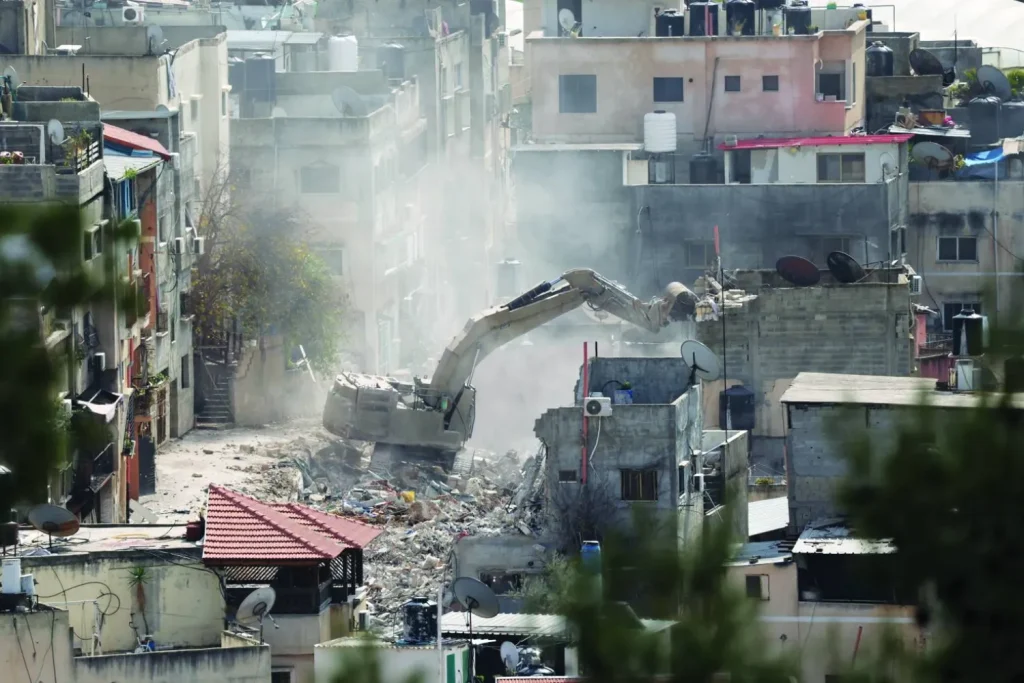
During May, Israeli bulldozers continued large-scale demolitions in Nur Shams and Tulkarm refugee camps, based on a military order to demolish 106 buildings: 58 in Tulkarm camp and 48 in Nur Shams camp.
On 5 May 2025, Israeli bulldozers demolished 15 housing units in the Al-Manshiya neighborhood of Nur Shams, belonging to the families of Abu Harb, Al-Alajmeh, Abdullah, and Shehadeh.
The following day, several homes and residential buildings in the Al-Jami’ neighborhood in Nur Shams were demolished, affecting over 18 families including Ghanam, Alayan, Khalifa, Omar, Shehadeh, Abu Jaysh, Aql, Jarrar, Qar’awi, Al-Sayes, Najjar, Abu Salah, and Saleh.
The local Popular Committee in Nur Shams and other local sources reported that over 68 homes and buildings were demolished within one week, primarily in the neighborhoods of Al-Manshiya, Al-Maslah, Al-‘Iyadah, and around the Abu Bakr Mosque. These demolitions led to the displacement of many families and widespread destruction of property and infrastructure.
Demolition of a Village in Hebron
In addition to the large-scale demolitions in Tulkarm camps, on May 5, Israeli bulldozers demolished the village of Khirbet Al-Daba’ in Masafer Yatta, south of Hebron. The village included 25 structures, such as homes, water wells, caves, agricultural rooms, pens, and solar cells.
The demolition left 120 people homeless. However, they refused to leave and began digging new caves and setting up tents to remain on their land and prevent settlers from seizing it.
Later, Israeli forces expelled foreign activists who came to document the violations and express solidarity. Meanwhile, settlers tried to intimidate them using reckless driving of 4×4 vehicles.
Khirbet Al-Daba’ is one of 12 residential communities in Masafer Yatta surrounded by settlements and outposts, including Karmel, Ma’on, and Avigayil. The Israeli High Court rejected an appeal on May 4, 2022, against the decision to close these communities and declare them “firing zones,” effectively ordering their displacement.
Economic Losses and Psychological Effects
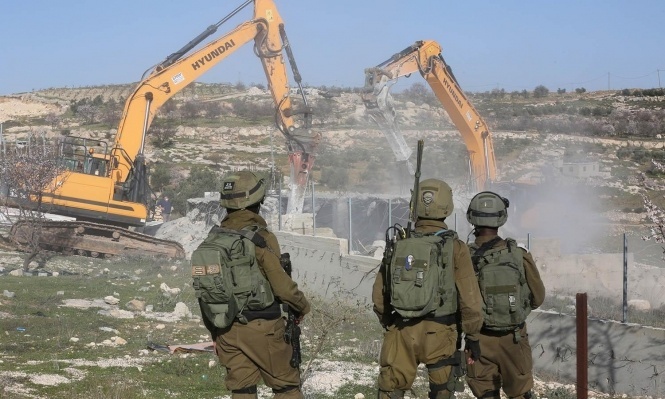
Demolitions often occur suddenly, usually at dawn. Israeli forces arrive at the targeted site and give residents no more than one hour to evacuate. The bulldozers then begin demolition, often before residents can remove all belongings. These operations are often accompanied by confrontations and assaults on homeowners who try in vain to stop the destruction.
These demolitions cause deep psychological trauma and major financial losses—sometimes amounting to millions of shekels. Families lose their only source of income and are left devastated, staring at the ruins of their homes, overcome with feelings of helplessness and despair.
Legal Violations
The demolitions carried out by Israeli authorities contradict numerous UN Security Council resolutions, especially Resolution 1544 of 2004, which calls on Israel to comply with international humanitarian law, particularly the prohibition of home demolitions contrary to international law.
The Fourth Geneva Convention of 1949 also prohibits an occupying power from destroying private property unless absolutely necessary for military operations. Article 53 explicitly states:
“Any destruction by the Occupying Power of real or personal property belonging individually or collectively to private persons, or to the State, or to other public authorities, or to social or cooperative organizations, is prohibited, except where such destruction is rendered absolutely necessary by military operations.”
Furthermore, the Israeli policy of home demolition may fall under the jurisdiction of the International Criminal Court. Article 8 of the Rome Statute (1998) considers attacks on protected private property under the Geneva Convention as a clear war crime.
