
September 22, 2025 — Union for Justice Foundation
For many years, the Israeli occupation has been inventing new tools to control the daily lives of Palestinians in various cities and villages of the West Bank. While visible military checkpoints have become a defining symbol of policies of repression and restriction, the iron gates planted by the occupation at the entrances of towns and villages now represent another form of silent siege—no less dangerous than the separation wall or permanent checkpoints.
The occupation forces install massive iron gates at both the main and secondary entrances of dozens of Palestinian towns and villages. At first glance, these gates appear to be “ordinary infrastructure,” but in reality, they are remotely controlled by the army. They can be closed at any time, without prior warning, turning Palestinian villages into small prisons.
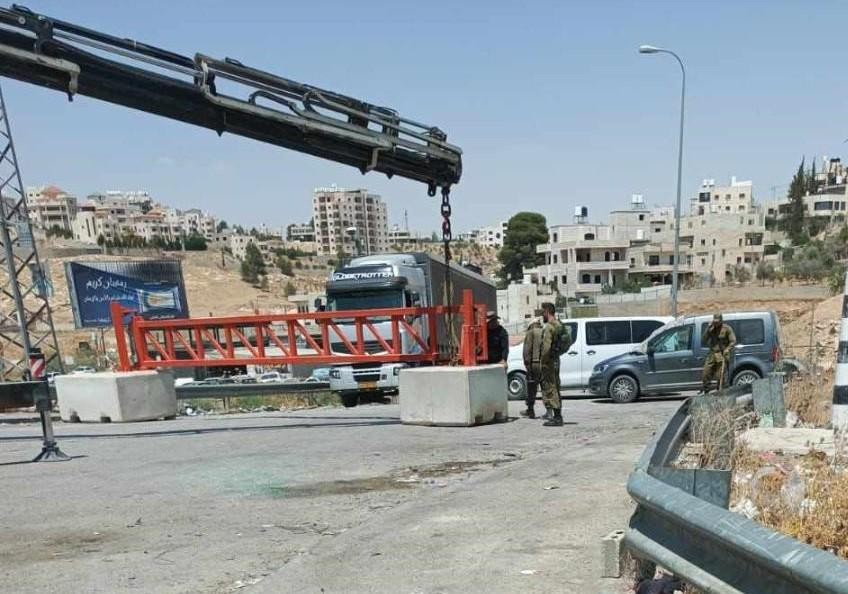
A village with only one entrance becomes hostage to the decision of a single soldier—whether to open or close the gate—thus paralyzing people’s access to their workplaces, schools, and hospitals, and suffocating social and economic life in an instant.
It is difficult to determine the exact number of these gates, as the occupation continues to install more of them gradually and quietly. What is certain, however, is that dozens of towns in the governorates of Hebron, Bethlehem, Nablus, Jenin, and Ramallah have turned into isolated islands because of these gates. Every time the occupation closes one, residents are forced to take long and rough detours—some unfit for vehicles or emergency services.
While reports may differ on the numbers, the lived experience of residents is more than enough to reveal the scale of suffering caused by this seemingly “simple” tool.
Daily Human Suffering
Students are delayed getting to school or forced to turn back midway.
Patients may find themselves trapped behind a closed gate while their lives hang in the balance.
Farmers are prevented from reaching their lands during olive-picking or harvest seasons.
Local economies are damaged by the difficulty of moving goods in and out of the villages.
Over time, these small details add up to a fully besieged life, where Palestinians feel that their villages are no longer connected to the outside world except through an occupation-controlled decision.
The Gates Between International Law and Ground Reality
From a legal perspective, sealing off Palestinian towns and villages in this way constitutes a form of collective punishment—explicitly prohibited under the Fourth Geneva Convention. Freedom of movement is a fundamental right guaranteed by international humanitarian law, and any collective restrictions imposed on civilians represent a blatant violation.
Yet in practice, the occupation has never been held accountable for this policy, which has encouraged its expansion and normalization as a quiet, daily instrument of control—away from media attention.
Iron gates may not receive the same media coverage as the separation wall or settlements, but for Palestinians, they are another wall—one that encircles their lives from within. They are the “open-air prison” controlled by the occupation with the press of a button, leaving behind lives suspended by a soldier’s decision. Therefore, confronting this policy requires more than simply tracking the number or locations of these gates. It demands exposing their human and legal consequences and making them part of the documented file of violations that must be presented to human rights and international institutions—as further evidence that Palestinians continue to live under occupation in every detail of their daily existence.
