April 21, 2026 – Union for Justice Foundation
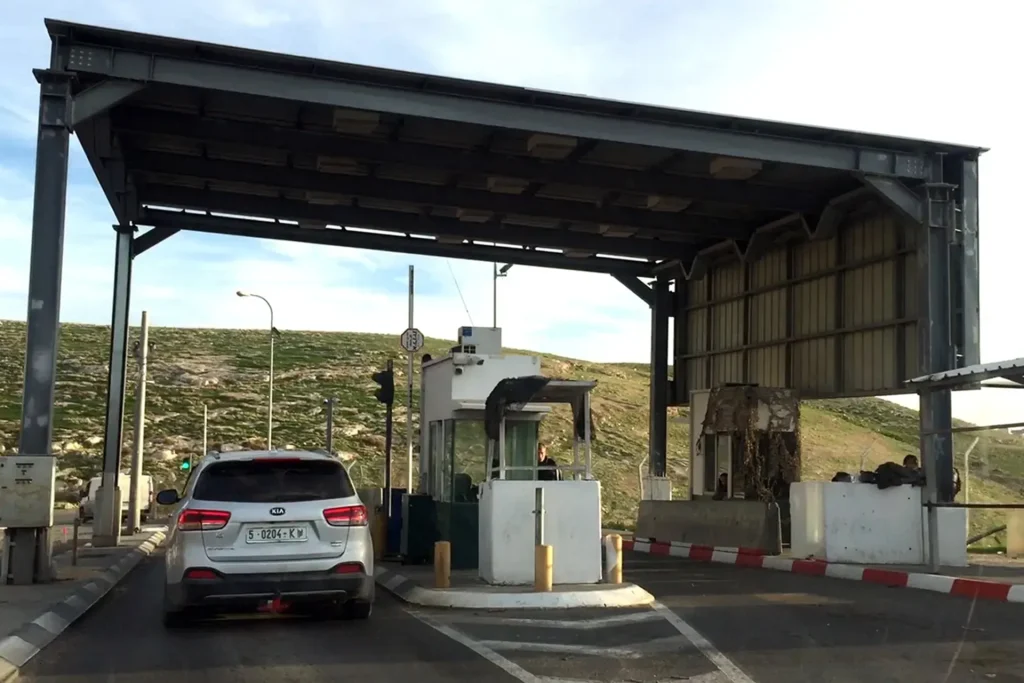
The policy of Israeli military checkpoints constitutes the most prominent instrument for fragmenting Palestinian geography and transforming the West Bank into enclaves and open-air prisons, with the number of these obstacles and gates approaching 900 checkpoints. Among this vast number, the “Container” checkpoint stands out as one of the worst and most geopolitically pivotal military checkpoints, having loomed over one of the mountains of Wadi al-Nar, east of the city of Bethlehem, since 2002. The danger of this checkpoint lies in the fact that it serves as the sole passage connecting the southern West Bank (the governorates of Hebron and Bethlehem) with its central and northern regions, effectively making it a “bottleneck” that controls the fate of more than 1.1 million people. This study aims to analyze the transformation of this checkpoint from a rugged road into a systematic instrument of repression, reviewing its social, psychological, and economic impacts, particularly in light of the escalation following the events of October 7, 2023.
Historical Roots: From a Pack-Animal Path to a Forced Artery
In the 1990s, the Wadi al-Nar road was nothing more than a narrow and rugged path used only by pack animals, as Palestinians moved freely toward Jerusalem and from there to all governorates via Damascus Gate. With the outbreak of the Al-Aqsa Intifada in 2000, the Israeli occupation completely closed the Jerusalem route, forcibly compelled citizens to carve alternative paths through harsh mountainous terrain using vehicles under extremely difficult conditions. During that period, a resident of the town of al-Sawahra invested in the area by opening a small kiosk inside a shipping container to provide coffee and rest for exhausted travelers. From this, the checkpoint derived its popular name, which became embedded in Palestinian collective consciousness, even before the occupation had established a permanent military presence. With the intensification of “Operation Defensive Shield” in 2002, the occupation expelled the kiosk owner and converted the site into a temporary (“flying”) checkpoint, which soon became a permanent checkpoint controlling pedestrian and vehicular movement.
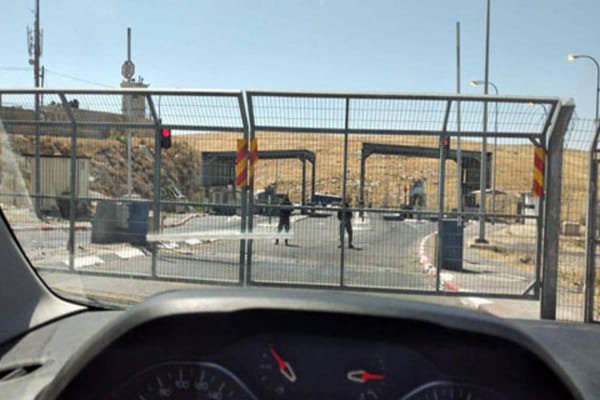
The checkpoint’s structure has undergone rapid technological and military development. What began as simple concrete blocks has transformed into a facility resembling a border crossing in both design and security procedures. The checkpoint has been equipped with advanced surveillance technology, including cameras, ground-based closure systems, iron gates, and traffic lights. The most recent upgrade—installing terminal iron gates enabling the occupation to completely isolate the south without the physical presence of soldiers—represents a dangerous development in remote-control domination strategies. This engineering design, located at the beginning of a steep slope, renders the checkpoint an impregnable fortress for soldiers and a trap for civilians. Soldiers remain fortified inside military bunkers that prevent any direct contact, making the possibility of carrying out resistance operations there nearly impossible.
“People Beyond the Container”: Sociology and Collective Identity
The existence of the checkpoint has produced a collective culture and a distinct spatial consciousness, manifested in the emergence of the term “People Beyond the Container.” Despite its sarcastic tone—reflecting a form of dark humor—the term expresses a reality of imposed separation, whereby residents of Hebron and Bethlehem have come to feel as though they live in a separate world that has shaped their customs, culture, and even their characteristics. The checkpoint has become a dividing line between the private sphere of the south and the public sphere of the rest of the Palestinian territories. Once it is closed, southern cities become entirely isolated from administrative and security centers in Ramallah. In this context, distance is no longer measured in kilometers, but in the “luck” of the traveler, the timing of soldiers’ shift changes, or the nature of identity checks, turning Palestinian time itself into a hostage of the occupation’s arbitrary procedures.
Personal Memory: Between Risky Adventure and Daily Suffering
The checkpoint forms an integral part of the memory of youth and university students. Hardly any student from the south studying in central universities lacks a personal story of suffering with the “Container.” Citizens recount stories resembling adventure films about attempts to bypass the checkpoint by climbing steep mountains during total closures. One such account is that of the student Sana Mohammad, who was forced to climb a towering mountain in high-heeled shoes under the watch of soldiers in order to reach her university. She considered the risk of falling less severe than facing the humiliating procedures of the checkpoint. At times, civilians’ vehicles are compelled to travel unpaved roads that pass through sewage runoff in order to circumvent closures—an expression of a state of “forced coexistence” with a harsh reality.
The “Container” has evolved from a checkpoint into a site of deliberate abuse and humiliation and a trap for arrest and killing. Drivers document painful testimonies of soldiers forcing them to stop for hours without reason or challenging them to retrieve their car keys placed on the roof under threat of weapons. The suffering has not been limited to psychological humiliation but has extended to loss of life. In 2013, the child Noor Atiya died due to delayed access to the hospital caused by checkpoint congestion. Moreover, the checkpoint has witnessed cases of extrajudicial execution under flimsy pretexts, such as the case of martyr Anas al-Atrash who was executed in front of his brother, and Ahmad Erekat, who was killed on his sister’s wedding day under the claim of an attempted vehicular attack—an allegation inconsistent with the circumstances of his life at that moment.
Escalation After October 7: The Tragedy of Intensified Repression
Following October 7, 2023, conditions at the Container checkpoint entered a more severe phase, marked by an increased frequency of total closures and daily violations. Many citizens were forced to cancel appointments or temporarily relocate to Ramallah to avoid long and degrading queues, causing significant economic damage to the transportation sector. No one has been spared violations. Journalist Majd Atmeizeh was subjected to abuse, beating, the tearing of her hijab, and the removal of a necklace bearing the map of Palestine from her chest, merely because surveillance cameras had identified her. Likewise, American citizen Hala Suleiman and her children were threatened with firearms and beaten despite her nationality, confirming that the checkpoint’s repressive policy spares no one. These incidents left deep psychological scars, driving some—like Majd—to decline professional and training opportunities beyond the checkpoint out of fear of reliving the hysteria and breakdown she endured.
In conclusion, the Container checkpoint cannot be reduced to merely a physical barrier; rather, it is a tool for reshaping Palestinian consciousness and the public sphere. As described by Azmi Bishara, it is “the divider and the connector between two worlds; it is the boundary and the crossing, the pain and the hope of exit.” The transformation of this road from a simple passage into a sophisticated military facility reflects a broader strategy of isolating the south and producing a distorted social and psychological reality for the “People Beyond the Container.” This checkpoint remains a living testament to a policy of systematic humiliation and a daily reminder to Palestinians that their freedom of movement—and life itself—is contingent upon the mood of a soldier standing behind a cold, iron gate.
End
