A Single Wound and an Ongoing Nakba: 78 Years from Deir Yassin to the Devastation of Gaza
10/04/2026 – Union for Justice Foundation
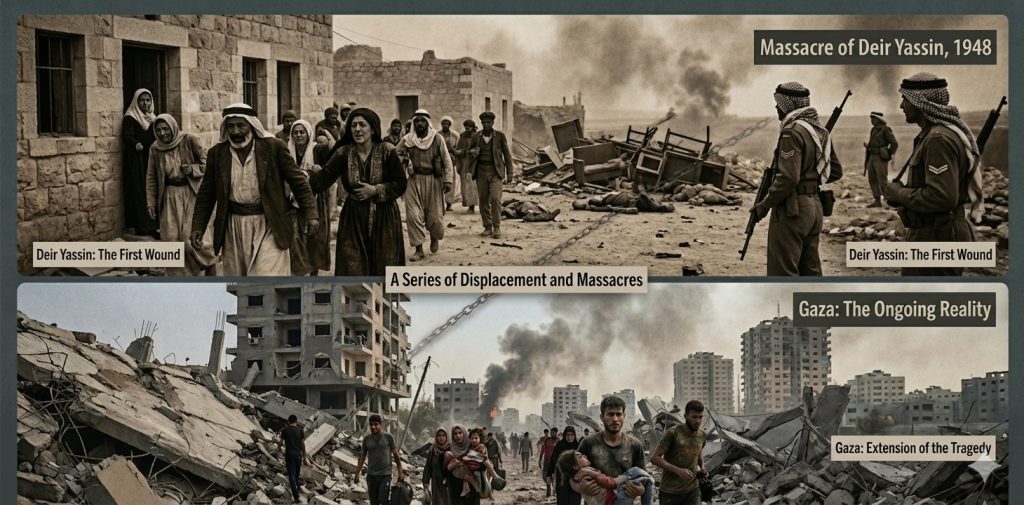
For seventy‑eight years, time in Palestine has not been a sequence of numbers folded away nor calendars hung on walls; rather, it has been a river of blood flowing from one wound to another, from one village to a city. As we recall today the anniversary of the Deir Yassin massacre, we are not digging into forgotten pages of history, but reading the reality we live moment by moment in the Gaza Strip and the West Bank. The image conveyed to us by memory of that quiet village west of Jerusalem in April 1948 is the very same image transmitted today by television screens from the alleys of Jabalia, the Zeitoun neighbourhood, and Khan Younis.
In Deir Yassin, it was the beginning; people awoke to a nightmare no human mind could have imagined, when the “Irgun” and “Stern” gangs, under the cover of the “Haganah,” stormed the homes of civilians. Killing was indiscriminate, and mutilation of bodies was a systematic policy aimed at instilling terror. Hundreds of martyrs fell that night, and the objective was clear: not merely to seize land, but to force the Palestinian into permanent displacement under the weight of fear. Yet this plan, which began decades ago, did not end with the massacre; rather, it transformed into a fixed military doctrine that we now witness in its most horrific forms in the Gaza Strip.
The comparison between Deir Yassin and Gaza today reveals that the “Zionist doctrine” is one grounded in spatial and human eradication. If Deir Yassin witnessed the fall of hundreds of martyrs in a single night, Gaza today is witnessing a recurring “Deir Yassin” every hour. The figures in Gaza are no longer mere statistics; they are the cries of thousands of children and women targeted by the same mindset that targeted the people of Deir Yassin. The occupation in Gaza is not merely fighting armies; it is fighting the entire Palestinian existence. It bombs hospitals just as it once bombed schools and homes, and cuts off water and food just as villages were besieged in the 1940s. What truly connects the past to the present is the undeniable fact that the perpetrator has not changed; and although the tools have evolved from handheld bullets to smart bombs, the objective remains the same: to erase human existence from its land. We are living in a time in which Gaza has become the major laboratory for these crimes, where genocide is practiced before the eyes of a world that claims to be civilized—just as the world once stood silent before the blood of Deir Yassin that stained the mountains of Jerusalem red.
Reflecting on the timeline between the memory and the present, we find that the philosophy of the occupation in committing massacres is based on breaking the morale of the people. In 1948, the perpetrators paraded survivors of Deir Yassin through the streets of Jerusalem to humiliate them; today, we see the same images repeated with detainees in Gaza, who are stripped of their clothes and displayed under degrading conditions. This parallel in criminal behavior confirms that what is happening today is not a transient reaction, but a continuation of a project that began with the Nakba and has never ceased.
The occupation that committed massacres in Lebanon, in the West Bank, and now in Gaza, proves to the world that it is an entity that thrives on blood and cannot exist without creating new tragedies. But what the occupier fails to account for is that the people who did not forget Deir Yassin after all these decades will not forget Gaza—and that the blood being shed today is paving the way toward return and freedom. Every martyr who fell in Gaza is an extension of the martyrs of Deir Yassin, and every child’s cry in the north echoes the cries of Jerusalem’s children in 1948.
The Union for Justice Foundation affirms that the continuation of this chain of crimes places the Zionist narrative in a moral and historical dilemma. The massacre that was intended to end the Palestinian story has instead become the fuel that ignites revolution in the hearts of new generations. Deir Yassin did not succeed in breaking the will to remain, nor will Gaza succeed in imposing surrender, for the right to the land does not expire with time, nor can bombardment—no matter how intense—erase it.
Loyalty to the martyrs of Deir Yassin today is embodied in the legendary steadfastness shown by the people of Gaza, who confront the most powerful machines of destruction with their bare chests, affirming that geography may change, but Palestinian history is written in ink of dignity that does not accept defeat.
According to the legal monitoring conducted by the Union for Justice Foundation, and in light of the provisions of international law, what Israel is committing in Palestine in general, and in Gaza in particular, constitutes a flagrant violation of all international conventions and treaties. International humanitarian law, specifically the Fourth Geneva Convention, was designed to protect civilians under occupation—something Israel violates daily through policies of collective punishment, targeting of civilian objects, and forced displacement. From a strictly legal perspective, the actions of the occupation in Gaza are described as “genocide,” pursuant to Article II of the 1948 Convention on the Prevention and Punishment of the Crime of Genocide, as the elements of deliberate killing, causing serious bodily and mental harm, and the imposition of living conditions intended to bring about the physical destruction of the group are all present. Meanwhile, settlement expansion in the West Bank and the demographic alteration of Jerusalem are legally classified as “war crimes” and “crimes against humanity,” falling within the jurisdiction of the International Criminal Court.
The legal status of Palestine confirms that it is an occupied territory, and that the Palestinian people possess the legal right to self-determination and to resist occupation. Meanwhile, Israel lacks any legal justification for the continuation of its blockade or the annexation of land by force, making international accountability an indispensable demand to end this era of impunity. Legal justice, despite its obstruction in the corridors of politics, will remain the weapon that pursues perpetrators—from the leaders of militias in 1948 to the generals of killing in our present time.
End
