Coinciding with the Olive Harvest Season
“Union for Justice”: Settlers Carried Out More Than 350 Attacks Against Palestinians in October
4/11/ 2026 – Union for Justice Foundation
The Union for Justice Foundation said that settler gangs carried out more than 350 attacks against Palestinians during October, coinciding with the olive harvest season in the West Bank.
The Foundation added: “Settler attacks against Palestinians during the olive harvest season are not new. These scenes recur every year. However, what is new this year is that it has been the most dangerous in terms of the nature and number of attacks, which have reached record levels, the geographical area affected, extending from Jenin in the north to Hebron in the south, and the violent nature of the attacks carried out by settlers who receive full protection from the Israeli army.”
The Foundation explained that settler attacks last month resulted in the martyrdom of three Palestinians and injuries to hundreds of others, who sustained various wounds and bruises. In addition, thousands of farmers were prevented from accessing their lands and were unable to harvest their olives, particularly on lands near settlements and behind the Separation Wall, which extends for 712 kilometres.
It noted that between 80,000 and 100,000 Palestinian families consider the olive harvest season a primary source of income.
According to official Palestinian data, the area of olive-planted land accessible to farmers has shrunk to only around 5,000 dunums. This has caused a sharp decline in oil production and widened the food supply gap in this vital sector.
Since the beginning of the war in October 2023, hundreds of cases have been recorded in which thousands of dunums of olive groves were left unharvested. This has led to an 87.5% decline in total olive production, from 40,000 tonnes annually to only around 5,000 tonnes. Meanwhile, olive oil production has fallen by more than 86%, from 5,000 tonnes to only 700 tonnes, depriving families of their essential supplies and driving up market prices.
Stealing Olives and Palestinian Traditions
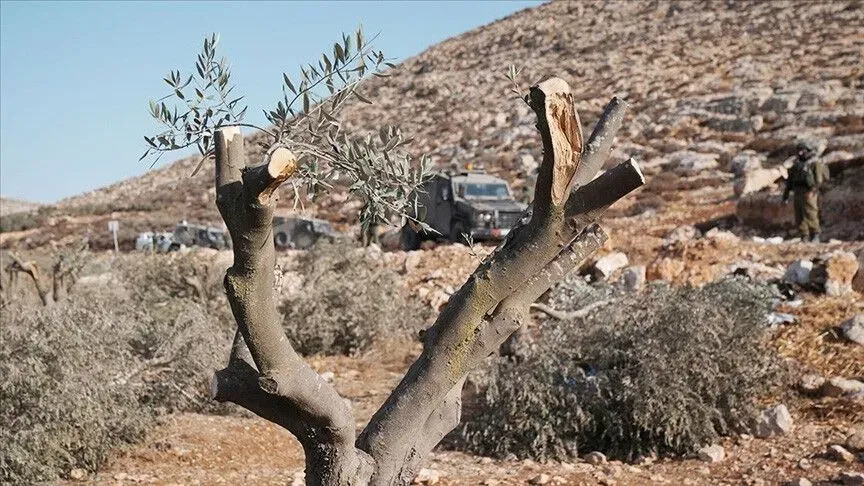
Settler attacks during the olive harvest season take several forms, most notably raiding Palestinian villages and towns, opening fire on farmers, carrying out physical assaults, forcibly removing farmers from their lands, pursuing foreign solidarity activists accompanying them, stealing olive crops and harvesting equipment, breaking trees, and bulldozing agricultural land.
According to the Palestinian Ministry of Agriculture, settlers stole approximately 50 tonnes of olives during this season. Meanwhile, the occupation’s policies, carried out by the army and settlers, resulted in damage to around 13,000 trees through burning, uprooting, cutting down and breaking them during the period between 25 September and 29 October of this year.
Settlers’ theft was not limited to olive crops. They also sought to appropriate the Palestinian traditions associated with this season. On more than one occasion, settlers posted videos on social media showing themselves harvesting olives, boiling tea over firewood and singing songs, imitating the Palestinian landowner.
Between Religious Rulings and Military Orders
The Union for Justice Foundation added: “What makes this year’s settler attacks particularly dangerous is the use of religious discourse to justify the seizure of Palestinian crops. The extremist rabbi Dov Lior issued a religious ruling declaring it permissible for settlers to harvest Palestinian olives.”
Alongside this religious ruling, the occupation authorities recently issued a military order prohibiting Palestinian farmers from entering what are known as “state lands” in the West Bank to harvest olives. This measure is being applied for the first time to these lands across different parts of the West Bank. At the same time, farmers’ access to privately owned lands has been made subject to prior coordination, restricting their ability to reach their crops.
The Union for Justice Foundation stresses that settler attacks against Palestinian farmers during the olive harvest season have become part of the struggle over land and sovereignty. They also form part of an Israeli policy aimed at weakening Palestinian agriculture and reducing the areas available for cultivation in favour of settlement expansion.
The Foundation noted that the Israeli Prime Minister’s description of the settlers carrying out these attacks as “a small number of rioters” is an attempt to mislead international public opinion and evade responsibility. It stressed that settler terrorism is carried out with the official endorsement and encouragement of this extremist government.
Key Attacks
During the past month, the Union for Justice Foundation documented more than 350 attacks carried out by settlers against Palestinians. Among the most notable incidents were the following:
On 3 October, settlers burned around 55 mature olive trees on land belonging to Ibrahim Ismail Abu Hilal in the Abu Dis wilderness area, southeast of Jerusalem. The land covers an area of approximately 14 dunums. The attack took place while he was harvesting olives from his land alongside his wife, children and grandchildren.
On 4 October, settlers bulldozed agricultural land in the village of Umm Safa, northwest of Ramallah, with the aim of expanding the settlement outpost established in 2024 in the Jabal al-Ras area. It is worth noting that they had seized hundreds of dunums in the southern part of the area while constructing roads there in recent months.
On the same day, settlers attacked farmers from the Sanjaq family while they were harvesting olives on their land in the town of Ramin, east of Tulkarem. They stole the olives and harvesting equipment and physically assaulted farmer Mujeer al-Din Sanjaq, leaving him with bruises and contusions across his body.
On 6 October, settlers attacked farmers in the village of Marda, north of Salfit, while they were harvesting olives in the Wadi al-Nar area east of the village. The attack resulted in injuries to brothers Mohammad and Nasrallah Majed Aqeel Khafash.
On 9 October, settlers attacked residents of the village of Deir Ibzi’, west of Ramallah, and a number of foreign solidarity activists who had come to support them during the olive harvest. The attack resulted in two Palestinians being injured after being beaten and sprayed with gas.
On the same day, settlers stole 16 bags of olives while occupation forces were detaining the vehicle of Rabi’ al-Makhal near the town of Ya’bad, southwest of Jenin.
On 15 October, a number of settlers attacked olive harvesters with stones and clubs in the al-Hadab area of the village of Burqa, in the Ramallah district. They assaulted farmer Haitham Taysir, causing deep wounds to his head and injuries to other parts of his body.
A day later, a large group of settlers launched an attack against olive harvesters in the al-Nab’at area of the town of Turmus Ayya, north of Ramallah. They set fire to three vehicles, olive trees and a vehicle belonging to Civil Defense volunteers. They also beat one of the volunteers, leaving him with moderate injuries.
On 18 October, settlers cut down 120 olive trees in the village of Kisan, southeast of Bethlehem Governorate.
On 3 October, settlers attacked the Abu Aisha family with stones, sticks and pepper spray while they were harvesting olives in the Tal al-Rumaida area of the Hebron district. They stole the family’s harvest, leaving five family members with various injuries.
Attacks Targeting Journalists and Foreign Solidarity Activists
Settler attacks were not limited to farmers during the olive harvest; they also extended to journalists, foreign solidarity activists and diplomats.
On 6 October, settlers attacked journalist Jaafar Ashtiyeh, a photographer for Agence France-Presse (AFP), near Aqraba, southeast of Nablus, while he was covering settler attacks against olive harvesters on the town’s lands. He had to be urgently transferred to hospital in serious condition. The settlers also destroyed and confiscated his journalistic equipment.
A day later, settlers set fire to a vehicle belonging to Russian journalist Andrei Ilyich and other foreign journalists while they were in the village of al-Mughayyir, northeast of Ramallah, documenting settler attacks against olive harvesters.
On 16 October, settlers attacked foreign journalists, including photographer Heidi Levine, who works on contract with the American newspaper The Washington Post, in the village of Abu Falah, northeast of Ramallah. She was injured and transferred to hospital for treatment.
A day later, masked settlers attacked a diplomatic delegation comprising representatives from France, Belgium and Poland with sticks and stones. The delegation had come to express solidarity with olive harvesters in the town of al-Taybeh, east of Ramallah. The attack sparked a wave of international condemnation.
End
