
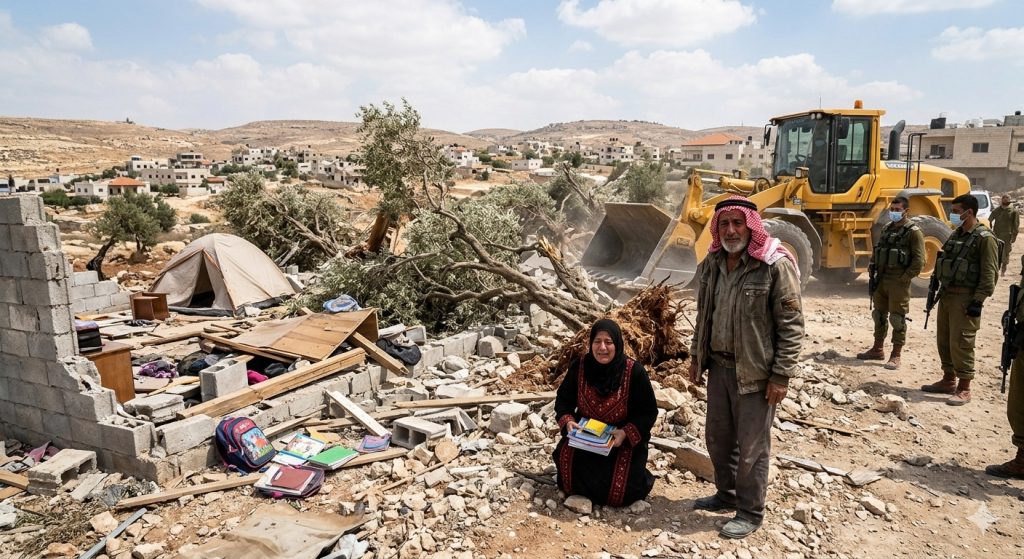
Dozens of Families Left Homeless
“Union for Justice Foundation”: The Occupation Carried Out More Than (29) Demolition Operations in the West Bank Last Month
7/10/2026 – Union for Justice Foundation
The Union for Justice Foundation said that the Israeli occupation authorities carried out 29 demolition and destruction operations targeting Palestinian buildings and structures in the West Bank last September, resulting in the displacement of dozens of citizens and causing others to lose their livelihoods.
The Foundation noted in its monthly report that the demolitions were concentrated in Jerusalem and targeted a large number of industrial, commercial, agricultural, and livestock structures, in addition to residential homes.
It added: “A single demolition operation may affect dozens of commercial shops, multi-story residential buildings, agricultural and industrial sheds, and Bedouin communities extending over dozens of dunums, meaning that entire neighborhoods have been wiped off the ground.”
The Union for Justice Foundation points out that through the escalating demolition operations, which have become part of the daily Palestinian reality, the occupation authorities seek to confine and concentrate Palestinians in specific areas to facilitate control over them, and to create new spaces allowing for the expansion of settlements and the establishment of buffer zones separating these settlements from Palestinian communities.
It emphasized that the organized and ongoing demolition campaign is part of a long-term Israeli plan aimed at displacing Palestinians from the West Bank and emptying it of its population, particularly in areas classified as Area (C) under the Oslo Agreement.
The Israeli government, dominated by the far right, strongly supports the demolition of Palestinian structures in service of the settlement project in the West Bank and views demolition as one of the means through which a policy of replacing Palestinians with settlers can be implemented.
Regarding the distribution of demolition operations among the Palestinian governorates, the Union for Justice Foundation recorded (10) demolition operations in the Jerusalem Governorate, (7) in Hebron, (3) in Jenin, (2) in Bethlehem, (2) in Nablus, (2) in Tulkarm, and one demolition operation each in Tubas, Jericho, and Salfit.
Extensive Demolitions in the Jerusalem Governorate
During last September, the occupation authorities carried out 10 demolition operations in Jerusalem. These included a residential building belonging to the Badran family in the Al-Bustan neighborhood of Silwan, south of Al-Aqsa Mosque in Jerusalem. The building consisted of three floors, contained four homes, and covered an area of approximately 500 square meters.
The occupation authorities also forced citizen Shadi Obeidat to demolish his own home in Jabal Al-Mukaber, south of occupied Jerusalem, on the pretext of construction without a permit. Meanwhile, occupation bulldozers demolished three homes in Beit Hanina, north of Jerusalem, belonging to the Abu Mayala family, resulting in the displacement of 21 citizens.
Occupation bulldozers also demolished a horse stable in the Aqbat neighborhood of Al-Ram, north of occupied Jerusalem, as well as the home of citizen Yousef Al-Rashq in the Al-Bustan neighborhood of Silwan, south of Al-Aqsa Mosque, which covered an area of 120 square meters.
The occupation municipality forced Adham Tabash to demolish five structures and commercial shops that he owned in the industrial area of Wadi Al-Joz in occupied Jerusalem, after threatening him with imposing heavy fines if the municipality carried out the demolition. The shops constitute a source of livelihood for dozens of Jerusalemite workers and their families.
Last September, the occupation demolished two homes in the “Al-Ashqariya” neighborhood of Beit Hanina, north of occupied Jerusalem, belonging to the Alqam and Abu Mayala families, whose members number more than 45 people who were left homeless. Meanwhile, occupation bulldozers demolished eight residential and agricultural sheds, bulldozed agricultural land, and destroyed solar energy systems in the Tablas area of Hizma, northeast of occupied Jerusalem.
The occupation also demolished five residential sheds inhabited by more than 30 citizens and a sheep pen in the Wadi Al-Bik area of Anata, northeast of the Jerusalem Governorate. They belonged to five brothers from the Jahalin family and were demolished on the pretext of construction without a permit. The bulldozers destroyed the structures and everything inside them, including electrical appliances, furniture, clothing, and personal belongings. Israeli bulldozers also demolished sheet-metal industrial structures in the town of Jaba, northeast of Jerusalem, on the pretext of construction without a permit.
Demolitions in Hebron
During the past month, the occupation authorities carried out seven demolition operations in Hebron. In the village of Al-Taban in Masafer Yatta, south of the governorate, bulldozers demolished approximately 10 sheet-metal dwellings, sheds, sheep pens, water wells, caves, tents, and other structures belonging to the Abu Ubeid and Al-Hamamdeh families.
The occupation also demolished four artesian wells used for irrigation and other purposes, as well as plastic houses in the Al-Thaghra neighborhood of Beit Ummar, north of Hebron. It also demolished a sheet-metal home covering 200 square meters and housing 14 people, as well as a residential cave, and filled in two water wells in Khirbet Al-Dabaa in Masafer Yatta, south of the governorate. Dwellings and sheep pens were also demolished in the Khirbet Al-Fakhit community in Masafer Yatta, south of the governorate.
Israeli machinery demolished an agricultural room, bulldozed land, demolished stone terraces, and uprooted a number of trees in Khirbet Humsah, west of Hebron. It also demolished a two-story house, with each floor covering 200 square meters, belonging to citizen Fadl Al-Haddar in Khirbet Al-Homs, in the town of Yatta, south of Hebron.
The occupation also demolished 10 dwellings, sheds, livestock pens, and water wells belonging to residents in the village of Jinba in Masafer Yatta, south of the governorate, owned by the Mohammad, Rabai, and Jabarin families.
Demolitions in Jenin
Last September, the occupation carried out three extensive demolition operations in Jenin. It demolished two sheds in the town of Silat Al-Dhahr, south of the governorate. The first belonged to citizen Yousef Joudeh Othman Mousa and was used for raising sheep, covering approximately 200 square meters. The second belonged to citizen Khalil Ibrahim Hantouli and was used for storing and collecting scrap and iron.
It also demolished 12 plastic houses, eight commercial storage facilities, and 10 agricultural rooms, as well as the fences of two farms, near the entrance to the town of Arrana, northeast of the governorate. Israeli bulldozers also demolished agricultural and residential structures in the town of Aaba, southeast of the governorate, including four horse stables, agricultural plastic houses, livestock sheds, a house under construction, a wall, and two agricultural rooms.
Demolition and Bombing of Homes in Nablus
In the Nablus Governorate, the Israeli army carried out two operations involving the demolition and bombing of two homes. In the town of Aqraba, south of Nablus, a military bulldozer demolished parts of the home of martyr Abdul Karim Mohammad Khader Suleiman, while the army blew up the home of prisoner Dawas Hassoun in the village of Beit Imrin, northwest of the governorate, after surrounding and evacuating it, causing damage to neighboring buildings.
Demolitions in Various Areas
During the past month, occupation bulldozers demolished a number of agricultural greenhouses in the Attil–Deir Al-Ghusun plain and an agricultural shed in the Shuweika suburb, north of Tulkarm Governorate.
In Bethlehem, occupation bulldozers demolished the home of citizen Moataz Hassan Mousa Najajreh in the Wadi Salem area of Nahalin, covering approximately 200 square meters. It had been built and inhabited for more than 15 years. In the village of Battir, they also demolished the home of citizen Mohammad Shahir Oweina, which covered 170 square meters.
In Tubas, occupation bulldozers demolished residential structures and livestock belonging to citizen Mohammad Abdul Qader Awad and his son Abdul in the Al-Ras Al-Ahmar area, southeast of Tubas Governorate.
In Salfit, occupation bulldozers destroyed a herding community in the western area of Deir Ballut, west of the governorate. More than 20 citizens have lived there for more than 20 years and own approximately 1,000 sheep, threatening the livelihoods of the families living there, amid fears of their complete displacement and the emptying of the area of its residents.
In Jericho, occupation bulldozers demolished five dwellings and a prayer room belonging to citizen Omar Al-Dais and his sons in the Al-Daisat community in the village of Al-Jiftlik.
Legal Perspective
The Union for Justice Foundation emphasizes that all demolitions carried out by the occupation authorities in Palestinian areas, whether in the West Bank or the Gaza Strip, regardless of the justification or pretext, constitute grave violations and are inconsistent with United Nations provisions and the principles of international human rights law, including the right to adequate housing.
The Union for Justice Foundation considers that demolitions and the displacement accompanying them may amount to prohibited forcible transfer, which may constitute a war crime under the Rome Statute establishing the International Criminal Court.
The Foundation stresses that forced displacement resulting from demolitions, or from a coercive environment created by restricting means of livelihood, amounts to prohibited forcible transfer and may constitute a war crime under the Rome Statute establishing the International Criminal Court.
It continued: “Demolitions carried out on the pretext of construction without a permit, within a discriminatory planning system that imposes near-absolute restrictions on Palestinian construction, are contrary to law and conventions, while the occupation authorities provide broad facilities for illegal settlements under international law.”
End
