After Colombia’s Decision… What Will Happen to the Genocide Case Against Israel?
29/9/2026 – Union for Justice Foundation
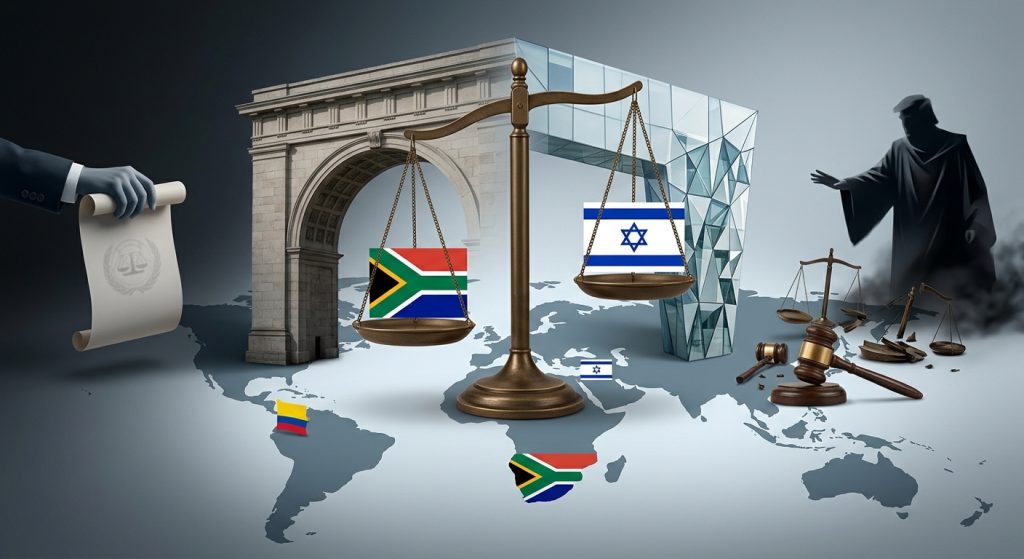
The decision by the Republic of Colombia to withdraw its declaration of intervention in the case brought by South Africa against Israel before the International Court of Justice has raised questions about the fate of the case and whether the decision affects the judicial proceedings related to the war in Gaza. However, from a legal perspective, the picture is clearer than it may appear.
Colombia did not withdraw from the case, because it was not the party that brought it in the first place. South Africa is the state that instituted proceedings against Israel under the 1948 Convention on the Prevention and Punishment of the Crime of Genocide. Colombia, meanwhile, submitted a declaration of intervention in April 2024 under Article 63 of the Statute of the International Court of Justice. Accordingly, the withdrawal of this declaration ends Bogotá’s participation within this framework, but it does not dismiss the case or terminate the proceedings before the Court. Nor does it annul the provisional measures previously issued by the Court, and it does not constitute a judgment on the merits of the allegations presented by South Africa, as the determination of the merits of the case remains solely within the jurisdiction of the Court.
However, the significance of the step extends beyond the legal aspect to the political dimension. The Colombian intervention in 2024 was submitted during the tenure of former President Gustavo Petro, while its withdrawal comes after a change in the country’s political leadership and Bogotá’s move toward rebuilding and strengthening its relations with Israel. This reflects the extent to which changes in governments and political orientations can affect the level of states’ support for international litigation processes.
Here, an important paradox emerges: governments can change their policies and positions, but this does not automatically lead to the disappearance of the international obligations incumbent upon the state. The Colombian Foreign Ministry itself confirmed that the withdrawal of the declaration of intervention does not change Colombia’s status as a state party to the Genocide Convention, nor does it affect the scope or binding force of its obligations under the Convention.
The Colombian decision comes at a time when political pressure on international justice institutions is increasing. On September 22, 2026, U.S. President Donald Trump, in his address before the United Nations General Assembly, called on the member states of the International Criminal Court to withdraw from it. This represents an escalation beyond the sanctions previously imposed by his administration on judges and officials of the Court, extending to an explicit call to reduce its membership and isolate it internationally.
In this context, it is important not to confuse the two institutions. The International Court of Justice, which is hearing South Africa’s case against Israel, has jurisdiction over legal disputes between states. The International Criminal Court, which is targeted by the U.S. measures, has jurisdiction over the criminal responsibility of individuals for genocide, crimes against humanity, war crimes, and other crimes within its jurisdiction.
Despite the differences between the two courts in terms of jurisdiction and structure, the timing of Colombia’s withdrawal of its intervention before the International Court of Justice alongside the escalation of the U.S. campaign against the International Criminal Court highlights a broader issue: the extent to which international justice processes are affected by changes in governments, shifts in the balance of power, and political pressure.
The most important question remains: To what extent can international judicial institutions maintain their independence and continue to perform their functions when cases reach matters that intersect with the interests of major powers and their allies?
End
