
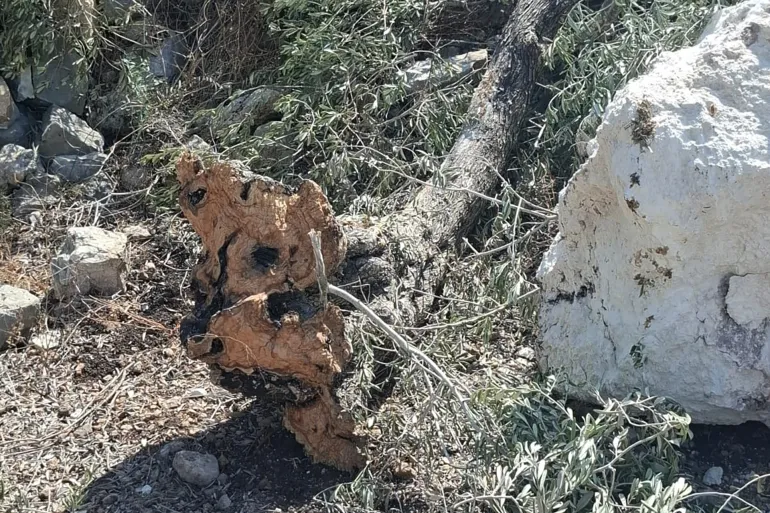
Continued Israeli Attacks on Olive Trees and Agricultural Lands Adjacent to the Wall West of Jenin
3/7/2026 – Union for Justice Foundation
Olive trees in Palestine are considered more than just an economic resource; they are a symbol of national identity, steadfastness, and the historical connection to the land. From this perspective, the repeated Israeli attacks on olive trees and agricultural lands in Jenin Governorate, particularly in the villages of Zububa and Rummanah located west of the city, constitute a direct targeting of the Palestinian people, their livelihoods, and their cultural heritage.
The villages of Zububa and Rummanah are located adjacent to the Separation Wall, which has made them among the areas most exposed to Israeli military measures, including land leveling, tree uprooting, the closure of agricultural roads, and restrictions on farmers’ access to their lands. In recent years, these attacks have noticeably escalated, as the occupation forces have carried out extensive leveling operations on agricultural lands adjacent to the wall and uprooted dozens of ancient olive trees under the pretext of security considerations or the construction of military roads, causing significant economic and environmental losses to farmers.
The attacks are not limited to land leveling and tree uprooting but also extend to the outbreak of fires in agricultural lands near the wall, whether as a result of the firing of incendiary or illuminating munitions during military operations, or due to military measures that lead to the spread of fires in the fields. These fires have caused the burning of hundreds of olive trees and vast areas of agricultural land around the village of Rummanah, directly affecting the income of dozens of families that depend on the olive harvest season as a primary source of livelihood.
These practices leave consequences that go beyond the economic aspect, as they lead to the destruction of vegetation cover, harm biodiversity, and increase the risk of desertification and the deterioration of the agricultural environment. Moreover, the uprooting of ancient trees, some of which are several decades old, means the loss of an agricultural and cultural heritage that is difficult to replace, given the deeply rooted value that the olive tree holds in the Palestinian conscience.
From a legal perspective, these attacks constitute a violation of the rules of international humanitarian law, particularly the provisions of the Fourth Geneva Convention of 1949, which prohibit the destruction of private property except in cases of imperative military necessity, in addition to the rules that oblige the occupying power to protect civilian property and refrain from causing damage to it without legal justification.
The land leveling, uprooting of olive trees, and burning of agricultural areas adjacent to the wall in the villages of Zububa and Rummanah reflect an ongoing policy that affects the environment, economy, and social life of the Palestinian population. Despite these challenges, farmers in both villages continue to hold on to their lands and replant what has been destroyed, reaffirming their attachment to their land and their determination to preserve their agricultural and national heritage for future generations.
End
