
Israeli Occupation Authorities Issue a New Military Order Targeting the Village of Al-Jib
01/04/2026 – Union for Justice
The official in charge of Government Property and Absentee Property in the Israeli Civil Administration published, on 11 March 2026, a notice declaring the intention of the so-called “Custodian of Government Property and Absentee Property” in the occupied West Bank to approve the “temporary use” of land alleged to be classified as “State Land” in the village of Al-Jib, Jerusalem Governorate. According to the notice, the Israeli occupation authorities are set to use a plot of land measuring 6.83 dunums from the lands of Al-Jib, located in Basin No. 3 in the area known as “Qit‘at Biddu,” as indicated in red on the map attached to the notice, for settlement purposes.
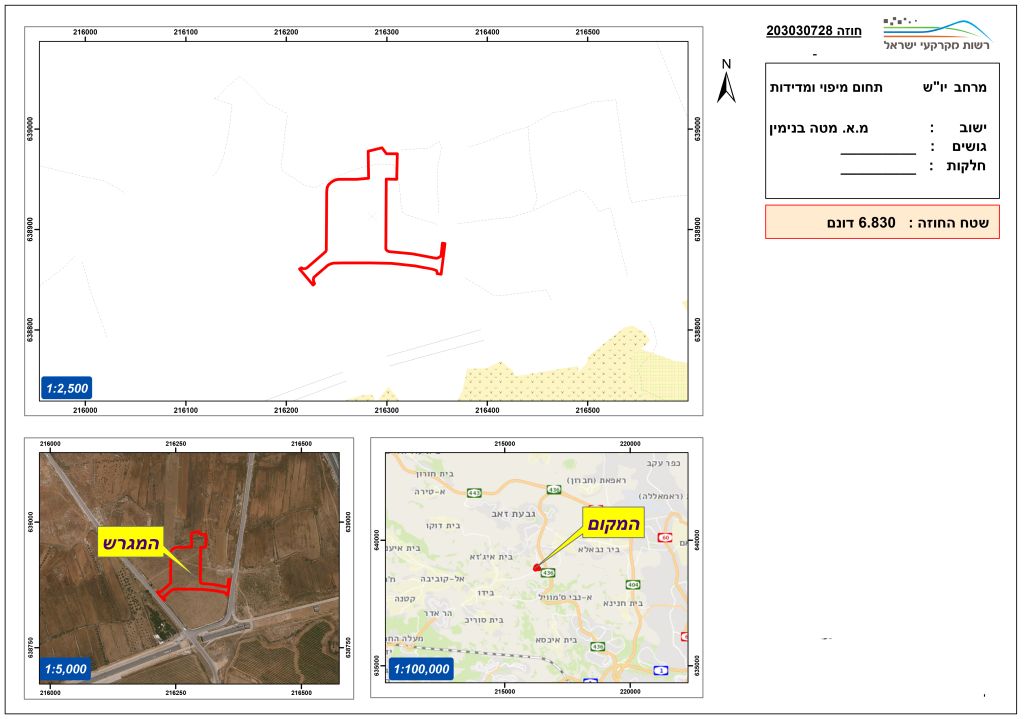
According to the issued notice, those affected (namely, the Palestinian landowners) may submit objections to the Office of the Custodian of Government Property and Absentee Property (Abandoned Property) within only 30 days from the date of publication of this notice.
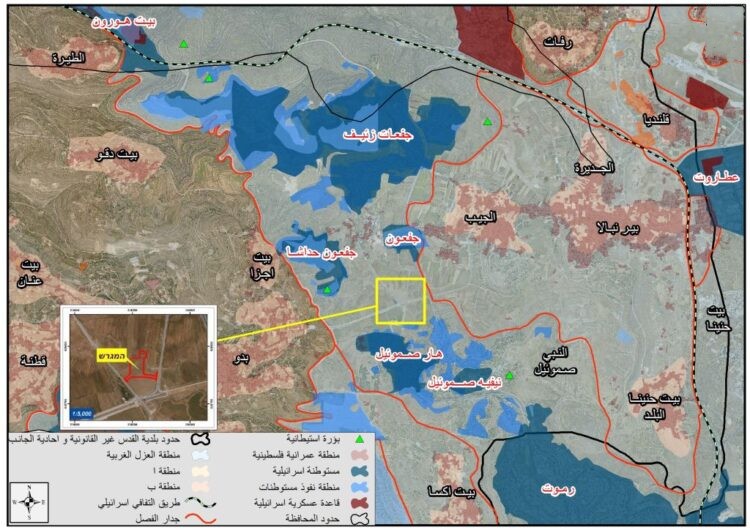
The map attached to the military order states that the Israeli occupation authorities are in the process of imposing additional security measures in the area, particularly at the junction leading to the settlement of Giv’on Hadasha (both its western and eastern parts) and the settlement of Har Shmuel to the south. The occupation authorities intend to shorten a segment of the road used by settlers to move between Israeli settlements (between bypass Road No. 4362 and bypass Road No. 4360). Beneath this segment lies a tunnel used by Palestinians to travel between the villages of Bir Nabala, Al-Jdeira, and Al-Jib, as well as the villages of Biddu, Beit Ijza, Beit Surik, and other neighboring villages northwest of Jerusalem. This tunnel was inaugurated by the occupation authorities in 2008 as part of a policy of separation, segregating roads used by settlers from those used by Palestinians.
It is noteworthy that the newly issued Israeli military order is part of a larger settlement plan that the occupation authorities intend to implement in the area. The plan provides for the construction of 800 settlement units on an area of 268 dunums belonging to the villages of Al-Jib and Nabi Samuel, in order to expand the existing settlement of “Har Shmuel.”
Giv’at Ze’ev Settlement Bloc
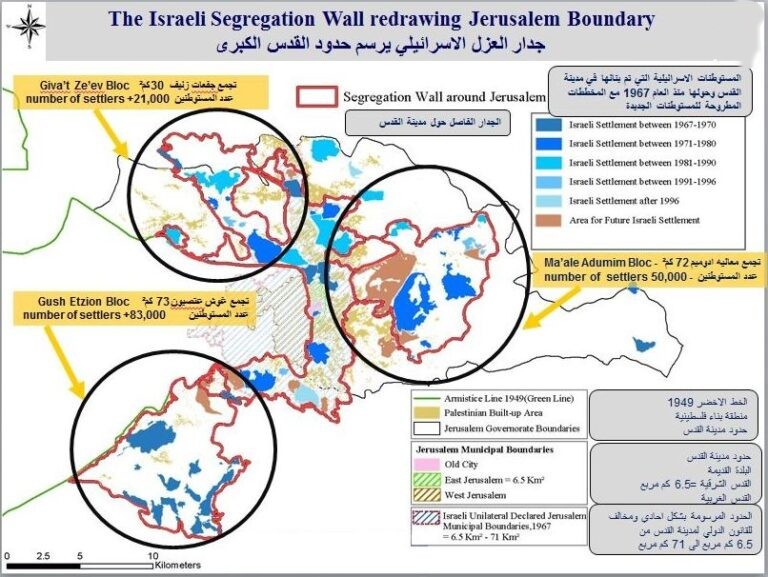
The aforementioned Israeli settlements are part of the Israeli settlement bloc “Giv’at Ze’ev,” which consists of 11 settlements with a total area of approximately 30,000 dunums and a population of around 29,000 settlers residing in Giv’at Ze’ev, Beit Horon, Giv‘on Hadasha, Har Shmuel, Neveh Shmuel, and Giv‘on. It is important to note that the Giv’at Ze’ev settlement bloc, along with other settlement blocs surrounding the city of Jerusalem, is at the forefront of Israeli targeting through settlement plans and military orders. This is in line with the broader Israeli scheme known as “Greater Jerusalem,” through which the occupation authorities seek to annex the major settlement blocs encircling Jerusalem—namely, the Ma’ale Adumim bloc to the east of the city, the Gush Etzion bloc to the southwest, and the Giv’at Ze’ev bloc to the northwest, extending toward Ramallah—so as to unilaterally and unlawfully redefine the city’s boundaries. This is being pursued through the construction of the Israeli apartheid separation wall around Jerusalem and the intensification of settlement expansion within these areas.
It is important to emphasize that Israeli military orders for land confiscation under the pretext of “security purposes” are not a temporary or incidental phenomenon. Rather, they constitute part of a systematic and organized Israeli policy aimed at controlling Palestinian land and expanding Israeli settlement presence.
These orders are systematically used to declare vast areas as “closed military zones,” “State Land,” “firing zones,” “expropriation for public use,” or “nature reserves,” among other flimsy pretexts. Such classifications deprive Palestinian landowners of access to or use of their lands, which are often later converted into settlement sites or infrastructure serving settlements and outposts, or into “security zones” around them under the same security pretext.
This Israeli approach contributes to creating new facts on the ground that undermine the viability of establishing an independent and geographically contiguous Palestinian state. These military orders serve as the executive arm of Israeli settlement and expansionist policies, operating under a seemingly “legal” framework presented as “security-driven,” while in essence remaining expansionist and settlement-driven.
The Union for Justice affirms that this military order and the resulting land confiscation in the village of Al-Jib constitute a grave and blatant violation of the principles of international law and international humanitarian law. The organization stresses that the pretexts of “temporary use” or “State Land” invoked by the occupation authorities do not exempt them from their obligations under the Fourth Geneva Convention of 1949, particularly Article 49, which prohibits the occupying power from transferring parts of its own civilian population into the territory it occupies, and Article 53, which prohibits the destruction of private or public property unless absolutely required by military operations—conditions that do not apply to settlement expansion projects or the construction of settler roads.
The organization further notes that these measures disregard United Nations Security Council resolutions, particularly Resolution 2334 (2016), which clearly affirmed the illegality of Israeli settlements in the occupied Palestinian territory since 1967, including East Jerusalem, and called for their immediate cessation as they constitute an obstacle to peace. Attempts by the occupation to impose a “fait accompli” policy through the “Greater Jerusalem” plan fall within the crime of settlement activity, which is classified under the Rome Statute of the International Criminal Court as a war crime. This necessitates immediate international action to hold the occupation authorities accountable for their continued undermining of the fundamental rights of the Palestinian people and their right to self-determination on their land.
End
