March 31, 2026 – Union for Justice Foundation
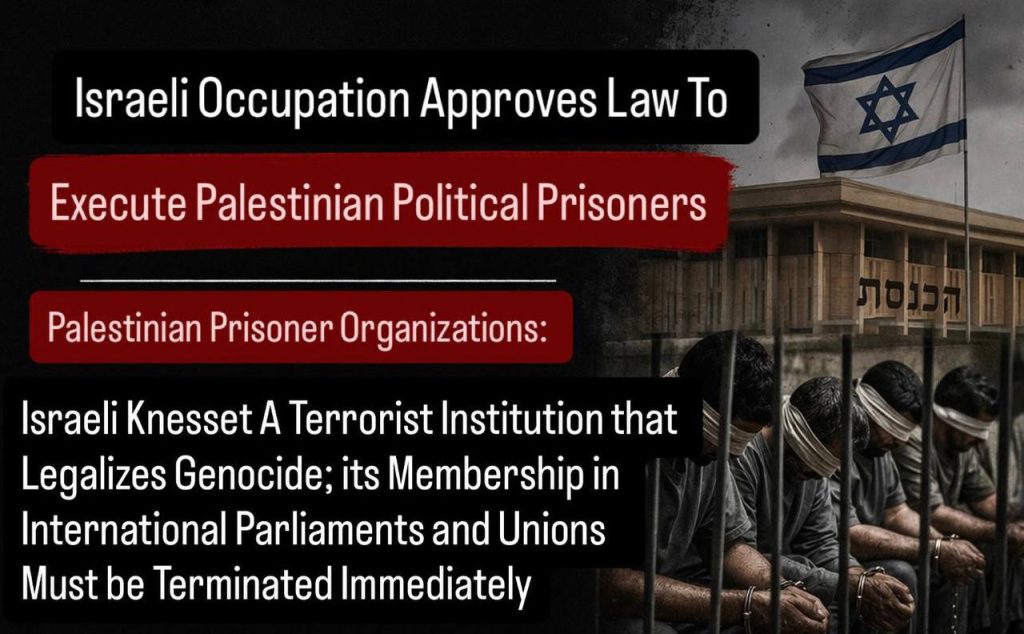
In an unprecedented escalation signalling a more dangerous phase, the Israeli Knesset’s National Security Committee has advanced a bill on the execution of Palestinian prisoners to the final stages of approval. This move has sparked widespread outrage and escalating warnings about consequences that could threaten the lives of thousands of prisoners and entrench a new path of harsher punishment.
The National Security Committee of the Israeli Knesset approved the bill on the execution of Palestinian prisoners after introducing amendments and referred it for a vote in the second and third readings required for its passage.
On Monday, March 30, 2026, the Israeli Knesset passed the law by majority vote, with 72 in favor, 47 against, and 1 abstention. The law thereby passed all three readings. Israeli Prime Minister Benjamin Netanyahu voted in favor, alongside Avigdor Lieberman.
The law primarily targets Palestinian prisoners accused of killing Israelis in operations described as having “national or security motives.” It does not apply to Jewish prisoners accused of killing Palestinians, rendering it a discriminatory and racist law.
Days earlier, the National Security Committee introduced amendments aimed at reducing the severity of the bill, following pressure from the office of Israeli Prime Minister Benjamin Netanyahu, who reportedly considered the original draft harsher than capital punishment standards in the United States and likely to expose Israel to international legal and diplomatic accountability, according to The Times of Israel.
This legislative move is led by far-right National Security Minister Itamar Ben-Gvir, leader of the “Otzma Yehudit” party, with direct backing from the ruling Likud party headed by Benjamin Netanyahu. The opposition party “Yisrael Beiteinu” also joined in supporting the bill, reflecting a broad right-wing consensus to target Palestinian prisoners with unprecedented punitive measures.
Under the law, the Minister of Defense is granted the authority to determine the venue for trying a prisoner from the occupied West Bank, whether before a military court or a civilian court. According to the formulation advanced by Itamar Ben-Gvir, unanimity among judges shall not be required to impose the death penalty in the West Bank, nor shall such a sentence be contingent upon a request by the prosecution.
The law stipulates that the death penalty shall be imposed on anyone who causes death “with the intent of negating the existence of the State of Israel.” It further ensures that prisoners sentenced to death cannot be released as part of any future prisoner exchange deals.
According to the law, its aim is to impose the death penalty on prisoners who carried out “deadly terrorist attacks”. It further states that anyone who deliberately causes the death of a person with the intent of harming an Israeli citizen or resident, and with the aim of rejecting the existence of the State of Israel, shall be punished by either death or life imprisonment, with no alternative penalties.
According to the law, “a final death sentence shall be carried out within 90 days by the Israeli Prison Service. If the Prime Minister determines that there are special grounds warranting a delay in execution, he may petition the court that issued the ruling to order postponements for additional periods, provided that the total duration does not exceed 180 days… The sentence shall be carried out by hanging, and the execution shall be carried out by a prison officer appointed by the Commissioner (Prison Commissioner).”
Amnesty International warned of the consequences of this law, describing it as entrenching a system of apartheid. The organization stressed that proceeding with such legislation places Israel in direct confrontation with the global trend toward abolishing the death penalty, and that its implementation could amount to a full-fledged war crime.
Prior to the law’s adoption, Germany, France, Italy, and United Kingdom expressed deep concern over Israeli plans to pass a law providing for the “execution of Palestinian prisoners.” They urged decision-makers in the Knesset and the government to abandon these plans, but to no avail.
On the Palestinian level, political forces, factions, and human rights institutions unanimously rejected the law, describing it as a bloody escalation that exploits the international community’s preoccupation with regional crises. Prisoners’ institutions issued a joint statement affirming that the occupation seeks to physically eliminate prisoners after failing to break their will within their prison cells. They also called for designating the Knesset as a terrorist entity and a body that legitimizes genocide, and for its membership in international parliamentary bodies and unions to be immediately terminated.
The President of the Palestinian National Council, Rawhi Fattouh, stated that the law represents a “dangerous moral decline” and reflects the racist structure of the legal system under the far-right government, asserting that “this law embodies a formal shift toward legitimizing killing on the basis of national identity.”
Israel currently detains approximately 10,000 Palestinian prisoners. Around 9,500 Palestinian prisoners are held in 23 prisons, as well as detention and interrogation centers, including 73 female prisoners and 3,442 administrative detainees, in addition to approximately 115 prisoners serving life sentences, according to the Palestinian Prisoners’ Club.
The figures also include no fewer than 350 children and minors held in “Ofer”, “Megiddo”, and “Damon” prisons, in addition to hundreds of sick prisoners and 325 martyrs from the Palestinian prisoners’ movement.
End
